
Weighted Sleep Mask vs Regular Sleep Mask
Written by the Mellooa Editorial Team
A weighted sleep mask and a regular sleep mask can both reduce light. The real difference is what you want to feel while they do it. A regular mask is usually chosen for a lighter, less noticeable layer over the eyes. A weighted mask adds mass, so the contact is more present and the construction has to manage that mass across the face and head. Neither category is automatically darker, more comfortable, or better for sleep.
That makes the useful weighted sleep mask vs regular sleep mask question personal but not vague. If you want the mask to disappear once it is on, start with a light unweighted design. If you like a clear tactile boundary around rest, a weighted design may suit you. Then test fit, movement, warmth, and pressure in your own sleep position. The label alone cannot decide those things.
Start with two different sleeper profiles
Profile one wants as little sensation as possible. This sleeper notices seams, pressure, warmth, or fabric touching the eyelids. Their priority is a light barrier that can sit gently and stay out of the way. For them, added weight may feel like extra information rather than comfort.
Profile two likes a mask to feel settled and present. This sleeper may dislike a loose mask shifting when they turn, or may prefer broad, steady contact to a narrow strap. They are not asking for a medical effect. They are choosing a more noticeable physical cue at the end of the day.
Many people sit between those profiles. That is why “weighted” and “regular” are starting points, not quality rankings. A well-fitting regular mask can be more useful than a poorly fitting weighted one, and the reverse can also be true.
The difference in one decision matrix
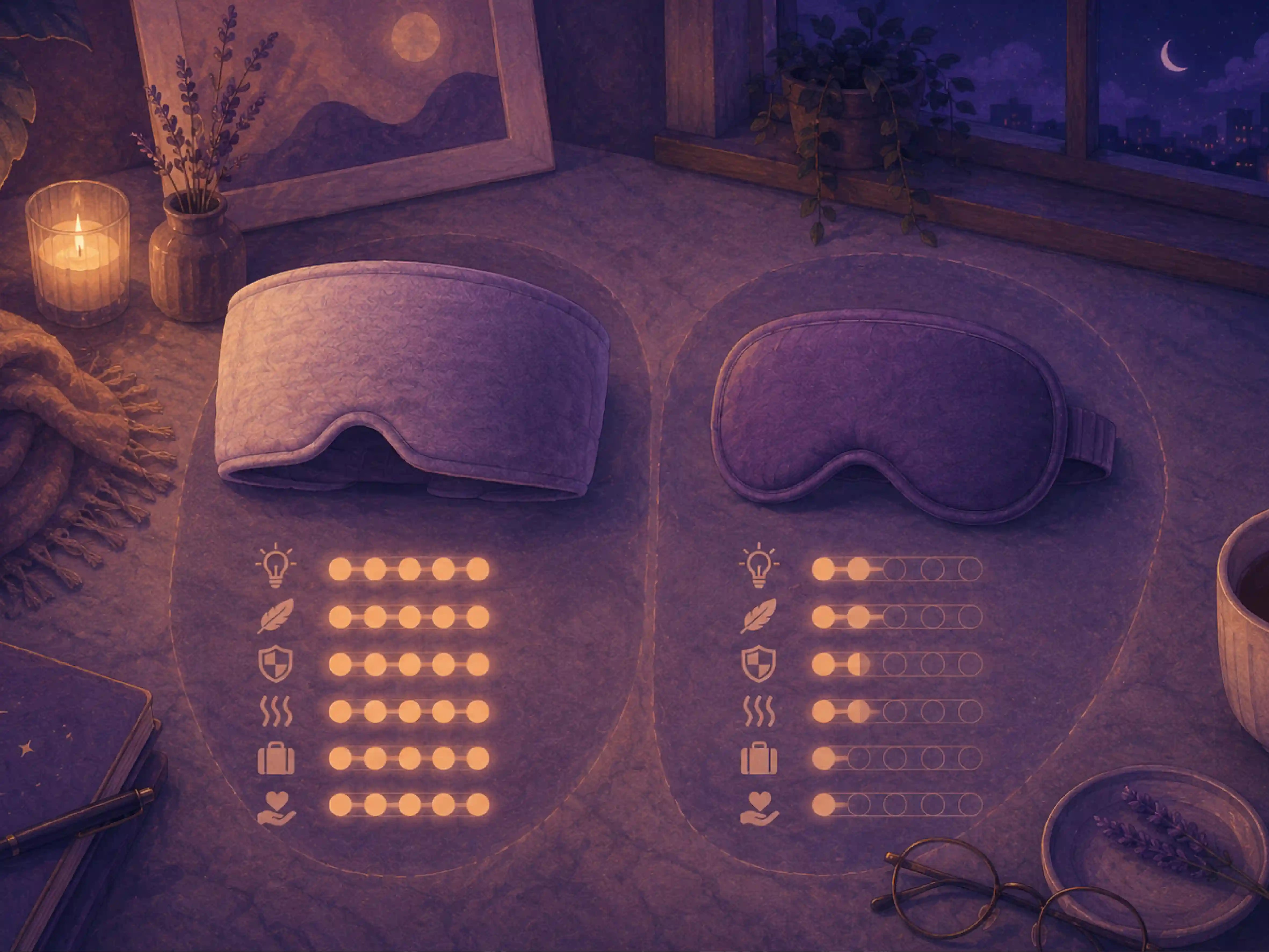
| Decision factor | Regular sleep mask | Weighted sleep mask | Question to ask yourself |
|---|---|---|---|
| Light control | Depends on coverage, nose-bridge fit, edge gaps, and sleep position. | Also depends on coverage and fit; added mass does not guarantee darkness. | Where does light enter when I lie down normally? |
| Face sensation | Usually aims for a lighter, less noticeable feel, although materials and straps vary. | Adds more noticeable contact; comfort depends on how the filling and band distribute it. | Do I prefer barely-there contact or a clear tactile cue? |
| Stability | Often relies more on strap tension, shape, or contouring. | Mass may change how the mask settles, but shape and fastening still decide whether it shifts. | Does the mask stay predictable when I turn my head? |
| Coverage and warmth | Can range from a small eye panel to a broad wrap; smaller designs may cover less skin. | Can also vary, but broad weighted designs may cover more of the temples, sides, or ears. | How much coverage feels reassuring rather than warm? |
| Portability | Light designs are usually simpler to fold into a small space. | Filling adds bulk and mass, even when the product remains travel-sized. | Will I carry it daily, or mostly use it at home? |
| Care | Care depends on fabric, padding, and fasteners. | Filling and layered construction can add care constraints; the product label must decide. | Can I follow the exact wash and drying instructions? |
The table deliberately avoids a winner. Light blocking is a fit problem before it is a weight problem. Comfort is a sensory preference before it is a feature score. Stability is a system of shape, fastening, pillow contact, hair, and movement—not a simple result of making a mask heavier.
Where both masks do the same job
Both categories begin with the same basic task: reduce ambient light around the eyes. A 2023 study in Sleep compared an ordinary light-blocking eye mask with a control condition in adults aged 18 to 35. The researchers reported improvements in episodic encoding and alertness after the eye-mask condition. This supports the practical role of reducing light during sleep. It did not test a weighted mask or compare weighted and regular masks, so it cannot show that added mass improves the result. The study details are available in the PubMed record for the ordinary eye-mask experiment.
In everyday use, darkness depends on the path light can still take. A gap beside the nose, an edge lifted by the pillow, or a band that shifts upward can matter more than the category name. If a regular mask seals those paths comfortably, weight is not required for the light-blocking job. If a weighted mask has gaps, its added mass does not turn those gaps into blackout.
This is also why no honest comparison can promise one category blocks 100 percent of light for every face. Nose shape, head circumference, sleep position, pillow height, and the mask’s own construction all change the result.
Where added weight changes the experience
Added filling changes how a flexible object behaves. It gives the mask more mass, changes its drape, and makes its contact easier to notice. In a broad design, that contact can be spread across a larger area. In a small or poorly fitted design, the same idea can feel concentrated. The meaningful question is therefore not simply how much a mask weighs, but where and how that mass is carried.
A regular mask can feel almost absent when it uses light fabric and low fastening tension. That can be ideal for someone who dislikes pressure or wants more space around the eyelids. A weighted mask creates a more distinct boundary. Some people may describe that sensation as settling or grounding; others may find it distracting. Both responses are valid personal experiences, not evidence that one nervous system is working correctly and the other is not.
Pressure should never be treated as a challenge to endure. Direct eye pressure, pinching, headache, numbness, blurred vision, or persistent discomfort are reasons to remove or adjust the mask. Anyone with an eye condition, an eye injury, unexplained eye pain, or recent eye surgery should ask their own eye-care professional before using a product that adds contact around the eyes.
Do not borrow the weighted-blanket story
Weighted sleep masks are often explained as miniature weighted blankets. That shortcut is appealing, but the products are not interchangeable. A blanket distributes weight across much of the body. A mask is worn on a much smaller and more sensitive area. The pressure field, product mass, movement, population, and outcomes are different.
A 2024 systematic review and meta-analysis reported some positive weighted-blanket findings in psychiatric populations, while also noting heterogeneous outcomes, small samples, and limited high-quality randomized evidence. Another 2024 review found a small pooled anxiety effect but a nonsignificant pooled insomnia difference before sensitivity analysis, again with limited and heterogeneous studies. These papers help define the evidence boundary; they do not prove that weighted masks outperform regular masks. Read the weighted-blanket review by Wong and colleagues and the randomized-trial review by Zhao and colleagues.
For this comparison, the honest evidence statement is short: ordinary eye-mask research supports light blocking as an environmental intervention, while direct peer-reviewed evidence comparing weighted and regular sleep masks remains limited. Added weight should be evaluated as a design and preference choice, not a proven treatment advantage.
Run a five-minute fit test instead of reading more promises
1. Check light before changing tension
Put the mask on in the room where you actually sleep. Lie in your normal position and look for light near the nose, lower edge, and temples. Reposition the mask before tightening it. More tension can replace one problem with pressure or pulling.
2. Name the contact you prefer
Ask whether you want the mask to fade from awareness or become a clear bedtime cue. If light contact already feels busy, a regular mask is the better starting point. If broad contact feels familiar and steady, a weighted design may be worth testing.
3. Turn your head and notice the system
Roll once to each side. Notice shifting, twisting, pillow interference, hair pulling, and changes in pressure. A mask that feels fine while sitting upright may behave differently against a pillow. Change one variable at a time so you know what fixed or worsened the fit.
4. Check warmth after a few minutes
Coverage can feel different once heat builds. A small mask may leave the sides and ears open; a broad wrap may feel more enveloping. Neither is inherently more comfortable. The room, fabric surface, hair, and length of wear all matter.
5. Remove it at the first wrong signal
Pain, visual change, numbness, or a trapped feeling is not a sign to wait for adaptation. Remove the mask. A sleep accessory should reduce friction in the routine, not create a test of endurance.
How Mellooa changes the comparison
The Mellooa weighted sleep mask is a continuous broad wraparound band rather than a small eye panel attached to a thin elastic strap. Its front, temple, and side sections remain nearly full-height as the band curves around the head. A centered lower-edge nose notch shapes the front, while a wide rear overlap closes the band. Weighted filling makes the contact more present, and two fabric surfaces provide different tactile options.
Those are construction facts, not a universal comfort verdict. Mellooa may suit someone who wants broad coverage, no narrow strap, and a noticeable weighted cue. It may not suit someone who wants the smallest possible mask, almost no face contact, or rigid eye cups that keep fabric away from the eyelids.
If you want to understand the physical design before choosing, read How It Works. For the separate evidence question, see how weighted sleep masks work. The comparison here stays narrower: it helps you decide which sensation and construction belong in your own routine.
A choice checklist, not a best-mask verdict
Start with a regular sleep mask if you want the lightest, least noticeable option; dislike pressure around the face; need a compact object; or are still learning whether any eye covering feels comfortable.
Consider a weighted sleep mask if you already tolerate face contact; prefer a more present tactile cue; dislike narrow straps; or want to test a broad wraparound construction. Then verify where the contact lands and whether it stays comfortable when you move.
Choose neither if covering the eyes makes you anxious, the fit causes pain or visual symptoms, or your own clinician has advised against pressure around the eyes. A dark room, curtains, or a different sleep-environment change may solve the actual problem more directly.
The weighted sleep mask vs regular sleep mask decision is not “basic” versus “advanced.” It is light contact versus more noticeable contact, one construction system versus another, and your preference in a real sleeping position. The better mask is the one that reduces the light you care about without asking your face to tolerate a sensation it does not want.