
How Do Weighted Sleep Masks Work?
Written by the Mellooa Editorial Team
How do weighted sleep masks work? At the simplest level, they combine two physical features: a fabric barrier that reduces light around the eyes, and added mass that changes how the mask rests against the face. A well-designed weighted mask also has to distribute that contact across a broad area, stay in place without a narrow strap, and leave the nose and eyes feeling comfortable. Those are mechanical functions. They are not proof that a weighted mask treats insomnia, changes brain chemistry, or guarantees better sleep.
That distinction matters because search results often compress several very different ideas into one promise. Light blocking has been studied with ordinary eye masks. Weighted blankets have also been studied, but over the whole body and often in specific clinical groups. A weighted sleep mask is neither of those products. The most useful answer therefore begins with what can be observed directly, then marks where research stops.
The direct mechanism: less light, more distributed contact
A weighted sleep mask works first as a light barrier. When the fabric covers the eye area and the edges sit close enough to the face, less ambient light reaches the eyes. Fit does most of that work: a heavy mask with a large gap beside the nose can still leak light, while a lighter mask that follows the face closely may block more. Weight does not automatically create darkness.
A 2023 study in Sleep tested an ordinary eye mask as a way to block ambient light overnight. Participants wore a light-blocking eye mask during one condition and a control mask in another. The researchers reported differences in next-day learning and alertness, with a second experiment linking the result to measured sleep. This is useful evidence for the light-blocking role of an eye mask. It did not test a weighted mask, a wraparound mask, or Mellooa, so it cannot prove that added pressure produced the result. You can read the eye-mask study record on PubMed.
The second mechanism is simply contact. Beads or another filling add mass, so the mask settles differently from an unweighted layer of fabric. Depending on its construction, that mass may be spread across the brow, temples, upper cheeks, and sides of the head rather than concentrated at one small point. Some people describe broad, gentle contact as settling; others prefer almost no pressure around the face. That response is personal. It should not be converted into a universal nervous-system claim.
What the “weighted” part changes mechanically
Imagine placing an empty fabric sleeve on a curved surface, then filling the sleeve with many small particles. The empty sleeve mainly follows the tension of its fastening. The filled sleeve has more inertia and conforms differently as the particles settle. In a sleep mask, that can change three practical things:
- How the fabric drapes. Small weighted beads can help a flexible mask rest along the contours around the brow and sides of the face.
- How contact is spread. A broad construction can distribute the added mass over more surface area than a small padded eye piece or a narrow elastic strap.
- How noticeable the bedtime cue feels. Added weight makes the object more present on the face. That may feel pleasantly grounding to one person and distracting to another.
None of these observations requires a claim about hormones, anxiety, deep sleep, or REM sleep. They describe the product in physical terms: mass, drape, surface area, and fit. That is the most reliable way to understand what the weighted component actually does.
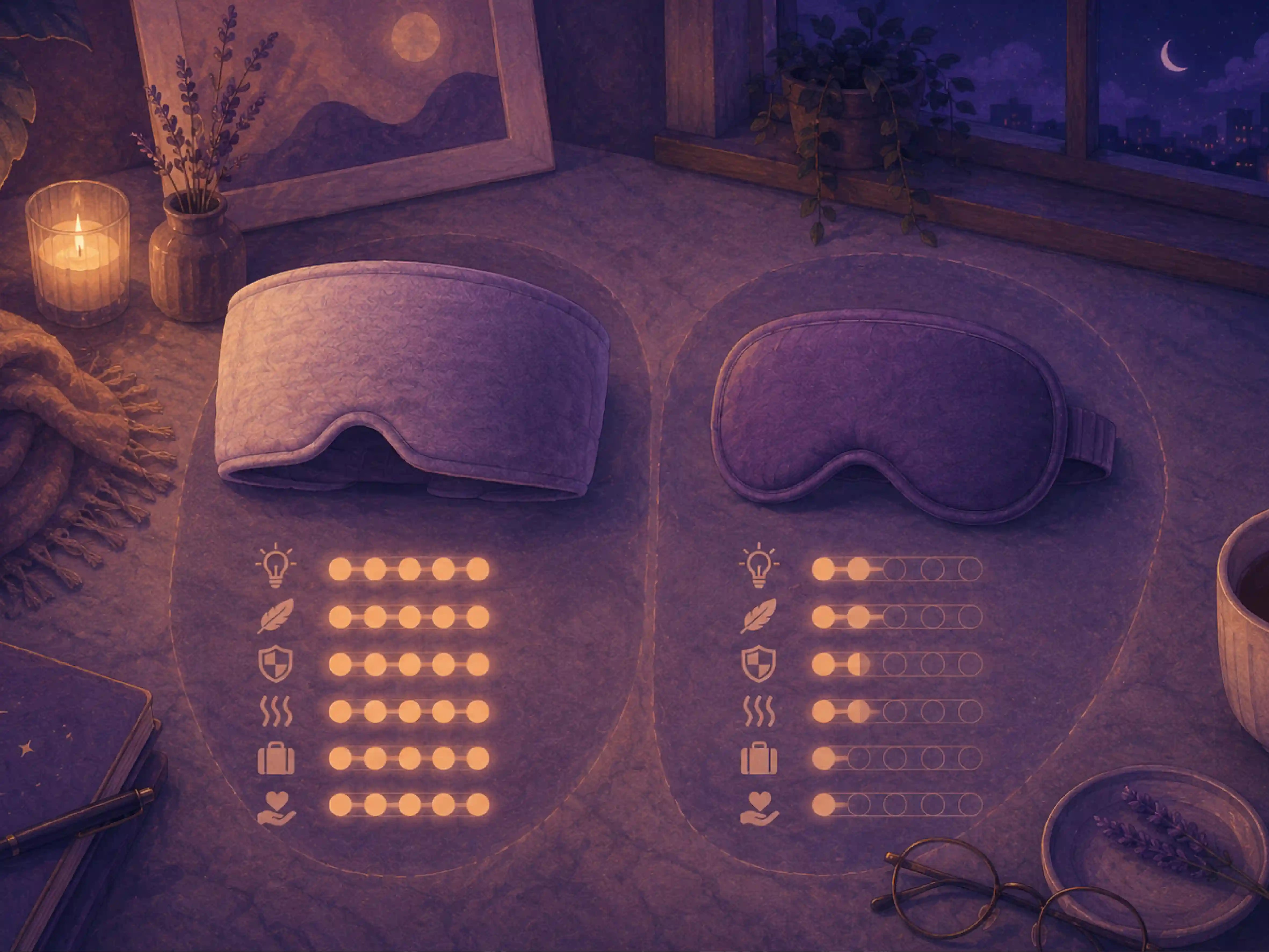
Mellooa’s current product construction places weighted beads between inner fabric layers. Its form is a broad wraparound band rather than a small eye piece attached to a thin strap. The broad wraparound construction keeps the front, temple, and side sections nearly full-height as the mask curves around the head. These facts explain how this particular mask carries and distributes its filling; they do not establish a medical result.
An evidence ladder for weighted sleep mask claims
Not every sentence about a sleep product rests on the same kind of evidence. A practical way to read claims is to sort them into four levels.
| Evidence level | What it can support | What it cannot support |
|---|---|---|
| Direct construction evidence | The mask contains weighted filling, covers a defined area, and uses a particular fastening geometry. | That the construction improves a clinical condition. |
| Ordinary eye-mask research | Blocking ambient light with an eye mask was the tested intervention in that study. | That added weight caused the reported result. |
| Weighted-blanket research | Full-body weighted blankets have been studied in selected populations. | That a much smaller face-worn product has the same mechanism or outcome. |
| Individual experience | A person can report whether the contact feels comforting, warm, distracting, secure, or too noticeable. | That everyone will experience the same response. |
This ladder is especially important when weighted blankets enter the explanation. A 2024 systematic review and meta-analysis found some positive signals in weighted-blanket studies but also reported heterogeneity, small samples, and a shortage of well-designed randomized trials. The research concerns blankets, not weighted eye masks. See the weighted-blanket review on PubMed.
One randomized trial, for example, studied heavy chain blankets in adults with psychiatric diagnoses and insomnia. It was a whole-body intervention in a specific clinical population. Its findings may justify further blanket research, but they cannot be shrunk down and pasted onto a sleep mask. The weighted chain blanket trial is a useful example of why product, pressure area, population, and outcome must stay attached to the original study.
Weighted blanket evidence cannot establish that a weighted sleep mask treats insomnia, anxiety, migraines, or another condition. It also cannot prove that a mask raises melatonin, increases deep sleep, improves REM sleep, or works through the same full-body pressure pathway. Honest product education keeps those categories separate.
Fit decides where the mechanism is felt
Two masks with the same total weight can feel completely different. A narrow mask may concentrate contact around a small edge. A broad band may spread the same mass across more of the brow, temple, and side area. A loose fit may shift when the sleeper turns. A tight fit may create pressure that the user never wanted. This is why a number printed on a product page cannot explain the entire experience.
For a wraparound design, the important geometry is continuity. The band should remain broad across the front and sides rather than narrowing into a thin strap behind the eye. The nose notch should let the mask follow the bridge without turning into a hard pressure point. At the back, a wide overlap can adjust circumference while keeping the load distributed across a larger area.
The practical test is not “Can I tolerate this because weighted masks are supposed to work?” It is “Where do I feel the contact, and does the fit remain easy?” Direct eye pressure, pinching at the nose, headache, numbness, blurred vision, or persistent discomfort are reasons to remove or readjust the mask. Discomfort is information, not a challenge to push through. Anyone managing an eye condition or recovering from eye procedures should ask their own eye-care professional before using a product that adds contact around the eyes.
Three questions reveal more than a miracle claim
If you are trying a weighted mask, three simple observations explain more than a long list of benefits.
1. Does it reduce the light that bothers you?
Check the actual room, not a product label. Lie in your normal position and notice the nose bridge, lower edge, and temples. If dawn light or a hallway lamp still appears through a gap, adjust the placement before tightening the closure. A 100-percent-blackout promise would require a defined test across faces and positions; this article does not make one.
2. Where does the added contact land?
The broad areas around the brow and sides should feel different from pressure directly on the eye itself. A weighted mask should never require you to ignore pain or visual changes. Because faces, sleep positions, and pressure preferences vary, there is no single sensation that proves the mask is “working.”
3. Does it stay predictable when you move?
Turn your head the way you normally do in bed. Notice whether the mask shifts, twists, becomes warmer, or pulls at hair. Then change one variable at a time: placement, overlap, pillow contact, or which surface faces inward. A repeatable fit matters because the mechanisms—light coverage and distributed contact—depend on the mask remaining where you placed it.
Where Mellooa fits in this explanation
The Mellooa weighted sleep mask uses a broad wraparound shape with weighted beads held between inner layers. It is designed to cover the eye-to-ear area without a narrow elastic strap. The back fastens through a wide overlap, and the two fabric surfaces offer different tactile options. Those are product facts you can inspect and compare with your own preferences.
The mask may be useful when your real problem is ordinary environmental light and you like noticeable, distributed contact. It may be a poor match if you want zero pressure on the face, dislike warmth around the ears, or need a rigid eye cup that keeps all fabric away from the eyelids. Choosing by those preferences is more responsible than treating “weighted” as an automatic upgrade.
If you want the shorter product explanation, visit How It Works. For the separate question of what blanket research can and cannot tell us, read our weighted blanket evidence boundary. And if unfamiliar rooms are the problem, the guide to sleeping in a new place covers the wider environment without asking one accessory to solve everything.
What the mask can—and cannot—claim
A weighted sleep mask can honestly claim a physical design: it covers the eyes, uses added filling, and creates a particular pattern of contact. A specific model can describe its materials, shape, fastening, and care instructions. A wearer can say how it feels to them.
What it cannot honestly claim without direct product-level evidence is a guaranteed sleep outcome or treatment effect. Darkness is one environmental input. A tactile cue is one preference. Neither replaces medical care, fixes the causes of insomnia, or controls everything that happens during a night.
So, how do weighted sleep masks work? They reduce light when the fit closes gaps, and their filling changes how the mask rests and distributes contact around the face. The value comes from whether those two mechanisms match your room, your face, and your sensory preferences. The evidence-based answer is quieter than a miracle claim, but it is far more useful.