
Article: Why You Sleep Worse in a New Place
Why You Sleep Worse in a New Place
Written by Nora Ellis
Nora writes about travel, sensory comfort, and the small routines that make unfamiliar places easier to rest in.
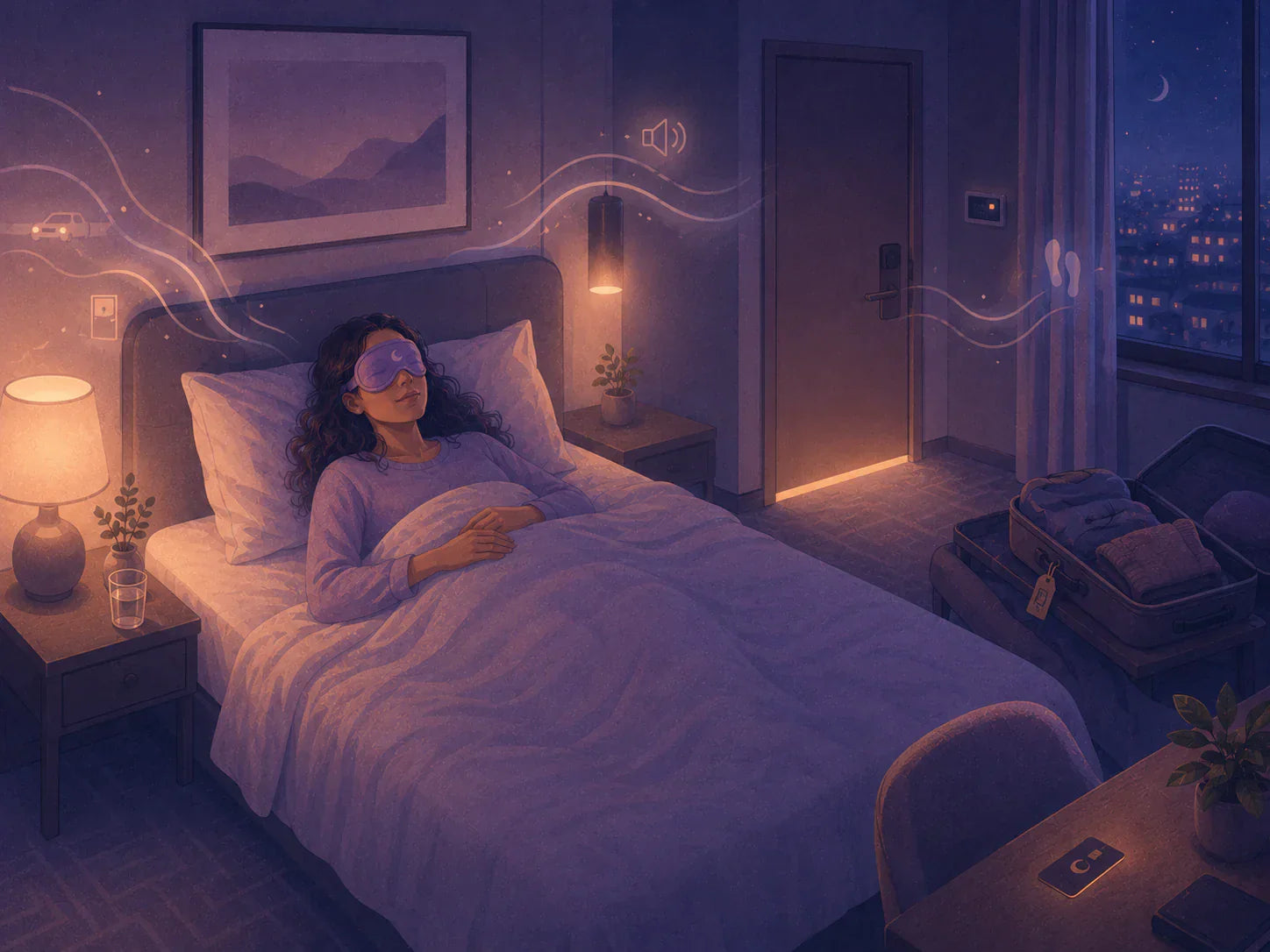
You checked in exhausted. Why are you suddenly wide awake? The hotel bed is perfectly made. The room is quiet enough. Tomorrow begins early. Yet every detail seems newly important: the air conditioner clicks on, a hallway light reaches under the door, the pillow sits at the wrong angle, and the refrigerator hums in a rhythm you have never heard before.
This experience is common enough to have a name: the first-night effect. In sleep research, people often sleep differently during their first night in a laboratory or another new setting. They may take longer to fall asleep, spend more time awake after sleep begins, and get less total sleep than they do on a later night.[1]
A difficult first night does not mean the hotel is bad, the mattress is wrong, or you have forgotten how to sleep. It can simply mean that your brain has not yet decided the new room is predictable.
You cannot pack your bedroom.
You can pack a few consistent signals that make bedtime feel recognizable wherever you are.
Why can’t you sleep in a hotel even when you are tired?
You may sleep worse in a hotel because tiredness is only one part of falling asleep. The brain also needs to reduce its monitoring of the environment. In a familiar bedroom, it has already learned which sounds repeat, where the light comes from, how the mattress moves, and what normally happens next. A new room removes that history.
At home, the boiler turning on may disappear into the background. In a hotel, the same mechanical sound may prompt a small internal check: What was that? An elevator bell, footsteps in the corridor, a changing ventilation tone, or light from an unfamiliar control panel can keep attention loosely attached to the room.
Travel also changes more than the room. Dinner may be later. Alcohol or caffeine may be different from usual. The day may include airport stress, a presentation, family logistics, or a long period of sitting. If you crossed time zones, your internal clock may disagree with the clock beside the bed. The first-night effect can be part of the problem without being the whole explanation.
What the first-night effect actually means
The first-night effect was first observed because sleep laboratories routinely recorded people sleeping away from home. A 2022 meta-analysis covered 53 studies and 1,422 healthy participants. It found that first nights were generally associated with longer sleep-onset latency, more wakefulness after sleep onset, less total sleep, lower sleep efficiency, and less rapid eye movement sleep than second nights.[2]
That does not mean everyone sleeps badly whenever they travel. The size of the effect varies, and some people sleep wonderfully in hotels. It also does not mean exactly half of the brain stays awake all night. A widely discussed 2016 study of healthy young adults found greater vigilance in one hemisphere during deep sleep on the first laboratory night, including a stronger response to unusual sounds.[1] The finding supports a “night watch” interpretation, but it came from a controlled setting and should not be turned into a universal rule about every hotel stay.
More recent work also complicates a simple unfamiliar-room explanation. A 2024 study found first-night changes across nonconsecutive recordings in both laboratory and home settings, suggesting that the effect may reflect a mixture of environmental familiarity, the recording situation, and person-specific or day-specific factors.[3]
The useful conclusion is modest: a first night can be objectively different, but the reason is not one single switch. Newness, expectation, schedule, stress, light, sound, temperature, and individual sensitivity can all participate.
Why a better bed does not always mean better sleep
A luxury mattress solves a comfort problem. It does not automatically solve a prediction problem.
Your own bed contains thousands of repetitions. You know where the edge is without looking. You know whether the floor creaks. You know the sound of traffic at 2 a.m. and how the room changes before sunrise. None of these details needs fresh interpretation.
A hotel room may be softer, larger, and more carefully designed while still presenting the brain with new information. The pillow has a different rebound. The sheet touches the legs differently. The room smells faintly of detergent. The thermostat behaves in unfamiliar cycles. Even a beautiful city view can introduce moving light that your bedroom never has.
This helps explain a frustrating travel paradox: the body can be more fatigued than usual while the mind remains more watchful than usual. Fatigue increases the need for sleep; environmental uncertainty can keep the threshold for letting go slightly higher.
First-night effect, jet lag, or travel stress?
These problems overlap, but they are not interchangeable.
First-night effect is about adaptation
The first-night effect describes changes that appear when sleep is recorded in a new or newly monitored setting. It can happen without crossing a time zone. You might notice it at a friend’s house, in a rental apartment, after moving, or during a one-night stay in your own city.
Jet lag is about circadian timing
Jet lag follows rapid travel across time zones, when the internal biological clock is temporarily out of sync with local time. The CDC describes sleep disturbance and daytime impairment as core features, and recommends treating light exposure, sleep timing, caffeine, naps, and any melatonin use as timing questions rather than generic bedtime tricks.[6]
If your body thinks the local bedtime is the middle of the afternoon, making the room familiar will not fully solve the mismatch. For complex trips, medication questions, or persistent symptoms, individualized medical guidance is more appropriate than improvising with supplements.
Travel stress is about what the trip is asking of you
A hotel night before an important meeting is different from a relaxed weekend away. Rehearsing tomorrow’s presentation, worrying about an early alarm, checking whether the door is locked, or listening for a child in the next bed can keep the nervous system engaged. Sometimes the room is unfamiliar; sometimes tomorrow is simply carrying too much weight.
Naming the likely source changes the response. Circadian mismatch needs timing. Environmental disturbance needs practical control. Emotional activation needs a way to close the day. A first-night routine can support all three, but it should not pretend they are the same problem.
Do a room scan before bedtime, not after the lights are off
The best time to discover that the blackout curtain does not meet in the middle is not midnight. Use the first few minutes after check-in to make the room less surprising.
- Find the light: close the curtains fully, identify bright clock or charging displays, and check whether hallway light reaches the bed.
- Listen through one ventilation cycle: notice whether the air conditioner clicks, rattles, or changes volume. If the sound is unusually disruptive, ask about another room before unpacking completely.
- Set the temperature early: a room that feels comfortable while standing may become too warm under hotel bedding. The National Heart, Lung, and Blood Institute recommends a cool, quiet, dark sleep environment.[4]
- Remove avoidable alerts: silence the room phone if appropriate, switch personal devices to Do Not Disturb, and confirm the alarm once instead of checking it repeatedly.
- Locate what matters: know where the bathroom, water, room key, glasses, and exit information are. A small amount of practical certainty can prevent repeated searches after bedtime.
Noise deserves particular attention because unpredictability is often more distracting than volume alone. The World Health Organization identifies environmental noise as a contributor to sleep disturbance.[5] A steady ventilation sound may fade into the background, while an intermittent door slam keeps reintroducing a reason to listen.
If a room is genuinely unsuitable—next to a loud elevator, filled with smoke odor, excessively hot, or impossible to darken—requesting a change is not being difficult. A sleep accessory should help with normal variation, not make you tolerate a preventable problem.
A first-night ritual that travels
A travel routine works best when it follows the shape of the evening rather than appearing as a complicated checklist at the moment you are already tired. Think of it as a short itinerary with four stops.
At check-in: make the room legible
Complete the room scan. Unpack only the items needed for the night and morning. Set the alarm, place the key in one location, and deal with the curtain, thermostat, and unnecessary lights now. The goal is not to make the room look like home. It is to remove questions the brain might otherwise reopen in the dark.
One hour before bed: return to a familiar order
Keep two or three actions in the same order you use at home. You might wash your face, fill a glass of water, read a few pages, or listen to one familiar audio track. The objects can change; the sequence stays recognizable.
Avoid turning the hotel bed into a late-night office if possible. If work must happen in the room, close the laptop, pack it away, and write the first task for tomorrow. This creates a visible end rather than asking the mind to remember an unfinished work session all night. The same principle appears in our guide to winding down after scrolling before bed: finish one necessary action, then stop reopening the input.
At lights-out: reduce decisions
Use the same small final cue you can repeat on most trips. Put the phone out of reach. Settle the pillow once. Pull on a sleep mask or start steady background sound if those are already comfortable for you. Do not add five unfamiliar relaxation techniques simply because you are in an unfamiliar place.
The familiar cue is not a sedative. Its value is that it does not require interpretation. It makes the final minute of the evening resemble other nights when no more action was needed.
If sleep does not arrive: do not turn the room into a test
Checking the time every few minutes converts wakefulness into a countdown. If you are becoming frustrated and it is safe to do so, move to a chair or another low-light area and do something quiet until sleepiness returns. NHLBI describes stimulus control—going to bed when sleepy and getting out of bed when unable to sleep—as part of cognitive behavioral therapy for insomnia.[8]
One imperfect hotel night does not require a diagnosis. Repeated difficulty sleeping, significant daytime impairment, or symptoms such as loud snoring, gasping, breathing pauses, severe anxiety, or unusual nighttime behavior deserve professional assessment.
What if you are staying for only one night?
A one-night stay creates a special problem: by the time the room begins to feel familiar, it is already time to leave. The answer is not to build a perfect hotel routine. It is to spend less of the evening negotiating with the environment.
Before the trip, make a small default sleep kit and keep it together rather than repacking from memory every time. Include only items you already use comfortably—perhaps a sleep mask, appropriate earplugs, a charging cable long enough to keep the phone away from the pillow, and one familiar low-stimulation audio option. A business trip is not the ideal night to test a new supplement, an unfamiliar sound app, and three relaxation exercises at once.
When booking or checking in, ask for practical conditions rather than vague promises of a “quiet room.” A room away from the elevator, ice machine, street-facing entrance, or event floor may reduce intermittent noise. If morning light is likely to matter, ask about blackout curtains. None of these requests guarantees perfect sleep, but they address disturbances before willpower is at its lowest.
Protect the morning as well. Pack what you need, set out clothes, and decide when you will leave before getting into bed. Travel-related alertness is not always fear of the room; sometimes it is the mind rehearsing the next morning because too many details remain undecided.
If the trip crosses time zones, keep this environmental plan separate from the circadian plan. A darker, quieter room can support sleep, but the timing of light, naps, caffeine, and local bedtime still matters. The room routine handles uncertainty; the time-zone strategy handles the clock.
Can familiar sensory cues reduce the first-night effect?
The idea is appealing: bring the same pillowcase, scent, sound, or eye mask, and the brain will recognize bedtime. The evidence is not strong enough to promise that result.
A small hotel pilot study tested whether using a personal pillowcase improved first-night sleep quality. Only 16 participants completed the study, and the researchers found no statistically significant benefit.[7] That result does not prove familiar cues are useless. It shows why a practical comfort strategy should not be marketed as a scientifically proven cure for the first-night effect.
Familiar cues still have a sensible role. They reduce the number of decisions needed at bedtime and give a changing environment one stable element. Their value may be behavioral, sensory, or simply personal. A routine can be worthwhile because it feels easier to repeat—not because it guarantees a particular change in brain waves.
This is the idea behind a portable sleep environment: not a copy of your bedroom, but a compact set of controllable signals. Stable darkness. A predictable sound choice. A familiar tactile cue. A final sequence that does not change with the hotel.
The room may be unfamiliar.
Your final bedtime cue does not have to be.
What Mellooa can make familiar—and what it cannot
A sleep mask cannot control jet lag, silence a hallway, fix an uncomfortable mattress, or prevent the brain from noticing every new environment. Its role is narrower—and more believable.
First, it creates a stable field of darkness. Hotel curtains, electronic displays, an early sunrise, or a travel companion’s reading light can make darkness difficult to control. The room may change each night; what reaches the eyes can remain more consistent.
Second, a gently weighted mask adds a repeatable tactile cue around the brow and eye area. Evidence from full-body weighted blankets cannot simply be transferred to an eye mask, as we explain in our review of weighted blankets and weighted eye masks. The honest claim is experiential: some people find soft, evenly distributed pressure settling and familiar.
A sleep mask is not hearing protection or noise cancellation. Use appropriate earplugs, a steady sound source, or a room change for disruptive noise. Mellooa’s role in the travel routine is to combine darkness with a gentle, recognizable feeling—not to claim control over the entire environment.
That is where the Mellooa weighted sleep mask fits: as the same small boundary in a hotel, an overnight train, a guest room, or your own bed. It does not make every place home. It makes one part of bedtime less dependent on the place.
You do not need to sleep exactly as you do at home
The pressure to “get a perfect night” can become another unfamiliar sound in the room. Travel changes sleep. Sometimes the first night is lighter, shorter, or more interrupted. Often the next night is easier as the environment becomes more predictable.
The useful goal is not to defeat the first-night effect. It is to remove the disturbances you can control, recognize the ones you cannot, and stop asking one object or ritual to guarantee sleep.
Scan the room while you are still awake. Distinguish jet lag from newness and stress. Keep the final sequence simple. Carry one or two cues that feel familiar. Then let the room become boring enough that the brain no longer needs to keep learning it.
You cannot bring your bedroom with you. You can bring a clearer way to end the day.
Sources
- Tamaki M, et al. Night Watch in One Brain Hemisphere during Sleep Associated with the First-Night Effect in Humans. Current Biology. 2016.
- Zhou J, et al. A meta-analysis of the first-night effect in healthy individuals for the full age spectrum. Sleep Medicine. 2022.
- The first-night effect of sleep occurs over nonconsecutive nights in unfamiliar and familiar environments. Journal of Sleep Research. 2024.
- National Heart, Lung, and Blood Institute. Healthy Sleep Habits.
- World Health Organization. Guidance on Environmental Noise.
- Centers for Disease Control and Prevention. Jet Lag Disorder. CDC Yellow Book 2026.
- Earl V, et al. Can familiar sensory inputs reduce the first night effect when sleeping in an unfamiliar hotel room? BMJ Open Respiratory Research. 2019.
- National Heart, Lung, and Blood Institute. Insomnia Treatment.
Medical disclaimer: This article is for general education only and is not medical advice, diagnosis, or treatment. Sleep products can support a comfortable sleep environment but do not treat insomnia, jet lag, anxiety, or other health conditions.