
How to Wind Down After Scrolling Before Bed
Written by Sophie Lane
Sophie writes about the small habits and sensory cues that help busy days become quieter nights.
Your phone is off. Why is your mind still awake? The last video has ended, the screen is face down, and your body is finally in bed. Yet part of your attention is still moving—through a message you have not answered, a headline you wish you had not read, or the next clip your thumb almost reached.
Most sleep advice begins with a rule: stop using your phone before bed. It is sensible advice. It is also incomplete. Phones are our alarms, books, maps, workspaces, social rooms, and sometimes the only private corner of a crowded day. For many people, the realistic question is not, “How do I become someone who never scrolls at night?” It is, “What can I do once I finally stop?”
Going straight from scrolling to sleep is like asking a fast-moving car to stop without a slowing lane. The body may be still, but the systems that choose, react, anticipate, and monitor have not received a clear ending.
You do not need to erase the evening.
You need a short transition that asks less of your eyes, your attention, and your body.
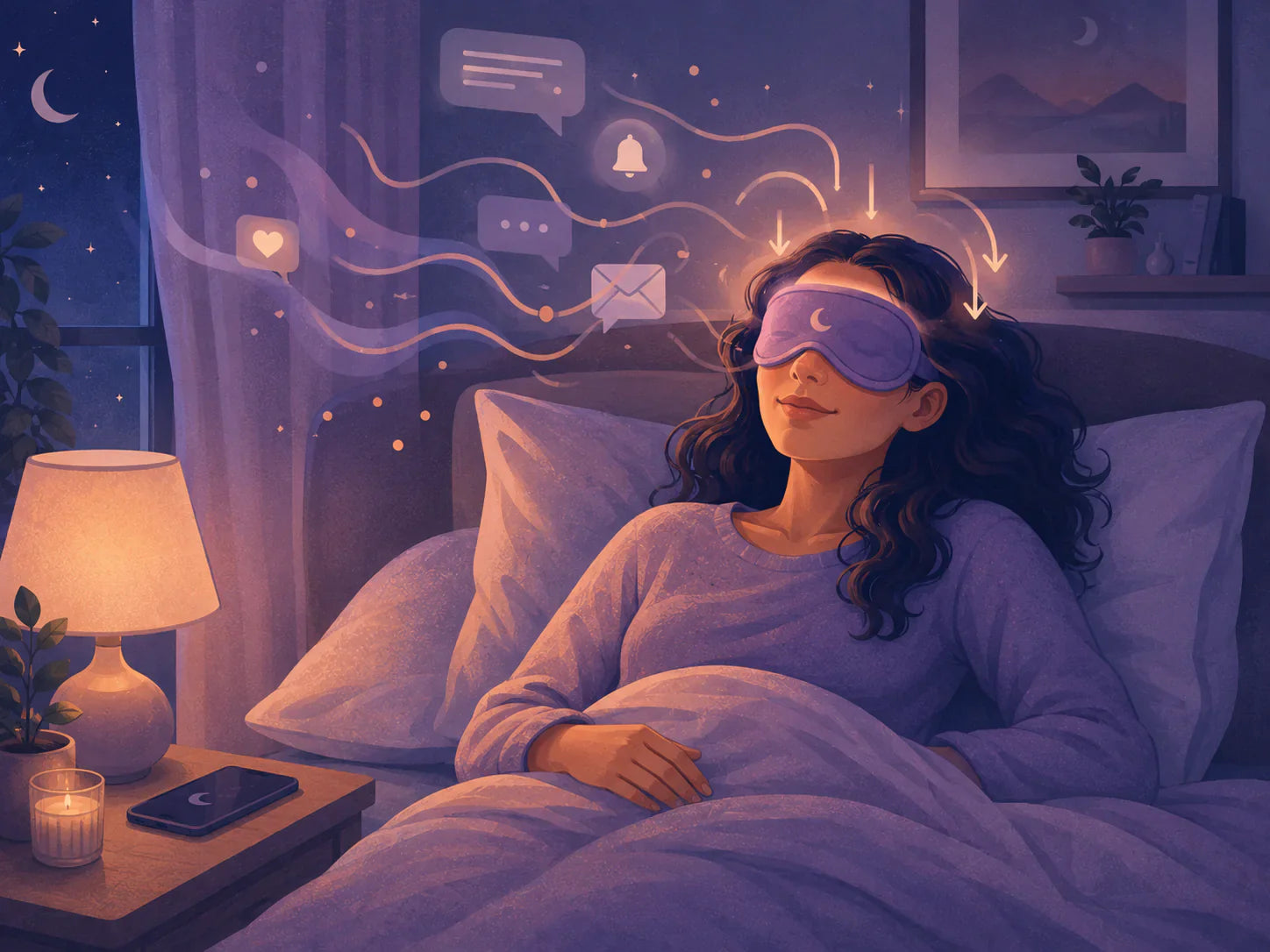
If you cannot sleep after scrolling, start by ending the input rather than trying to force sleep. Finish one necessary action, silence the alerts, place the phone beyond immediate reach, make the room darker, and give the body one familiar cue. This does not undo the screen time. It simply gives the night a clearer next step.
It is not just blue light
Blue-enriched light from screens deserves attention, but it is only one part of the story. In a controlled study, people who read on a light-emitting e-reader before bed took longer to fall asleep, showed delayed circadian timing, and felt less alert the following morning than when they read a printed book.[1] Another experiment found that unrestricted evening tablet use delayed self-selected bedtime and melatonin timing in a small group of healthy adults.[2]
Those studies help explain why bright, close-up light can keep the biological evening from feeling fully dark. They do not mean that every glance at a dimmed phone creates the same effect in every person. Screen brightness, distance, duration, timing, age, individual light sensitivity, and the content itself all matter.
Light keeps the visual system in daytime mode
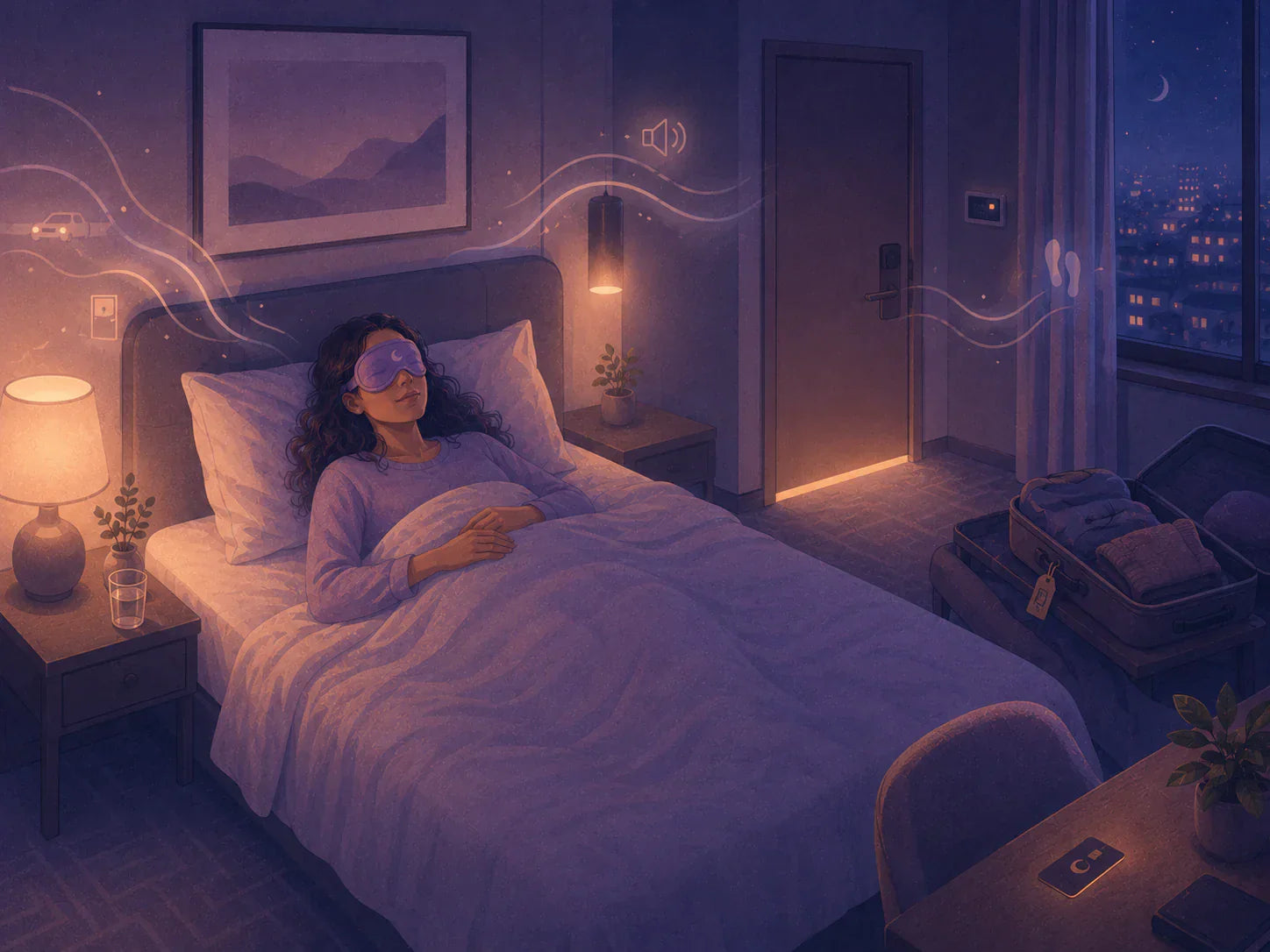
A phone is a light source held close to the face. Even after it is put away, the rest of the room may still contain visual interruptions: a charging indicator, a television standby light, light under the door, or a partner’s screen. The National Heart, Lung, and Blood Institute recommends using the hour before bed for quiet time, avoiding bright artificial light, and keeping the bedroom quiet, cool, and dark.[3]
Darkness does not force sleep, but it removes one category of information. There is less to watch, track, and interpret.
Content keeps the emotional system unfinished
The nervous system does not experience all screen time in the same way. A familiar audiobook at low volume is not identical to an argument in a group chat. A calm recipe video is not identical to breaking news. Interactive content repeatedly asks for a decision: open, answer, swipe, compare, react, or continue.
Research is more nuanced than the simple claim that “screens ruin sleep.” In one study using media diaries and objective sleep measurement, context, multitasking, and duration changed the relationship between pre-sleep media and sleep.[4] That nuance is useful. It moves the focus away from moralizing about phones and toward a practical question: what kind of stimulation did your last ten minutes create?
Scrolling quietly spends the time meant for sleep
Sometimes the mechanism is not mysterious at all. Ten more minutes becomes forty. Bedtime moves later while the morning alarm stays fixed. Direct measurements of adult smartphone use have found that longer screen time during the bedtime and sleep period was associated with poorer sleep quality, lower sleep efficiency, and longer sleep-onset latency.[5] Association does not prove that the phone caused every sleep problem, but it captures a familiar form of displacement: time on the screen can become time no longer available for sleep.
This is why the most useful boundary is often not a perfect one-hour digital detox. It is a clear final action that prevents the session from reopening.
What the last few minutes leave behind
“Scrolling” describes a gesture, not a single experience. The final ten minutes of a work chat, a news feed, and a stream of short videos can leave very different things active when the screen goes dark. Before choosing a wind-down step, it helps to notice what followed you into bed.
Work and messages leave an unfinished loop
You may not be thinking about the phone at all. You may be drafting tomorrow’s reply, rehearsing how a colleague will react, or trying to remember the task hidden three messages above. In that state, “just relax” gives the mind nowhere to place what feels unfinished.
Use a parking note instead. On paper, write the next action in one sentence: Reply to Maya after checking the delivery date. Add a time if that helps: 9:30 tomorrow. The note is not a second to-do list. It is evidence that the task has not been lost and does not need to be mentally guarded all night.
News and conflict leave emotional heat
A disturbing headline, an argument, or someone else’s carefully edited life can remain emotionally loud after the device is quiet. This is not the best moment to decide whether your reaction is reasonable or to read five more opinions in search of closure. More information often keeps the subject open.
Name the simplest version of what is present—worried, angry, left out, overstimulated—without building a case around it. Then reduce input. A glass of water, a dim room, and a few minutes without commentary can be a more useful bridge than trying to think your way into calm.
Short videos leave a novelty rhythm
Fast feeds train the last part of the evening around constant change. Every swipe brings a new face, sound, question, or reward. When that sequence stops, an ordinary dark bedroom can feel strangely empty, and the hand reaches back for the phone before a conscious decision is made.
Do not replace one rapid feed with another. Choose something steady and already familiar: the same low-key audio, the same few pages of a paper book, or the same simple physical sequence. The purpose is not entertainment. It is to let the pace of incoming information become predictable enough that attention no longer has to chase it.
Night mode changes the light, not the ending
Warm color settings and lower brightness can make a screen feel less harsh, but they cannot shorten a session, settle an argument, finish tomorrow’s work, or remove the pull of the next update. They address one feature of the screen. A real transition also needs a stopping point.
The type of content, the time it consumed, and the condition it left behind all matter. That is why the most useful reset is not identical every night, even when the final sequence stays simple.
The problem is the missing transition
Many evenings now have only two modes:
high input → expected sleep
There is no small ritual between them. The phone disappears, but the attention it organized has nowhere to go. The mind continues replaying, predicting, and completing. If this sounds familiar, it is related to the broader “tired but wired” pattern we explored in why young adults can feel exhausted yet unable to switch off.
A transition does not need to be impressive. In fact, it works better when it is boring enough to repeat. Its job is not to make sleep happen on command. Its job is to make the next five minutes contain fewer new decisions than the five minutes before them.
The five-minute screen-to-sleep reset
This reset is for imperfect nights—the nights when you scrolled later than planned and do not want to turn that into another reason to criticize yourself. Five minutes will not reverse hours of lost sleep or remove the effects of bright light. It can, however, create a clean boundary between input and rest.
Minute zero: finish one thing
Do not begin the reset by checking one final app. Choose one closing action: send the necessary goodnight, save the unfinished article, or write tomorrow’s task in one sentence. Then stop. A specific ending is easier for the brain to understand than a vague intention to “use the phone less.”
Turn on Do Not Disturb. Place the phone screen-down and beyond immediate reach. If the phone is your alarm, it can still be in the room without being in your hand.
Minutes one and two: remove the hooks
Lower or switch off the main light. Silence notification sounds and vibration. Let the room become visually uneventful. If a thought feels important enough to reopen the phone, write it on paper instead. The goal is not to solve it; the goal is to give it somewhere to wait.
Minutes three and four: let the body arrive
Unclench the jaw. Let the tongue rest. Drop the shoulders away from the ears. Exhale a little longer than you inhale, without turning breathing into a performance. Notice where the body meets the mattress. These are not tricks that guarantee sleep. They are ways to replace rapid external input with slower, predictable sensation.
Minute five: use one repeatable cue
Choose the same final cue most nights: pull up the blanket, switch on steady background sound, or put on a sleep mask. Repetition matters more than complexity. Over time, a familiar sequence can become a practical sign that no more responses are required tonight.
Less light. Fewer alerts. Less input.
Make the reset fit the night you actually had
After a work-heavy evening, make the first minute about containment. Write the next action, close the laptop as well as the phone, and avoid using bedtime to solve a decision that belongs to tomorrow. The physical act of putting work somewhere can be more useful than demanding that the thought disappear.
After an emotionally charged evening, make the room quieter before asking the mind to be quieter. Do not reopen the message to check its exact wording. Reduce light, choose a neutral sensory cue, and let the feeling exist without adding new evidence to it. If slow breathing feels irritating, simply notice the weight of the blanket or the contact between the pillow and the side of the face.
After an accidental hour of short videos, keep the reset especially plain. Avoid switching to another recommendation feed disguised as relaxation. A familiar audio track, steady background sound, or darkness behind a sleep mask asks for fewer choices. The evening does not need a perfect recovery routine; it needs an activity with no next thumbnail.
These versions share the same structure: close what can be closed, park what must wait, reduce new input, and repeat one final cue. The details change because the residue of the evening changes.
Where a weighted sleep mask fits
A sleep mask cannot undo the scrolling. It cannot restore the bedtime that passed, erase emotionally charged content, or treat insomnia. What it can do is help make the post-screen environment more definite.
The first function is straightforward: darkness. Once the phone is away, a wraparound mask reduces the remaining visual changes in the room. The charging light, early sunrise, hallway glow, and a partner’s screen no longer ask the eyes to keep checking the environment.
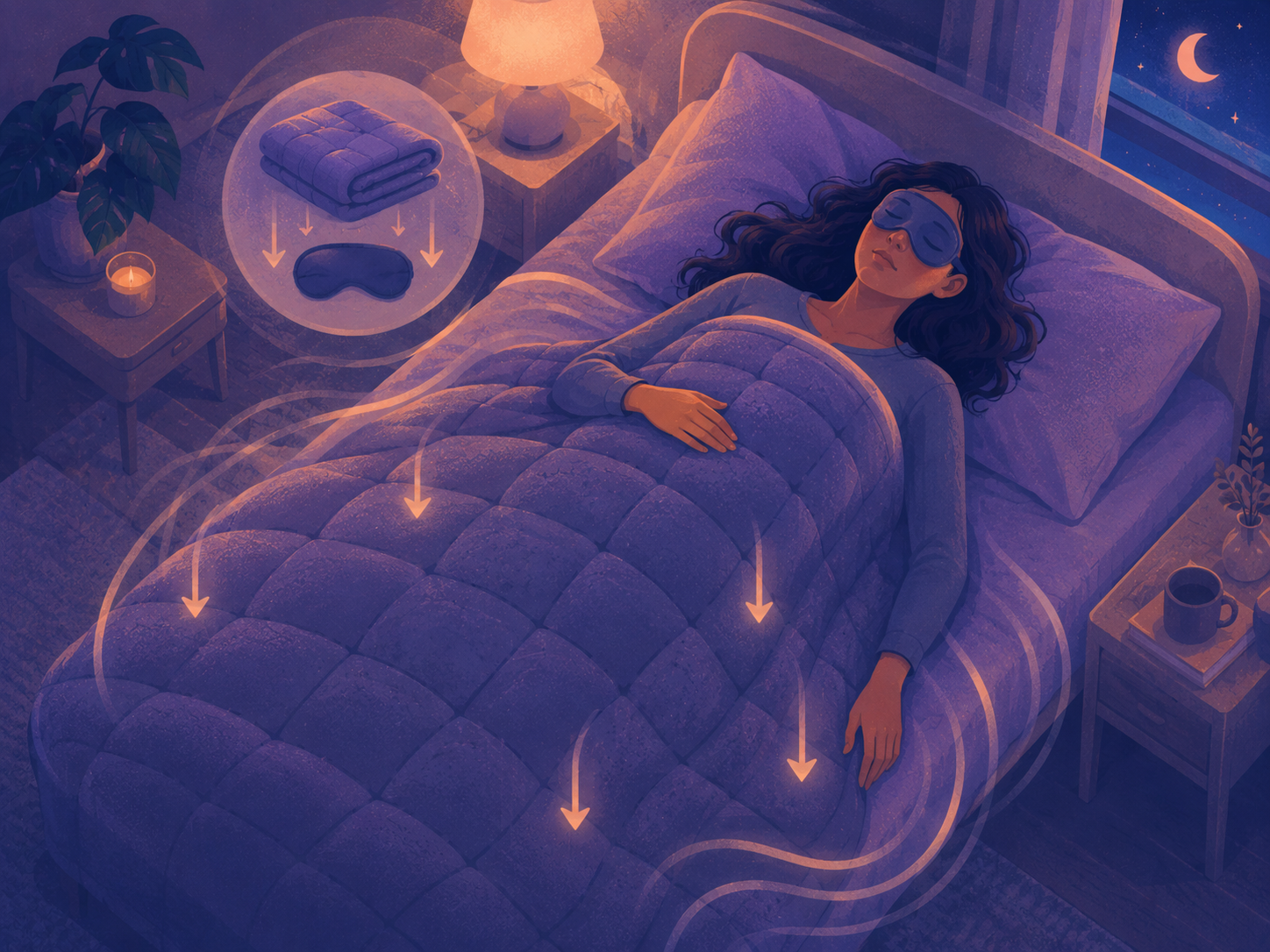
The second function is tactile. Fine weighted beads can create a gentle, distributed feeling around the brow and eye area—not pressure directly on the eyes. The evidence for full-body weighted blankets is still developing, and it should not be transferred wholesale to a weighted eye mask. We discussed those limits in our closer look at weighted blankets and weighted eye masks. Here, the honest claim is experiential: some people find a small amount of steady, familiar pressure grounding.
Sound needs its own solution. A sleep mask is not hearing protection and should not be presented as noise cancellation. Silence alerts, move the phone farther away, close the door, or choose an appropriate steady sound if that helps. Mellooa’s quiet, flat closure is designed not to add a loud fastening noise to the routine; its core sleep cues are darkness and gently distributed pressure.
This boundary can be especially useful in a shared bedroom. One person may be ready to sleep while the other is still reading, answering a message, or coming home from a late shift. The answer does not always have to be a perfectly synchronized bedtime. Reducing the light that reaches your eyes can make your side of the room feel finished even when the entire room is not.
That is where the Mellooa weighted sleep mask belongs in this ritual: after the phone is finished, as a physical boundary around what is no longer available to watch. It is not an antidote to screen time. It is a clearer ending to it.
Mellooa cannot erase the scrolling.
It can help the room—and the ritual—say that scrolling is over.
What if you cannot fall asleep after the reset?
Do not make the five minutes into a test you can fail. If you are still awake, avoid repeatedly checking the time or reopening the feed to escape frustration. A quiet, low-light activity away from the bed can be more helpful than remaining there and struggling. Return when sleepiness grows.
If difficulty falling asleep happens frequently, lasts for weeks or months, affects daytime functioning, or comes with loud snoring, breathing pauses, severe anxiety, low mood, pain, or medication concerns, speak with a qualified healthcare professional. Sleep hygiene can support rest, but persistent insomnia and other sleep disorders deserve proper assessment. Cognitive behavioral therapy for insomnia (CBT-I) is an established treatment that goes well beyond generic bedtime tips.
A clearer ending, not a perfect evening
People often reach for their phones at night because the phone is unusually good at meeting a real need. It offers connection after a lonely day, choice after a controlled one, distraction after stress, and a little private time when the rest of the day belonged to everyone else.
That is why shame is a poor sleep strategy. The aim is not to become a flawless person who never scrolls. The aim is to notice when the phone has stopped helping and give the evening a deliberate final line.
Finish one thing. Silence the hooks. Let the room become boring. Give the body one familiar cue. Sleep may not arrive immediately, but the day is no longer asking for another response.
Sources
- Chang A-M, et al. Evening use of light-emitting eReaders negatively affects sleep, circadian timing, and next-morning alertness. Proceedings of the National Academy of Sciences. 2015.
- Chinoy ED, et al. Unrestricted evening use of light-emitting tablet computers delays self-selected bedtime and disrupts circadian timing and alertness. Physiological Reports. 2018.
- National Heart, Lung, and Blood Institute. Healthy Sleep Habits.
- Ellithorpe ME, et al. The complicated impact of media use before bed on sleep: Results from objective EEG sleep measurement and media diaries. Journal of Sleep Research. 2022.
- Christensen MA, et al. Direct Measurements of Smartphone Screen-Time: Relationships with Demographics and Sleep. PLOS ONE. 2016.
Medical disclaimer: This article is for general education only and is not medical advice, diagnosis, or treatment. A sleep mask may support a darker, more consistent sleep environment but does not treat insomnia or other health conditions.