

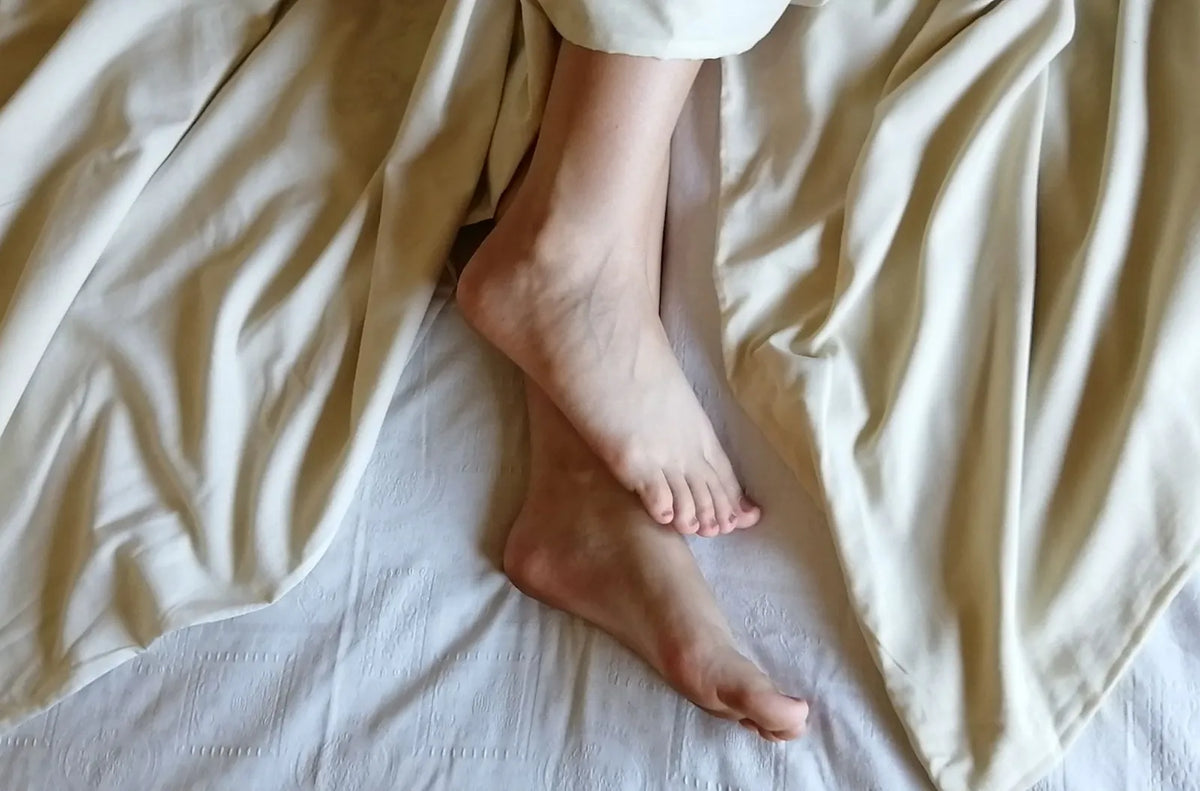
Most often it is restless legs syndrome: an urge to move your legs that shows up when you rest, feels worse in the evening, and eases when you walk. Low iron is the most common contributor doctors check first. Moving usually settles it for the night, but symptoms that return most nights deserve a conversation with a clinician.
What restless legs actually feel like
People describe it in strikingly similar words. A creeping or crawling feeling deep inside the calf, not on the skin. A fizzing or pulling sensation, as if something were moving under the muscle. An ache that is hard to place, because it is not quite pain. The shape of it stays the same: your legs feel wrong when they are still, and the only thing that feels right is moving them.
That is what sets it apart. The feeling builds while you lie in bed or sit still for a long time. You shift position and it eases for a minute. You get up and walk to the kitchen and it fades. You lie back down, and within minutes it is back, which is why a bad night can turn into a loop of pacing the hallway and lying down again.
It is common. Studies estimate it affects about 7 to 10 percent of adults in European and American populations, and the share rises with age. Women report it about twice as often as men. Many people live with it for years before learning it has a name, because the feeling is so hard to describe.
Five signs that point to restless legs
Sleep specialists use five features to recognize it, set out by the International Restless Legs Syndrome Study Group. When most of them fit, the picture is fairly clear.
First, an urge to move the legs, usually with an uncomfortable sensation that sits deep in the limb rather than on the skin.
Second, the urge begins or worsens during rest. Lying in bed is the classic trigger, but so is a long car ride, a flight, or a meeting that runs long. The longer you stay still, the stronger it gets.
Third, movement brings relief, at least for a while. Walking works best. Stretching or just standing up can take the edge off. The relief fades when you stop moving, which is the frustrating part.
Fourth, it is worse in the evening or at night. Symptoms follow the body clock, tracking the daily dip in dopamine signaling, the brain chemistry involved in movement. That is why many people finally fall asleep in the early morning, when the urge is at its lowest.
Fifth, nothing else explains it better. A cramp, a pinched nerve, or poor circulation can all make legs uncomfortable at night, and each has its own pattern. That is why a clinician asks questions instead of guessing from one symptom.
Restless legs is not a cramp
The two get mixed up constantly, and telling them apart matters, because what helps one does little for the other. A cramp is a sudden, painful tightening of a muscle. You can often feel the muscle harden under your fingers, and it hurts in a way that is impossible to ignore. It usually lasts seconds to a few minutes, then releases, and the muscle may stay tender afterward. Our piece on why you wake up with leg cramps at night covers that pattern in detail.
Restless legs is different. There is no hard knot to press. The discomfort is a feeling rather than a pain, and it does not come in a sudden spasm. It builds slowly while you are still, and it asks for movement rather than for you to hold still and wait it out. Stretching a cramp helps because the muscle needs to lengthen. Stretching restless legs helps because movement itself is the relief, and any movement counts.
Tingling or numbness is a third pattern again. Legs that fall asleep point toward pressure on a nerve or a circulation issue, and feeling returns in a rush of pins and needles when you change position. Restless legs rarely go numb. If yours tingle and go numb rather than urge you to move, describe it exactly that way to a clinician.
Why nights are the worst
The evening surge has a reason. Restless legs follows a circadian rhythm. Dopamine, the brain chemical that helps control movement, runs on a daily cycle, and its signaling dips in the evening and at night. In people with restless legs, that dip seems to cross a line where the legs start demanding movement.
Iron sits at the center of this story, because the brain needs iron to make dopamine. Studies of spinal fluid, brain scans, and tissue after death have repeatedly found lower iron in the brains of people with restless legs, even when their blood iron looked normal. The problem seems to be getting iron into the brain and keeping it there. That is why clinicians check ferritin, the protein that stores iron, and transferrin saturation, which shows how much iron is being carried.
None of this means you should start taking iron. It helps when iron stores are low, and does nothing when they are not. High-dose iron on your own can cause constipation and other problems. The useful step is a blood test and a conversation, not a supplement order.
What tends to sit behind it
For many people there is no single cause to find. It often runs in families: between 40 and 90 percent of people with the condition report at least one close relative who has it too, and it often starts before age 45. When no trigger turns up, doctors call it primary, which means the tendency itself is the explanation.
Sometimes there is a trigger worth finding. Low iron is the most common one, and the one clinicians check first. Pregnancy is another. About one in five pregnant women experience restless legs, and it is most common in the third trimester, when iron demands are highest and sleep is already harder. In most cases it eases after delivery, though it can return in a later pregnancy. Our guide to sleeping when you are pregnant covers the third trimester in detail, including positions that take pressure off the legs and hips.
Certain medicines can make it worse. Antihistamines, the kind found in many sleep aids and allergy pills, are a frequent culprit. So are some antidepressants and some anti-nausea drugs. If your symptoms started soon after a new prescription, mention the timing to the clinician who prescribed it. Do not stop a prescribed medicine on your own.
Long-term conditions can play a role too, including kidney disease, diabetes, and damage to the nerves in the legs. That is one reason frequent symptoms deserve a real check rather than a home remedy: a history, a look at your medicines, and blood tests, especially iron studies.
Daily habits matter at the margins, and they are the part you can change tonight. Caffeine, alcohol, and nicotine all tend to make symptoms worse, especially from the afternoon onward. Intense exercise late in the evening can stir the legs up rather than tire them out. None of these is the cause by itself, but each one can turn a mild night into a bad one.
What helps tonight
Start with the thing that works fastest: move. Get up and walk around the room, or down the hallway and back, for a few minutes. Stretch your calves slowly, holding each stretch for about 30 seconds. The goal is not a workout. It is a signal to the legs that movement is happening, which is what they have been asking for.
Warmth helps many people, and coolness helps others. A warm bath before bed relaxes the muscles and gives the legs gentle movement while you soak. A heating pad does the same in a smaller way. If warmth makes it worse, try the opposite: a cool compress, or simply uncovering your legs. There is no rule here. Use whichever one your legs prefer.
Massage is worth trying, and it is easiest when someone else does it. Rubbing the calves firmly for a few minutes can settle the crawling feeling long enough to fall asleep. A hand-held massager works too, and some people keep one by the bed for bad nights.
If you have been lying awake for more than about 20 minutes, get up. Read in a chair, stretch, or walk around the house quietly. Lying awake in bed trains your brain to link the bed with being awake, so go back when you feel drowsy and give the night a fresh start. Keeping a regular bedtime and wake time helps as well, because a steady schedule steadies the body clock behind the evening surge. Our piece on working out what time to go to bed shows how to count back from your wake time.
Look at the evening as a whole. Move caffeine earlier in the day, or skip it after lunch. Keep alcohol out of the last hours before bed, since it makes sleep lighter in the second half of the night even when it helps you drift off at first.
About the sock trick going around
You may have seen a video suggesting that wrapping a sock snugly around the arch of the foot stops restless legs. The idea is that steady pressure on the foot gives the brain a competing signal, which distracts it from the urge to move. It is a neat theory, and it has one problem: no clinical study supports it.
The comments tell the story. Many people who tried it said it did nothing. A few said it helped a little. Others pointed out that low iron was the real issue, and no sock could fix that.
There is no harm in trying a snug sock if it feels comfortable, as long as it is snug and not tight. Never wrap anything tightly enough to cut off circulation, and never fall asleep with a tight band around your foot. But do not let a sock stand in for the step that actually changes things, which is finding out whether your iron is low.
Does magnesium help?
Magnesium is the supplement people reach for first, and the evidence is mixed. Some small studies and many personal stories say it helps. Others find no effect. The honest summary is that it may help some people and does nothing for others, and nobody can tell in advance which group you are in. Our piece on whether magnesium helps you sleep walks through the studies.
High doses can cause diarrhea, and magnesium can interact with some medicines. If you want to try it, talk to a clinician first, and give it an end date: if a few weeks change nothing, stop spending money on it. A clear test beats a hopeful habit.
When to talk to a clinician
An occasional restless night is not a medical emergency. It becomes worth a visit when it keeps happening. Go if the urge shows up most nights, if it regularly costs you sleep, if you feel sleepy or foggy during the day because of it, or if it started suddenly after a new medicine. Go sooner if you are pregnant and it is severe, or if you notice weakness, swelling, or numbness alongside it.
The visit itself is usually straightforward. Expect questions about when the urge starts, what it feels like, what eases it, and whether anyone in your family has the same problem. Expect a review of your medicines and a blood test for iron, including ferritin. The 2025 guideline from the American Academy of Sleep Medicine puts iron testing first for people with frequent symptoms, because correcting low iron helps some people a great deal.
Medicines exist, and guidance has shifted in recent years: the older dopamine drugs are no longer the routine first choice, because they can make symptoms worse over time. What fits depends on your history, your iron levels, and what else you take, so the choice belongs in a clinic, not in a search result. If your symptoms are mild, you may leave with nothing more than the iron result and a few habit changes.
More than 80 percent of people with restless legs also kick or flex their legs repeatedly during sleep, a pattern called periodic limb movements. A bed partner often notices it before the person does. If your partner says your legs twitch all night, mention it at the visit.
Frequently asked questions
Is restless legs syndrome serious?
By itself it is not dangerous, and it does not damage the legs. What makes it serious is what it does to sleep. Night after night of broken sleep leaves you tired, irritable, and less able to concentrate. It is also worth checking because it can be the first sign of low iron, which is easy to miss and easy to treat.
Is it the same as leg cramps?
No. A cramp is a sudden, painful tightening of one muscle, and you can often feel the muscle harden. Restless legs is an urge to move, with a creeping or pulling feeling deep in the leg, and it builds slowly while you rest. Cramps want you to hold still and stretch. Restless legs want you to get up and walk.
Will it go away on its own?
Sometimes. In pregnancy it usually eases after delivery. Outside pregnancy it often comes and goes for years, and the pattern can change with age, iron levels, and medicines. If it keeps returning most nights, get your iron checked rather than waiting for it to pass.
Does magnesium help?
The evidence is mixed. Some people say it helps, and some small studies agree, but other studies find no effect. It is reasonable to discuss with a clinician, but it is not a reliable fix, and it is not a substitute for checking iron.
Can a sleep mask help?
Not with the legs. A mask does nothing for the urge to move, and no sleep product does. What it can do is help you fall back asleep once the legs have settled, by keeping the room dark. If you get up to walk the legs calm, a gently weighted sleep mask can make the return to bed easier. Think of it as help for the second half of the night, not the first.
Restless legs are annoying, but they are explainable, and that is the useful part. The urge follows a pattern, and the pattern points to iron and the body clock. If tonight is a bad night, get up, walk, and stretch. If most nights are bad nights, ask a clinician to check your iron.


Share:
How to Check Apartment Noise Before You Sign
Noisy Camping Sleeping Pad? Test It Before You Replace It