

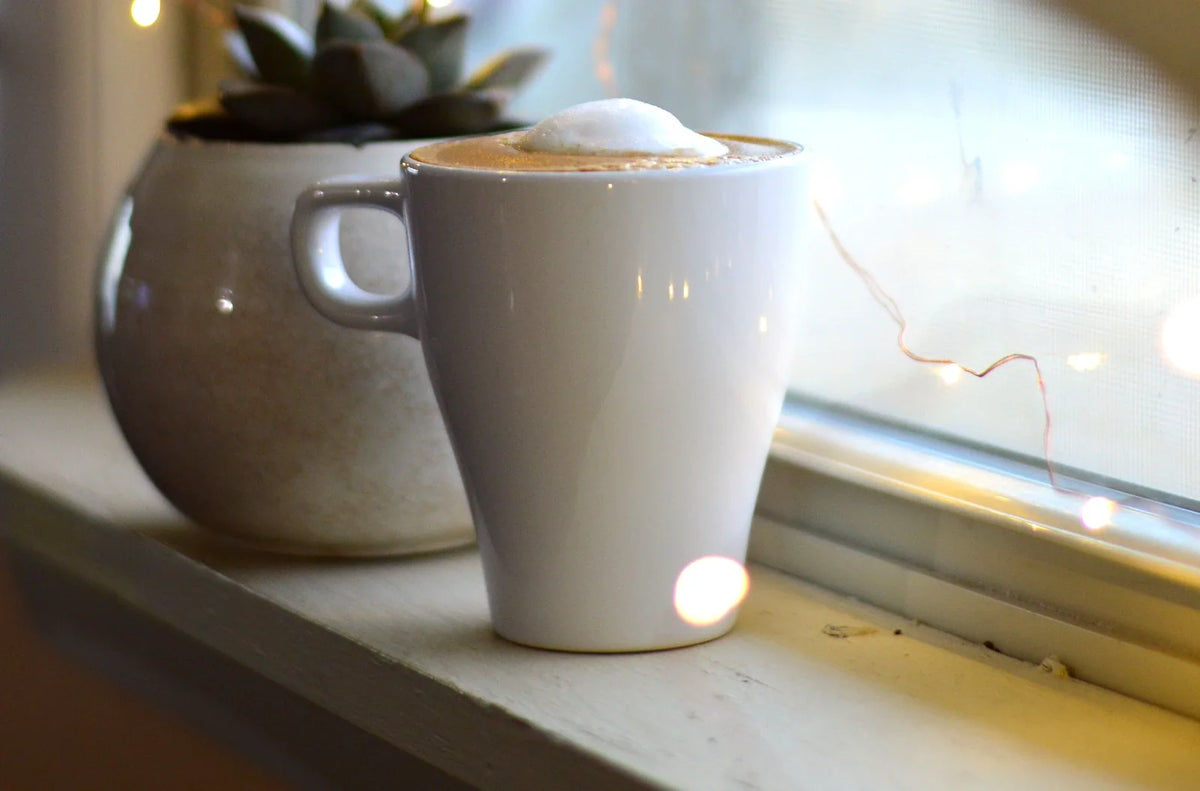
Count back 8 to 10 hours from your bedtime, and that is your caffeine curfew. If you fall asleep around 11 p.m., stop having coffee somewhere between 1 and 3 p.m. That is the whole rule. The reason behind it is caffeine's half-life: it leaves your body slowly enough that an afternoon cup is still working at midnight.
Why caffeine outlasts your afternoon
Caffeine has a half-life of about 5 hours on average in healthy adults, though it varies widely from person to person, roughly 1.5 to 9.5 hours. The half-life is the time your body needs to clear half of it. Run that clock forward from an 8-oz cup of coffee, about 95 mg, at 2 p.m.: roughly half is still in your system at 7 p.m., and about a quarter at midnight. A noon cup is down to about a fifth by midnight, and even a fifth of a cup is still working at bedtime.
It does not have to make you feel wired to cost you sleep. Caffeine works by blocking the brain's sleepiness signal, and even when you fall asleep on time, it can make the night lighter: more wake-ups, less deep sleep, an earlier final wake-up. People often blame a restless night on stress or a late dinner when the 3 p.m. coffee did half the work.
Find your curfew in ten seconds
Take the time you usually fall asleep, subtract 8 hours, then subtract 10. Your curfew sits between those two times.
| If you fall asleep at | Stop caffeine between |
|---|---|
| 9:30 p.m. | 11:30 a.m. and 1:30 p.m. |
| 10 p.m. | noon and 2 p.m. |
| 10:30 p.m. | 12:30 and 2:30 p.m. |
| 11 p.m. | 1 and 3 p.m. |
| 11:30 p.m. | 1:30 and 3:30 p.m. |
| midnight | 2 and 4 p.m. |
Use the earlier figure if you know you are sensitive to caffeine, and the later one if you sleep well after a mid-afternoon cup. The range is a starting point, not a prescription. Adjust it by an hour at a time until your nights tell you it fits.
Why everyone says 2 p.m.
The folk rule you see everywhere, no coffee after 2 p.m., is just the 8-to-10-hour count-back solved for a midnight bedtime. It is good advice for people who sleep around midnight, which is why it spread. If you sleep at 10 p.m., your personal 2 p.m. is noon, and following the folk rule literally will still leave you with a lighter night.
So keep the rule, but personalize it. The count-back version is the same wisdom, fitted to your own schedule.
Remember it is not just coffee
The curfew counts all caffeine: tea, energy drinks, cola, chocolate, and some over-the-counter pain relievers. A strong black tea at 4 p.m. is still a late caffeine dose, even if it did not come from a coffee maker. People who "don't drink coffee" sometimes find their curfew violation hiding in a thermos.
Your sensitivity is your own
How fast caffeine clears varies from person to person. Genetics plays the biggest role, and age, pregnancy, and some medications slow clearance too. This is why the 8-to-10 range exists: an 8-hour curfew can be plenty for one person while another needs the full 10.
Pay attention to your own nights rather than someone else's rule. If you fall asleep easily and wake rested after a 2 p.m. coffee, your curfew is working. If not, move it earlier by an hour at a time. This article is a lifestyle guide, not medical advice. If you are pregnant, on medication, or have a condition where caffeine timing genuinely matters, talk to your clinician instead of tuning it yourself.
What to do with the hours after the curfew
Stopping caffeine earlier in the day is only half of the sleep equation. The evening itself has to wind down. Dim the lights an hour before bed, put the workday somewhere it cannot follow you, and give your attention something dull and pleasant. A short breathing routine works well at the end of the day. If you want a guided starting point, this five-minute bedtime routine for light sleepers was written for exactly this moment.
If your mind tends to spin the moment the coffee wears off and the day catches up with you, you may recognize the pattern described in how to quiet racing thoughts before sleep. The curfew handles the chemistry. The wind-down handles the rest.
Frequently asked questions
What time should I stop drinking coffee if I go to bed at 10 p.m.?
Between noon and 2 p.m. Count back 8 to 10 hours from 10 p.m. If you are sensitive to caffeine, use noon.
Is 2 p.m. too late for coffee?
It depends on your bedtime. For a midnight sleeper, 2 p.m. is right on the 10-hour line and fine. For a 10 p.m. sleeper, it is only 8 hours out, and many people would sleep better stopping at noon.
How long does caffeine stay in your system?
With an average half-life of about 5 hours, half of a cup is still active at 5 hours, a quarter at 10 hours, and an eighth at 15. Full clearance takes roughly a day. Stopping 8 to 10 hours before bed is a common research-backed guideline: a 2023 review of 24 studies suggested having a regular cup at least 8.8 hours before bed, and a 2013 study found that a large dose taken 6 hours before bed still disrupted sleep. But some caffeine is still in your system at bedtime.
Does decaf coffee affect sleep?
Decaf still contains a small amount of caffeine, usually a few milligrams per cup compared with about 95 mg in an 8-oz cup of regular coffee. For most people a decaf in the evening is fine, but if you are very sensitive, even decaf late at night can be noticeable.
Will drinking water or exercising flush caffeine out faster?
No. Hydration and exercise are good for many things, but they do not meaningfully speed up caffeine clearance. Time is the only reliable way out. That is why the curfew works and last-minute fixes do not.
Your caffeine curfew is not about giving up coffee. It is about putting coffee where it belongs: in the morning and early afternoon, when it helps, instead of in the evening, when it quietly takes. If you are curious about pairing an early-afternoon cup with a short nap, see whether a coffee nap actually works. Set the curfew, keep it for a week, and let your nights tell you it is working. After the curfew, if sleep still will not come, make the bedroom darker and quieter. Caffeine is often only half the story.



Share:
Boring Podcasts That Actually Help You Fall Asleep
Can't Sleep? Why Sleep Experts Tell You to Get Out of Bed