

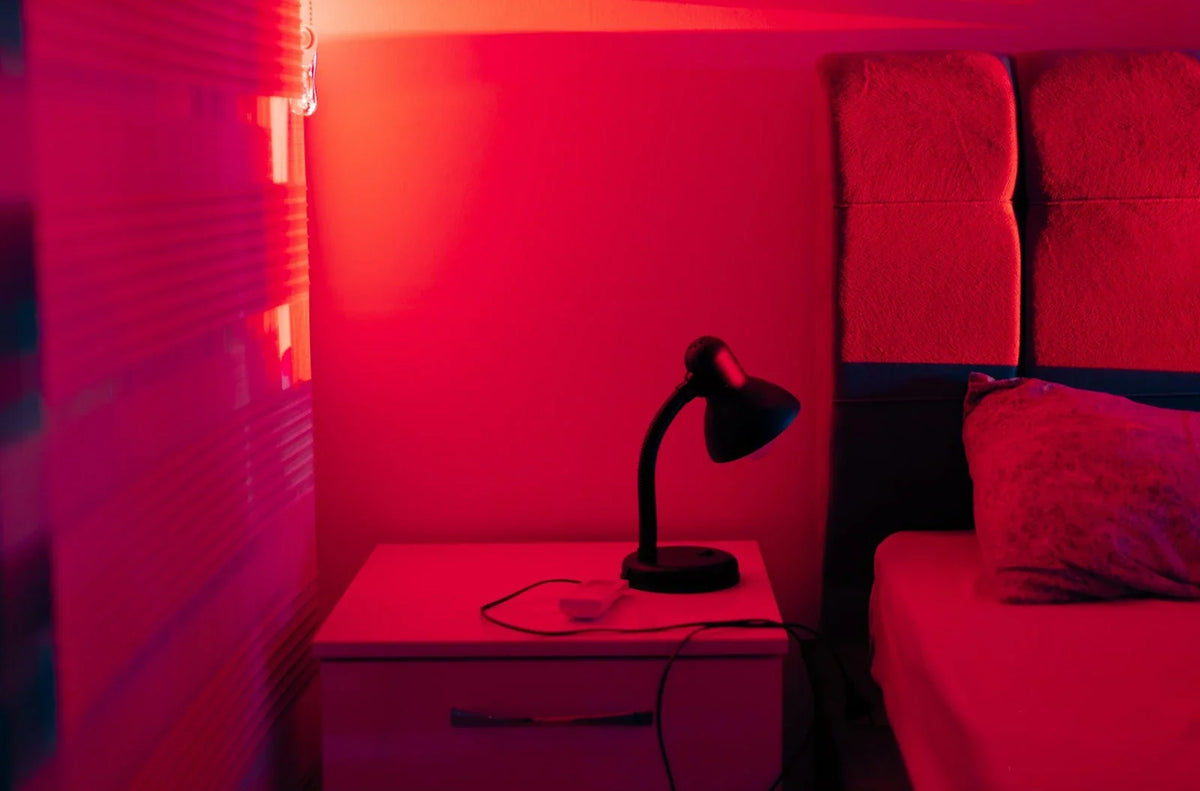
Red light will not knock you out on its own, but it disturbs your sleep chemistry far less than white or blue light. In a 2025 study, melatonin recovered under evening red light while blue light kept it suppressed for hours. So the honest answer is this: use red light as your evening light, then sleep in complete darkness.
Scroll through any sleep hashtag and you will find the same aesthetic: bedrooms bathed in red. Sunset lamps, red LED strips, amber night lights, and red light therapy panels, all promising deeper rest. The trend raises a fair question, because light color genuinely affects sleep. But most of the answers online come from the people selling the lamps. Here is what the research actually says, stripped of the marketing.
Quick Answers
Does red light help you sleep?
Not directly. No study shows red light making people fall asleep faster the way a sedative would. What it does is avoid the melatonin suppression caused by blue and white light, so your natural sleepiness arrives on schedule.
Is red light better than blue light at night?
Yes, clearly. In a 2025 trial, two hours of evening blue light held melatonin at 7.5 pg/mL while red light let it recover to 26.0 pg/mL. For evening lighting, red is the gentler choice.
Should you sleep with a red light on?
No. Darkness beats any light during sleep, including red. Use red light in the hour or two before bed, then turn everything off.
Can a red light bulb replace a therapy panel?
For sleep, probably yes, and it costs far less. The main benefit most people want is avoiding blue light at night, which a simple red bulb delivers. Panels add a possible direct dose effect, but that evidence is thinner.
Why Your Brain Reads Light Color
Your eyes do more than see. A separate set of cells in the retina, most sensitive to blue wavelengths around 460 to 480 nanometers, reports light directly to your body clock. When these cells fire in the evening, your brain holds back melatonin, the hormone that opens the gate to sleepiness, and your clock shifts later.
Red light sits at 620 to 700 nanometers, about as far from that sensitive zone as visible light gets. Your clock barely registers it. This is not a wellness claim. It is basic photobiology, and it is why sleep researchers have recommended dim, warm light in the evening for decades.
Timing sharpens the effect. The same light that barely matters at noon can shift your clock at midnight, because the circadian system is most responsive in the hours before your usual bedtime. That is why the studies below all test evening exposure specifically, and why a red bulb at 9 p.m. is a different intervention than the same bulb at 9 a.m.
Two caveats matter before the studies. First, brightness still counts. A blazing red floodlight will disturb you more than a dim warm lamp, because total light dose matters alongside color. Second, most of what follows was measured in small, short trials. Treat every finding below as a signal, not a prescription.
What Two Real Studies Found
The cleanest comparison arrived in 2025. Researchers in Zaragoza, Spain, exposed 12 healthy adults to three hours of evening light, from 9 p.m. to midnight, on separate nights: red LED light at 631 nanometers one night, blue at 464 nanometers another. They measured melatonin in saliva every hour.
After the first hour, both lights had suppressed melatonin to nearly the same low level. Then the paths split. By hour two, blue light held melatonin down at 7.5 pg/mL while under red light it had climbed back to 26.0 pg/mL, a statistically significant difference that persisted into the third hour. The authors concluded that red light is the less disruptive option for nighttime environments.
Twelve people is a small group, and the study measured melatonin, not sleep itself. Still, it is a real, peer-reviewed, controlled comparison, published in the journal Life, and it matches the photobiology exactly.
The second study is older and stranger. In 2012, researchers gave 20 Chinese female basketball players 30 minutes of whole-body red light every night for 14 days, while a control group lay in the same chamber with no light. The red light group's sleep quality scores improved, their blood melatonin rose, and even their endurance test performance improved, with the sleep and melatonin changes moving together.
That sounds impressive until you look at the frame: 20 elite young athletes, one lab, no blinding to speak of. It is the most cited positive result in this space, and also a reminder of how thin the evidence still is. One 2023 trial, rarely mentioned in marketing, found that red light actually worsened sleep for some participants. The honest summary: red light is almost certainly gentler than blue or white light at night, and it might actively help a little, but nobody has proven it treats poor sleep.
Notice what neither study tested. Nobody has run a large trial of ordinary adults buying a red bulb for the bedroom and tracking their sleep for a month. The Zaragoza trial measured a hormone, not sleep. The athlete trial used whole-body panels in a lab, not a nightstand lamp. When a product page cites "clinical studies" for a desk lamp, it is usually borrowing the athlete study's credibility for a product the researchers never touched. The gap between the lab and the nightstand is where most of the marketing lives.
During Sleep, Darkness Still Wins
Here is the mistake the trend encourages: leaving the red lamp on all night. Every study of light during sleep points the same way. Any light in the bedroom, whatever its color, can fragment sleep and blunt the deep stages, even when sleepers do not remember waking. Red light's job is the wind-down, not the night itself.
Think of it as a handoff. Red or amber light for the last hour or two protects your melatonin while you read, stretch, or get ready for bed. Then lights out, complete darkness, which remains the best-studied light condition for sleep. If streetlight or a hallway glow leaks in, that is a job for a gently weighted wraparound sleep mask, not for another lamp.
Panels vs Bulbs: What Are You Actually Buying?
Two very different products share the red light label, and the evidence behind them is not the same.
A red light therapy panel is a bright device you sit in front of for 10 to 20 minutes, usually marketed for skin or recovery, now repurposed for sleep. The only sleep-specific evidence for this format is the basketball-player study above: whole-body exposure, 30 minutes, every night for two weeks. Nobody has shown that a quick panel session while scrolling your phone does the same thing, and the brightness of the panel plus the ritual of using it can feel alerting rather than calming.
A red or amber bulb is the opposite approach: instead of adding a dose of red, you remove the blue. Swap the bedroom and bathroom overheads for dim red or amber bulbs, and your evening light stops suppressing melatonin at the source. For the sleep benefit most people are chasing, this is likely the better-value move, because the benefit comes from what the bulb is not emitting.
Sunset lamps sit somewhere in between. They look wonderful and they are dimmer and warmer than overheads, which is genuinely useful. Just do not expect the projection of a sun on your wall to do anything a plain dim amber bulb would not.
If you are shopping, three details matter more than the brand. First, check that the bulb or lamp emits no meaningful blue or cool-white light mixed in; many "red" LEDs leak other wavelengths. Second, pick dimmable, because the research used dim conditions and brightness undermines the whole point. Third, a timer or auto-off is worth having, since the goal is a wind-down bridge, not an all-night glow.
How to Use Red Light in the Evening
If you want to try it, copy the conditions the research actually used rather than the ads. Use red or amber light for the last one to two hours before bed, keep it dim, and place it below eye level or aimed at walls so you see reflected light, not the bulb. If you own a panel, run a normal 10 to 20 minute session earlier in the evening, not at lights-out, since several users report feeling more alert right after.
Then turn it all off. The red light was the bridge; darkness is the destination. Keep the rest of the routine boring and consistent: screens down or dimmed, a regular wake time, and bright light in the morning to anchor the clock that evening light disrupts. If you tried blue-light glasses and found them underwhelming, this is the stronger version of the same idea: fix the room, not the face.
When Red Light Is Not the Answer
A few people should skip the experiment. If you have a photosensitive condition or take medication that increases light sensitivity, check with your doctor first. If your sleep gets worse after starting red light use, stop rather than adjusting the protocol and hoping. And if poor sleep has lasted for weeks, or comes with loud snoring, gasping, or daytime sleepiness that intrudes on driving or work, that is a medical issue with effective treatments. The right response is an appointment, never a lamp.
Frequently Asked Questions
Does red light increase melatonin?
It appears to allow melatonin to rise normally rather than boosting it directly. In the 2025 Zaragoza trial, melatonin recovered to 26.0 pg/mL under red light after two hours while blue light held it at 7.5 pg/mL. In the 2012 athlete trial, blood melatonin rose after 14 days of nightly red light sessions. Both findings need larger replications.
What color night light is best for sleep?
Red or amber, kept dim. Both sit far from the blue wavelengths around 460 to 480 nanometers that suppress melatonin most strongly. For overnight use, such as a hallway or bathroom light, choose the dimmest red or amber option and keep it low, out of your direct line of sight.
Is it bad to fall asleep with red LED strip lights on?
It is worse than darkness. Any light during sleep can fragment rest, and bright strips near the bed deliver plenty of photons whatever their color. Use them for the wind-down, then switch them off.
How long before bed should you switch to red light?
The studies showing benefits used one to three hours of evening exposure. A practical rule: switch the bedroom and bathroom to red or amber for the last one to two hours of the night, then lights out.
Do I still need red light if I already dim my lights at night?
Probably not much. Dimming is doing most of the work. Red light is mainly an upgrade over bright white or blue-rich evening light. If your evenings are already dim and warm, you have captured the large majority of the benefit.
Can red light treat insomnia?
There is no good evidence for that. The studies show gentler effects on melatonin and, in one small athlete trial, better sleep quality scores. None tested red light as a treatment for chronic insomnia, and one trial found worse sleep in some users. Persistent insomnia deserves a clinician, ideally one who offers CBT-I, the best-studied treatment available.
The short version: red light is the gentlest way to keep a room lit at night, and two small but real studies suggest it protects, and may even support, your melatonin. It is not a treatment for insomnia, and it is no substitute for darkness once you are in bed. Used as a bridge from bright evening to dark night, it earns its place. The final step, as always, belongs to the dark: a gently weighted wraparound sleep mask for whatever light the room will not give up.



Share:
Do Blue Light Glasses Help You Sleep? What Research Says
Can You Hear Your Alarm With Earplugs In?