

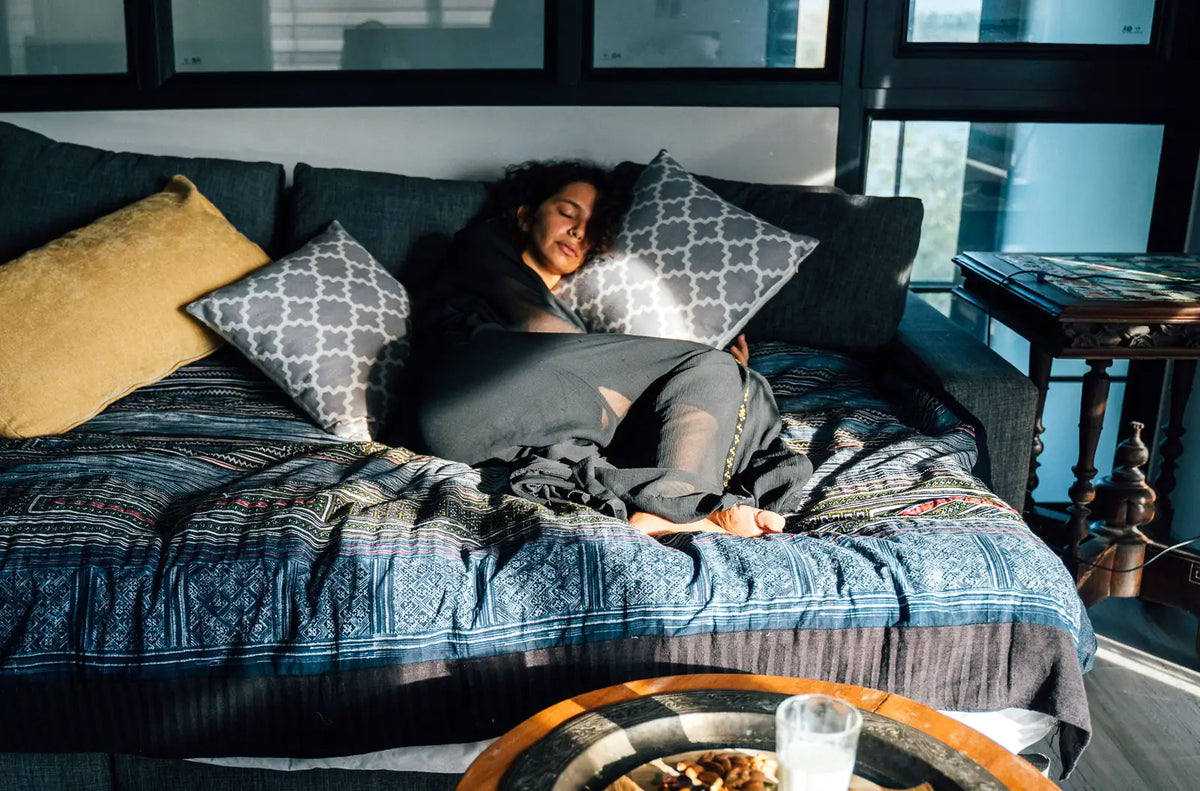
A nap mask is useful only when light is one of the things keeping the room from feeling rest-ready. Before comparing fabrics or shapes, define three variables: the room, the time you have, and the position you will use. That short check often tells you whether you need a mask at all—and, if you do, what kind of contact will be practical for this particular nap.
This guide owns one ordinary question: how to choose a sleep mask for naps at home or during a normal workday. It is not a travel guide, a night-shift protocol, an all-night verdict, or a promise that a mask will improve productivity. The goal is a repeatable nap setup you can describe before you buy anything.
Start with a room-time-position card
Write down these three answers before you reach for a mask:
- Room: Where is the light coming from, and can you change it without wearing anything?
- Time: How long is the rest window, including the minutes you need to settle and get up?
- Position: Will you lie on your back, turn onto your side, or rest partly upright?
Those answers matter more than a generic “best nap mask” label. A bright sofa beside a west-facing window creates a different problem from a bedroom with curtains already closed. A ten-minute eyes-closed break asks for quicker on-and-off handling than a longer scheduled nap. For a short rest lying still on your back, an eye pillow may suit you better than a strapped mask. A side position makes the mask’s edge and fastening area more noticeable against a pillow than a back position may.
CDC/NIOSH recommends a sleep environment that is dark, quiet, cool and comfortable, and lists an eye mask as one option when light is hard to avoid. That is the right order for this decision: check the environment first, then decide whether personal light control adds anything.
Room: fix the light source before adding a mask
Stand or sit where you plan to nap and look for the actual light path. Is it direct sun through a gap in the curtains? A bright ceiling fixture someone else needs? A screen or indicator light close to your face? Or is the room already comfortably dim?
If closing a curtain, turning off a nearby lamp, or moving to the shaded end of the sofa solves the problem, that is the simplest setup. You do not need a mask merely because the activity is called a nap. A no-purchase decision is still a good decision.
A mask becomes more relevant when the room cannot reasonably change: you share the space, daylight shifts across the room, the curtain gap is outside your control, or you want darkness around your own eyes without making the whole room dark. If the issue is a small gap around a mask you already own, use the separate light-leak troubleshooting guide instead of replacing it automatically.
Time: plan the whole rest window, not just the timer
“Nap length” is not one universal prescription. It includes the time you expect to settle, the intended sleep opportunity, and the transition after the alarm, when the groggy feeling after a nap can take a while to clear. If you need to join a call immediately, the setup should be easy to remove and leave easy access to the alarm. If the window is generous, you may care more about maintaining a consistent light boundary as daylight moves.
A randomized study of 10-, 30- and 60-minute mid-afternoon nap opportunities found different post-nap patterns across its measured outcomes. A review of short naps and sleep inertia also concluded that study results vary with prior sleep, time of day and other conditions. These sources make duration a real planning variable, but they do not give every reader one ideal timer setting.
For mask choice, use a practical question instead: will I want to remove this quickly and predictably when the alarm sounds? Check that you can reach the edge or fastening area without fumbling, that the mask does not cover your ears if you rely on an audible alarm, and that the alarm device remains accessible. Do not use the mask as a reason to compress a realistic wake-up transition.
Position: check pillow contact before judging comfort
Try the position you actually use. A mask can feel unobtrusive while sitting up and quite different once a pillow presses against its side edge. The contact map—not a marketing category—should decide whether the shape works for your nap.
If you nap on your back
Check the front contact and the rear closure. The mask should sit where you intend without requiring excessive tightness. Move your head gently left and right. If the product shifts immediately, first adjust placement rather than pulling harder.
If you nap on your side
Lie on the usual side with the usual pillow. Notice whether the side edge bunches, whether the fastening area sits under a pressure point, and whether the mask is pushed upward or downward. If side contact is the main question, the separate side-sleeper guide owns that deeper comparison.
If you rest partly upright
Check whether the mask stays in position with only light head movement and whether removal is simple. An upright break in a chair is not the same as a travel nap; this article stays with an ordinary home or workday room rather than planes, trains or hotel packing.
Use the three variables as a selector
| What you find | Best first move | What to check if you add a mask |
|---|---|---|
| The room is already dim and the rest window is short | Try the nap without adding gear | Only add a mask if small remaining light is actually distracting |
| Daylight cannot be changed, and you need quick removal | Choose personal light control with a clear edge or fastening point | Practice putting it on and removing it while awake |
| You turn onto your side | Test with the real pillow before deciding | Side-edge bulk, closure position and shifting |
| You prefer a broad, gently weighted wraparound feel | Compare that contact preference with a lighter or more localized design | Full side coverage, nose-notch position and rear overlap |
This table is intentionally conditional. A longer rest window does not automatically mean a heavier or more enveloping mask. A bright room does not automatically mean the first product that says “blackout.” Your three-variable card should keep the decision tied to the real setup.
A two-minute awake test before the first nap
Do a short setup test while fully awake:
- Put the mask on in the planned room and position.
- Check whether the light problem is materially reduced.
- Move into the actual back, side, or upright posture.
- Locate the edge or fastening point you will use at the alarm.
- Remove it, reset it once, and confirm the process is simple.
If you feel pinching, direct eye pressure, excessive warmth, or an urge to tighten the mask to keep it in place, pause and adjust. A nap is a poor time to discover that the contact pattern does not suit you. Persistent discomfort is a reason to stop using that setup, not a reason to pull it tighter.
Where Mellooa may fit—and where it may not
The current Mellooa Weighted Sleep Mask listing describes a gently weighted wraparound design. Its verified product geometry is one continuous broad band with an open top, a centered lower nose notch, broad side coverage and a flat rear overlap. That construction may appeal if you prefer a wider field of fabric contact rather than a small front pad with a thin strap.
It is not automatically the right nap mask. If you dislike broad side contact, want the lightest possible feel, or find a rear overlap noticeable against your pillow, compare another construction. The product link belongs after the preference check, not before it.
For an ordinary nap, the useful question is not “Is weighted always better?” It is “Does this contact pattern match my room, time and position without creating a new distraction?” The article on weighted versus regular sleep masks handles that construction tradeoff in more detail.
After the nap: keep one line of evidence
When you get up, write one short note:
- Room: Was light still the main disturbance?
- Time: Was the mask easy to remove when planned?
- Position: Did it stay where intended without over-tightening?
Change one variable next time. If the room was too bright, address the curtain gap or placement. If the edge met the pillow, change the position or mask construction. If removal felt awkward, simplify the setup. This turns a vague “good” or “bad” impression into a practical choice you can repeat.
Your repeatable nap setup card
Use this sentence before the next nap: “The room has ___ light; I have ___ minutes for the full rest window; I will rest on my ___; therefore I will change the room / use no mask / use a mask with ___ contact.”
That is enough. A sleep mask for naps should solve a specific light problem, fit the time available, and make sense in the position you actually use. If the room can do the job alone, let it. If personal light control is useful, choose by the contact you can test—not by a universal promise.


Share:
Can You Sleep With a Sleep Mask Every Night?
Reusable Earplugs for Sleeping: Choose by Fit, Reuse and Awareness