

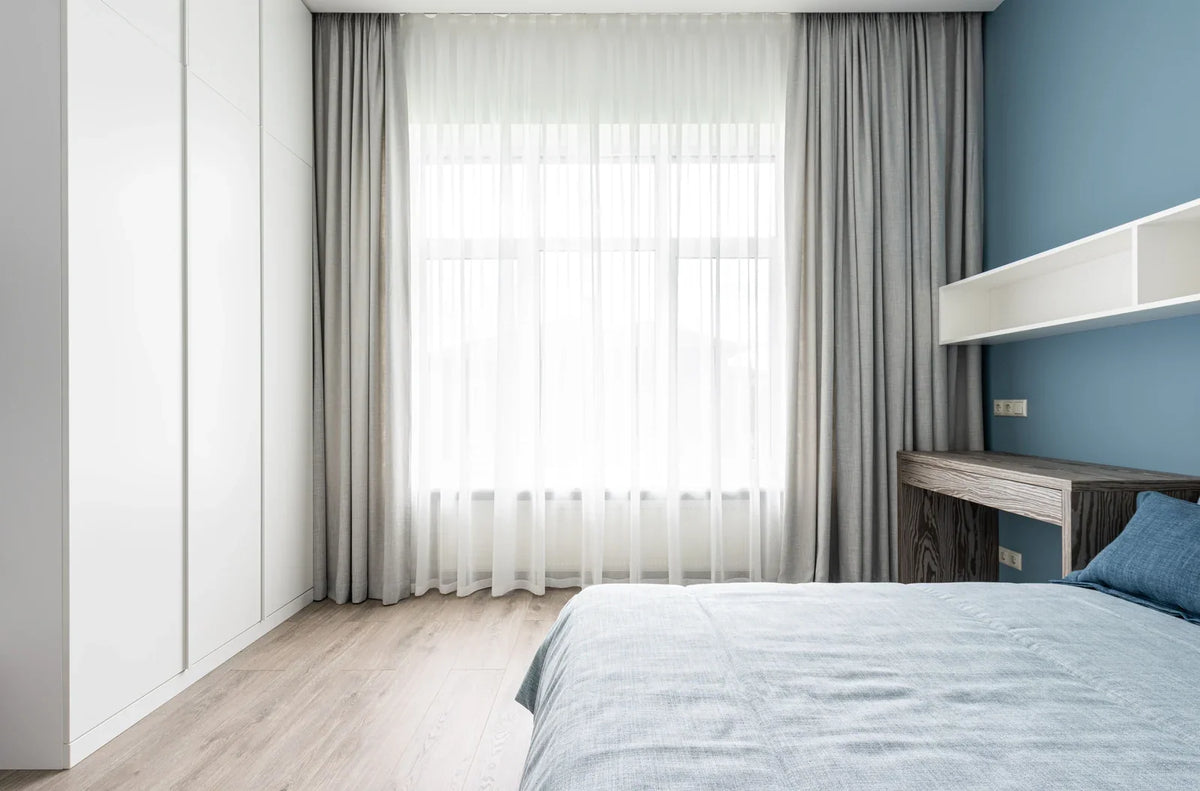
One person wants a dark room. The other wants to read, get dressed, or wake to morning light. That is the real sleep mask vs blackout curtains decision: do you need to change what one person sees, or change the whole room?
Choose blackout curtains when the window is the main source of unwanted light and everyone using the room benefits from reducing it. Choose a sleep mask when one person needs darkness but the room should stay usable, or when you cannot change the window. Choose neither, for now, if a smaller fix—closing an existing curtain properly, covering a device light, or moving a bedside lamp—solves the actual problem.
This is not a contest with one universal winner. It is a room decision with four variables: the light source, who needs darkness, whether anything touching the face feels acceptable, and whether you have permission to install or change window coverings.
Start with the light, not the product
Stand in the bedroom at the time the light is most annoying. Do not start by asking which product is “better.” Ask where the light comes from.
- The whole window glows at dawn: a room-level change is the more direct route.
- Streetlight enters around one edge: first test whether the existing curtain can be repositioned or extended. On a clear night, the same gap can let in moonlight, too. Here's what research says about whether the full moon affects sleep.
- A partner reads with a lamp: personal darkness may preserve both people’s routines.
- A clock, charger, or device LED is the only problem: fix that source before buying either option.
- Light comes from the hallway: curtains will not solve it; a door adjustment, source change, or personal mask may be more relevant.
The CDC/NIOSH guidance on sleep environments makes the same practical distinction: use an opaque window covering when necessary, or an eye mask when traffic or streetlight is hard to avoid. That guidance supports choosing around the source. It does not say one product works for every room or every person.
The difference in one decision table
| Question | Sleep mask | Blackout curtains |
|---|---|---|
| Who gets darkness? | The person wearing it | Everyone in the room |
| What light does it address? | Light reaching the wearer’s eyes from several directions | Mainly light entering through the covered window |
| Does it touch the face? | Yes; fit and sensory preference matter | No |
| Does it change the room? | No permanent room change | Yes; measuring, hanging, and edge gaps matter |
| Who must agree? | Mainly the wearer | Anyone sharing or managing the room |
| Can you take it elsewhere? | Yes | No; it stays with that window |
| When is no purchase sensible? | When the wearer dislikes facial contact or the source is easy to remove | When existing coverings already solve the window light |
The table deliberately compares control and trade-offs, not promised sleep results. A darker setup can be one part of a sleep environment, but neither curtains nor a mask diagnoses or treats a sleep problem.
Two common mistakes become visible here. The first is buying curtains for a light source that does not come through the window. The second is buying a mask for a shared room problem that everyone wants to change. Both purchases can be perfectly good products and still be the wrong tool. Source first, affected person second, product third.
Choose blackout curtains when the room owns the problem
Blackout curtains are the clearer first choice when the full window is bright and the whole room should become darker. This may be the case when early sun fills the room, exterior lighting reaches both sides of the bed, or two people want the same darker environment.
Before buying, check what “changing the room” actually requires. Measure the window and the area around it, note where light leaks now, and check whether you can drill, mount a rail, or use a renter-safe alternative. Fabric alone is not the entire system: light can remain at the top, sides, center, or bottom depending on the installation. That is why this article makes no measured-blackout promise.
Curtains also avoid face contact. If you dislike fabric, weight, warmth, or fastening around your head, that can outweigh portability. A product you do not want to wear is not the right personal solution, even if it is quick to buy.
There is also a shared-room consequence. Curtains change the room for everyone. If one person wants darkness while another needs a lamp, wants morning light, or gets up earlier, discuss the morning and evening routine before treating the window. The goal is not maximum darkness at any cost. It is a setup both people can actually live with.
Choose a sleep mask when one person owns the problem
A sleep mask is the more direct route when one person needs darkness and the room should remain available to someone else. It can also make sense when you rent, cannot alter the window, or want one personal item rather than a room installation.
The trade-off is contact. A mask has to rest on the face or wrap around the head, so shape, pressure, warmth, hair, nose geometry, and movement become part of the decision. No honest comparison can promise that one mask fits every face or blocks every edge gap.
If you choose this route, the Mellooa Weighted Sleep Mask is one specific construction to consider, not the default winner. It is a broad wraparound design rather than a small eye panel with a thin elastic strap. The current product page lists eye-and-ear coverage, a broad adjustable fabric fastening area, one smooth side, one soft brushed side, an approximate size of 72 × 13 × 1 cm, and an approximate weight of 309 g.
Those are product facts, not proof that it will suit you. The broad wrap and weight are noticeable choices. If you prefer nothing around your head, want zero face contact, or do not like added weight, curtains may remain the better answer.
If you are still deciding what kind of face contact you accept, keep that as a separate question. Our weighted versus regular mask comparison looks at category trade-offs without changing this room-level decision. If you already own a mask but it moves during the night, use the slipping diagnostic rather than turning this article into a fit guide.
Shared bedroom: protect two different routines
Imagine one person sleeps earlier while the other reads for twenty minutes. Closing blackout curtains does not remove the bedside lamp, and turning off the lamp may make the second person’s routine harder. A mask can localize the darkness to the earlier sleeper—if that person is comfortable wearing it.
Now reverse the scene. Both people wake when the east-facing window brightens, and neither wants morning light at that hour. Curtains address the shared source once, without asking either person to wear something. That is a room problem.
A third scene needs no new product: the curtain is already adequate, but a charging light faces the bed. Turn, cover, or relocate the device safely. Buying more fabric for a small removable source adds cost and maintenance without solving a larger need.
Run a two-night source test before you buy
- Name the source. Write down “window edge,” “partner’s lamp,” “hallway,” or the specific device. “The room is bright” is too vague.
- Test the smallest reversible change. Fully close what you already own, move a lamp, or cover a safe indicator light. Do not create a fire or trip hazard.
- Decide who needs darkness. One person points toward a personal solution. Everyone points toward a room solution.
- Check the contact rule. If fabric or weight on the face is unwelcome, do not talk yourself into a mask because it looks easier to install.
- Check permission and effort. If you cannot alter the window, a personal solution may be practical. If you can and the window is clearly responsible, measure before shopping.
- Write the no-purchase branch. If the small test fixed the issue, stop. A useful comparison should be allowed to end without a sale.
This short test will not measure sleep quality or prove a health effect. It simply helps you avoid solving the wrong light problem.
When using both is reasonable—and when it is not
Using both can make sense when curtains reduce the main window light but a separate source remains for one person, or when two people have different schedules. Each tool then has a separate job.
But “buy both” should not be the automatic conclusion. If well-fitted curtains solve the shared window problem, a mask may add contact and care with little practical value. If a mask gives one person the control they need while the room remains usable, curtains may be an unnecessary installation. Add the second tool only after you can name the remaining gap.
Your written room-change choice
Finish with one sentence:
“The light comes from ________. It affects ________. We can / cannot change the room. Face contact is / is not acceptable. So we will try ________ first.”
If your sentence points to the window and everyone wants the same darker room, start with curtains. If it points to one person needing darkness while the room stays active, consider a mask. If it points to one small removable light, change that first.
The best answer is not the product with the strongest promise. It is the smallest complete change that matches the real source, the people sharing the room, and the way you are willing to live with it.



Share:
A Gift for Someone Who Needs Rest
Earplugs vs White Noise: Choose Around What You Need to Hear