

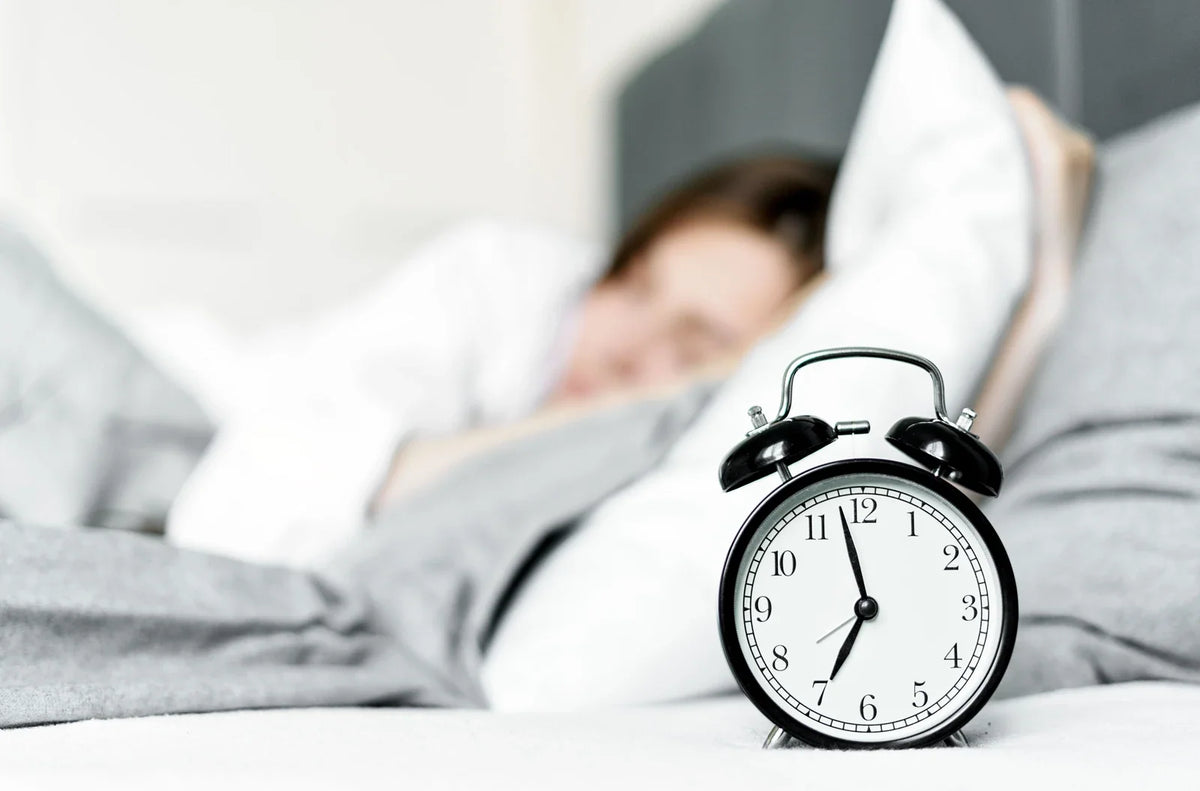
Your alarm goes off at seven on workdays, but on a free morning you might sleep until ten. Social jet lag describes the mismatch between sleep timing on workdays and free days, often reflecting a tension between your body clock and the schedule you have to keep.
The useful detail is timing, not just how late you get up. Two people can both wake at ten on Sunday and have very different patterns. Looking at the middle of their sleep helps explain why.
What does social jet lag mean?
Researchers use the term for the discrepancy between biological and social timing. In their 2006 paper introducing social jetlag, Marc Wittmann and colleagues examined work-day and free-day sleep in 501 volunteers. Later sleep preferences were particularly difficult to fit around early work schedules.
You do not have to travel anywhere. The “social” part can be an early shift, a school run or another commitment that determines when you must wake. Free days may allow a different schedule. They can also include catch-up sleep, which makes the picture less simple than comparing two alarms.
This is a way to describe a pattern, not a diagnosis you can make from one difficult Monday. It does not mean that an evening person has done something wrong.
How is social jet lag measured?
A common calculation compares mid-sleep on workdays with mid-sleep on free days. Mid-sleep is the halfway point between falling asleep and waking. The size of the difference, expressed in hours, is a simple estimate of social jet lag.
Start with estimated sleep onset, rather than the moment you get into bed. If you lie down at eleven but do not fall asleep until midnight, midnight is the relevant starting point. You do not need to watch the clock through the night to make a rough note the next morning.
Here are two invented examples. They illustrate the arithmetic, not prescribed sleep schedules.
| Example | Work-day sleep | Free-day sleep | Difference in mid-sleep |
|---|---|---|---|
| Same duration, later timing | 11 p.m.–7 a.m.; midpoint 3 a.m. | 2 a.m.–10 a.m.; midpoint 6 a.m. | 3 hours |
| Same sleep onset, longer sleep | Midnight–6 a.m.; midpoint 3 a.m. | Midnight–10 a.m.; midpoint 5 a.m. | 2 hours |
In the first example, both nights last eight hours, but the whole sleep period moves three hours later. In the second, bedtime stays put and the sleep period gets longer. Calling both simply “sleeping in” hides an important difference.
Calculate across midnight as one continuous interval. Eleven at night to seven in the morning is eight hours; halfway is four hours after eleven, or three in the morning. Do not subtract the clock numbers as though both were afternoon times.
What that number cannot tell you
The basic midpoint calculation mixes changes in timing with changes in duration. A 2021 review of social jetlag research explains that catch-up sleep can move the free-day midpoint later and influence the estimate. Researchers have proposed sleep-debt corrections, so figures from different methods are not automatically interchangeable.
A two-hour result does not prove your internal clock shifted exactly two hours. Nor does it diagnose a health condition or tell you how much sleep to remove from Sunday. A simple diary cannot measure the timing of your melatonin rhythm.
It helps to write duration beside timing. “My midpoint is later, and I sleep four hours longer” raises a different question from “I sleep eight hours on both schedules.” Our guide to weekend catch-up sleep looks at the separate question of recovering from short nights.
A useful way to look at your own week
For a week or two, note roughly when you fell asleep, when you woke, whether an alarm woke you and whether it was a workday or a free day. Add a short note about daytime sleepiness. A late party, illness or an unusually early journey is useful context, rather than a night you must somehow make fit the pattern.
Use ordinary days to understand the recurring schedule. If your days off are Tuesday and Wednesday, those are the relevant free days; Saturday is not automatically a free day. If childcare sets an early alarm every day, label that constraint rather than pretending the weekend shows unrestricted sleep.
Keep the record approximate. Our sleep diary guide explains how to do this without turning bedtime into a measuring exercise. The point is to notice what your week asks of you, not earn a low score.
What can you change once you see the pattern?
Look first at the part you can realistically change. If work nights are short because you finish household tasks late, sharing one of those tasks may create more room for sleep. If an early meeting is movable, asking about its timing may help more than making your alarm stricter on every day off.
For a conventional daytime schedule, the NHLBI recommends keeping weekday and weekend sleep schedules within about an hour, while also allowing enough time to sleep. Treat those as two goals to work toward together. Cutting needed rest just to make the numbers match misses the second goal.
The American Academy of Sleep Medicine’s sleep guidance recommends consistent timing and going to bed when sleepy. An earlier wind-down can make space for an earlier night; lying in bed wide awake to meet a new deadline is a different thing.
If the immediate difficulty is lying awake before Monday, our guide to Sunday-night sleep considers both timing and worry. You do not need to solve every sleep question with the midpoint calculation.
A darker sleeping environment may be useful when unwanted light is a practical obstacle. Mellooa’s Weighted Sleep Mask is an optional part of that environment: its wraparound shape blocks out light. It is not a way to change working hours or measure your body clock.
When to ask for help
Bring persistent sleep difficulty or daytime sleepiness to a healthcare professional, especially when it affects daily life despite enough opportunity to sleep. Rotating shifts and overnight work need advice suited to that schedule, rather than a standard weekday-versus-weekend example.
For now, one useful question is enough: does your week give you room to sleep at times you can sustain? A record of the pattern can make that conversation with a clinician, partner or employer more concrete.
This article is for general information, not medical advice.



Share:
Why Do I Wake Up With Leg Cramps at Night? Causes and What Helps
Why Do My Eyes Hurt After Wearing a Sleep Mask?