

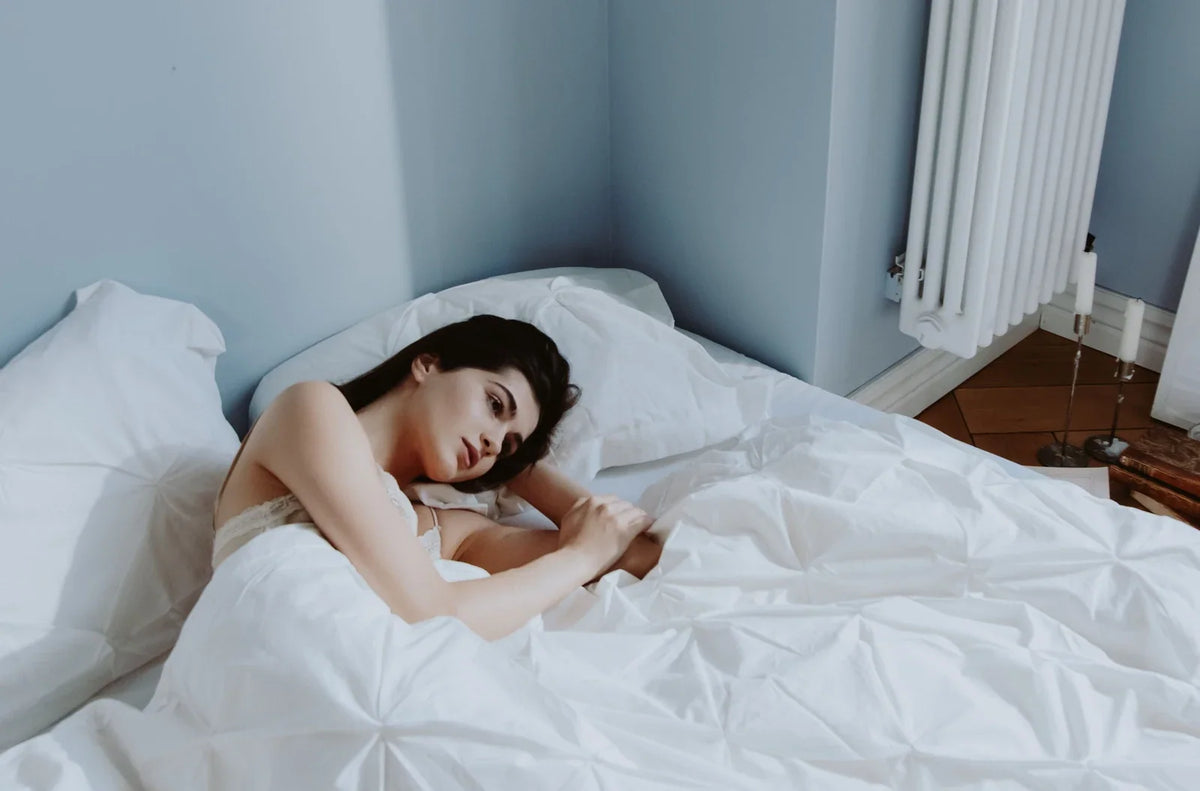
You slept eight hours and woke up feeling like you barely slept. When that happens night after night, the problem is rarely your hours. It is what those hours were made of: fragmented sleep, late caffeine, alcohol, an irregular schedule, or interrupted breathing. Fix the quality first: a steady wake time, an earlier caffeine cutoff, and a dark, cool room.
Eight Hours in Bed Is Not Eight Hours of Sleep
Sleep researchers make a simple distinction. There is time in bed, and then there is actual sleep. Between falling asleep, brief awakenings you will never remember, and the minutes it takes to drift off (sometimes interrupted by a hypnic jerk), a person who spends eight hours in bed often sleeps closer to seven. That gap alone does not explain whole days of exhaustion. But it is the first clue that the clock on your nightstand tells only part of the story.
The rest of the story is about quality. Sleep is not one flat state. It moves through light sleep, deep sleep, and REM in roughly 90-minute cycles, and your body does its most important repair work in deep sleep and REM. You can lie still for eight hours and get very little of either. A noisy room, a restless partner, alcohol, or a bedroom that is too warm can keep pulling you into light sleep just when you should be going deep. You wake up on time, technically rested by the clock, and your body never got what it came for.
Most of us also overestimate how much we actually sleep. When researchers compare sleep diaries with wrist trackers, people consistently report more sleep than the device records. The missing minutes are the brief awakenings scattered through the night: rolling over, a passing car, a partner shifting, a bathroom trip you barely register. None of them feel like "being awake." Together they can quietly shave an hour off your night while leaving your memory of it intact. If you use a tracker, look at the pattern across weeks, not the exact minutes of any single night. Trackers estimate sleep stages from movement and heart rate; they are good at showing trends and bad at precision. A week of restless-looking nights is a signal worth acting on even if no single number proves anything.
You May Be Paying Down a Debt You Can No Longer Feel
Here is the finding that changed how sleep scientists think about "enough." In a well-known study at the University of Pennsylvania, healthy adults were limited to four, six, or eight hours in bed for fourteen nights while researchers tested their attention and reaction time every day. The people restricted to six hours or less ended up performing as badly as people who had gone one to two full nights without any sleep. The unsettling part: their own ratings of how sleepy they felt barely moved. They were measurably impaired and could not feel it anymore. For what happens when sleep loss goes much further, see how long you can go without sleep.
If you have been running short on sleep for months, one good eight-hour night will not clear the balance. You are paying down a debt, not resetting a counter. That may be why a single early night feels like it did nothing. It takes a stretch of consistent, full nights before the fog starts to lift. If your schedule has been rough for a while, give it two weeks of steady bedtimes before you judge the results. Our piece on whether you can catch up on sleep on weekends explains why irregular catch-up rarely settles the account.
The Alarm Can Steal Your Morning
Sometimes the tiredness is only in the first hour, and that has a different explanation. If your alarm drags you out of deep sleep in the middle of a cycle, you wake up with what scientists call sleep inertia: that heavy, foggy, almost-drunk feeling where simple decisions feel hard. It is a real physiological state, not laziness, and it usually fades within an hour. If your grogginess reliably lifts by mid-morning, the alarm timing may be the whole story. We wrote a full guide to why you feel groggy after waking and how long it lasts, including the small timing shifts that help.
The Usual Suspects, in the Order Worth Checking
Most cases of tired-despite-eight-hours come down to a short list. Work through it in this order, because the first items are the most common and the easiest to test.
Caffeine is still in your blood. Caffeine has a half-life of about five to six hours, longer for some people. A coffee at 4 p.m. is still doing laps at midnight, and it does its damage quietly: you fall asleep fine, but your deep sleep gets thinner. Our caffeine curfew guide walks through what time to stop drinking coffee based on your bedtime. If you drink coffee after lunch, this is suspect number one.
Alcohol helps you fall asleep and ruins the rest. A drink makes the first part of the night feel easy. Then it suppresses REM sleep, and as your body clears the alcohol, the second half of the night gets lighter and more broken. You may not remember waking up. You will remember feeling flat the next day. If you drink most evenings, try two alcohol-free weeks and watch your mornings.
Your schedule keeps shifting. Eight hours starting at 10 p.m. is not biologically the same as eight hours starting at 2 a.m. Your internal clock expects sleep at roughly the same time every day. Sleeping in three hours late on weekends is, in clock terms, like flying two time zones and back every week. Researchers call this social jet lag, and it leaves people tired even when their total hours look fine. Keep your wake time steady, even on weekends, and let bedtime follow. Morning light helps anchor the clock: step outside or open the blinds soon after you get up, and your body gets a clearer signal about when night should start.
Light is getting in, at both ends of the night. Your brain reads light as daytime, even through closed eyelids. Streetlights, a hallway glow, or a bright phone screen in the last hour before bed can all delay the signal that tells your body to wind down. If you are sensitive to light while sleeping, start with the room itself: blackout the real sources first. A sleep mask helps with whatever the room cannot fix. A weighted sleep mask adds gentle pressure that many light sleepers find settling, and ours offers full eye-to-ear coverage.
You scroll until the last minute. An hour of feeds before bed does two things: the light pushes your clock later, and the content keeps your mind switched on. Put the phone down thirty minutes before bed, dim the lights, and give your brain a boring runway. Our guide to winding down after scrolling has a simple version that actually sticks.
Your breathing is interrupted. This one deserves care, not self-diagnosis. Loud snoring, waking up gasping, a partner noticing pauses in your breathing, morning headaches, or a dry mouth can all point to interrupted breathing during the night, which fragments sleep badly. None of these prove anything on their own. But if several of them sound familiar, it is worth a conversation with your doctor, because this is one cause that willpower and bedtime routines cannot fix. If a snoring partner is the one fragmenting your sleep, earplugs and a mask can buy you quieter nights while the bigger question gets sorted.
The Second Half of the Night Does Different Work
Your sleep is not evenly divided. The first half of the night is heavy on deep sleep, the physically restorative kind. The second half is heavy on REM, the stage tied to memory, learning, and emotional processing. This is why some disruptions cost more than they look like on the clock.
Alcohol is the classic example. It sedates you into the first half, so the night feels solid, then fragments the second half exactly when your REM should be peaking. Late-night noise works the same way in reverse: a partner who snores, traffic that picks up at 5 a.m., or a room that gets bright at dawn will chew through your REM-rich hours while leaving the deep-sleep hours untouched. You wake up after "eight hours" missing the specific stages your brain needed most.
This is also why sleeping in does not fully repair a broken night. Extra morning hours add mostly light sleep on top of a REM deficit. The repair that matters happened, or did not happen, between roughly 2 a.m. and 6 a.m. Protect those hours and the rest of the night gets easier: keep the room dark through dawn, keep noise out of the last third of your sleep, and be honest about the drink that makes the first half feel fine.
A One-Week Experiment
You do not need to overhaul your life. You need one clean week of data. Try this:
- Pick a wake time and keep it for seven days, weekends included. Let bedtime land where it lands.
- Move your last coffee earlier, or cut afternoon caffeine entirely. No caffeine after early afternoon is a good first test.
- Skip alcohol for the week and notice the second half of your nights.
- Make the room cool, dark, and quiet. Around 18 to 20 degrees Celsius suits most people. Fix the actual light sources rather than tolerating them.
- Put the phone away thirty minutes before bed.
One week is not a cure. It is a diagnostic. If your mornings change, you have found your lever. If nothing changes after two genuinely consistent weeks, that is useful information too, and it is worth bringing to a doctor.
When It Is Worth Talking to a Doctor
Most tiredness after full nights has ordinary causes and ordinary fixes. But some patterns deserve professional attention rather than another routine tweak: loud, nightly snoring; waking up gasping or choking; someone else noticing pauses in your breathing; morning headaches that keep recurring; or daytime sleepiness so strong it affects driving or work, no matter how long you sleep. This article is not a diagnosis, and it is not meant to be one. It is a map of the common causes, and a nudge to rule them out in order.
Frequently Asked Questions
Is eight hours of sleep enough for everyone? Not exactly. Most adults do well on seven to nine hours, but individuals vary, and some people genuinely need more or less. The better test is how you feel and function during the day across a few consistent weeks, not a single number.
Why do I feel more tired on days I sleep longer? Oversleeping on weekends usually means your weekday schedule left a debt, and the extra hours come with a shifted clock. Sleeping in three hours late confuses your internal timing, so you can wake up groggier than on a normal day. Steady wake times beat long lie-ins.
Can one bad night make me tired even if I usually sleep well? Yes, but usually only for a day. One short or broken night mostly affects the next day, and a normal night after it clears the effect. Tiredness that lasts weeks points to a pattern, not a single night.
Will napping fix it? A short nap of around twenty minutes can take the edge off an afternoon slump. Long or late naps can steal from the coming night and make the underlying problem worse. Naps are a bridge, not a fix.
Should I buy a sleep tracker to figure this out? A tracker can be useful as a diary, not as a diagnosis. It is good at showing patterns: restless second halves of the night, big differences between weekdays and weekends, or a bedtime that drifts later every week. It is not reliable at telling you exactly how much deep sleep you got. Use the trends to pick one thing to change, then watch whether the trend moves.
I do not snore. Could my breathing still be the problem? It is less likely, but fragmented sleep has many causes. If you have ruled out caffeine, alcohol, schedule, light, and noise and you are still exhausted after full nights, a doctor can help you look further. Bring notes about your actual sleep times for two weeks; it makes the conversation much more useful.
*If light is the thing that keeps pulling you out of deep sleep, a weighted sleep mask is a small, quiet intervention: full eye-to-ear coverage, and gentle weight that helps many light sleepers settle. Our weighted sleep mask is a gently weighted wraparound design that keeps your eyes gently covered.*
*Further reading: Sleep Inertia: Why You Feel Groggy After Waking Up (and How Long It Lasts) · Caffeine Curfew: What Time Should You Stop Drinking Coffee? · Can You Catch Up on Sleep on Weekends? · How to Wind Down After Scrolling Before Bed*



Share:
Sleep Paralysis: Why You Wake Up and Can’t Move
Should You Nap After a Bad Night’s Sleep?