

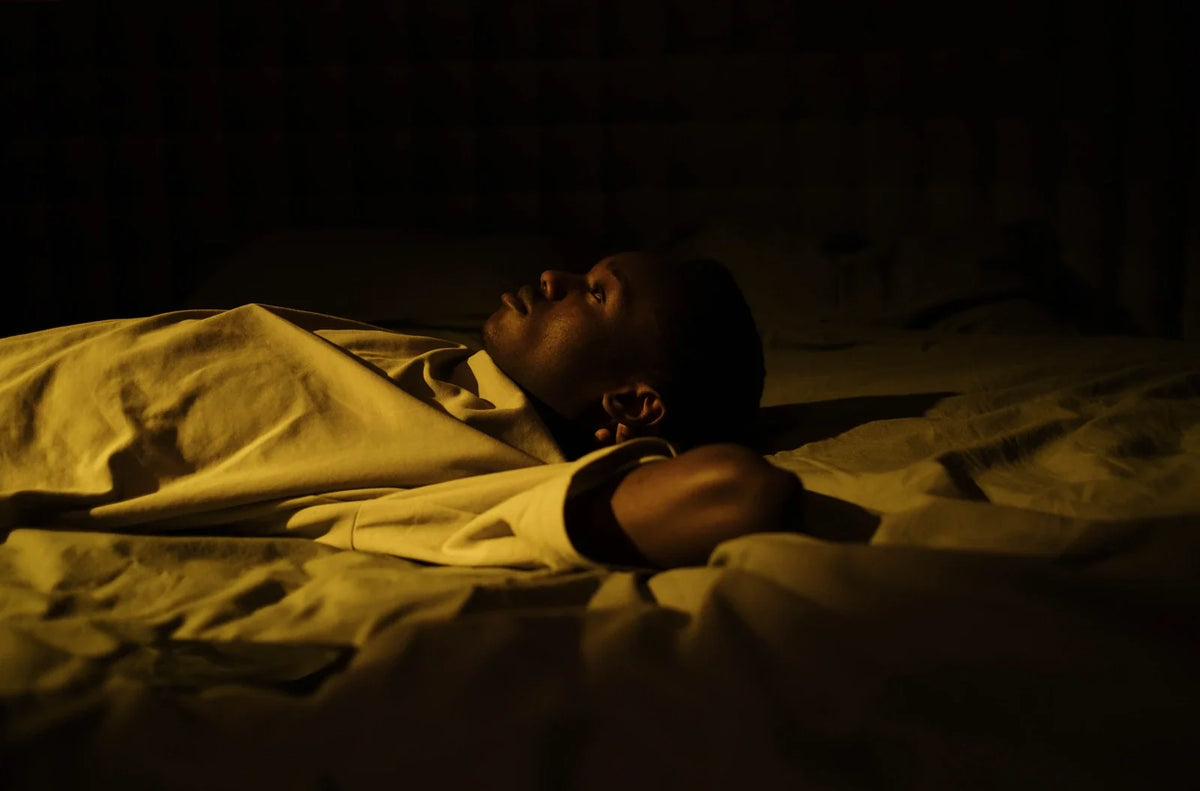
Why don't you remember falling asleep? Research suggests that noticing the transition and remembering it afterward are different things. Your sense of whether you are awake can differ from a sleep recording, and experiences close to sleep onset may not leave a clear memory. There is no single, fully settled explanation for everyone's missing moment.
You might remember turning onto your side, thinking about tomorrow, and then hearing the morning alarm. The gap can feel strange. It does not mean you should be able to find a precise instant when sleep began, or that everyone experiences the transition in the same way.
Feeling awake is not the same as measuring wakefulness
Researchers identify sleep using more than a person's impression. Sleep studies record signals including brain activity and eye movements. The National Heart, Lung, and Blood Institute describes the first stage of non-REM sleep as the transition between wakefulness and sleep.
What that transition feels like is another question. In a 2010 experiment, 20 young adults completed monitored naps and were awakened at different points to describe their experience. How much control they felt over their thoughts, and how logical those thoughts seemed, helped predict whether they believed they had fallen asleep.
It was a small laboratory study, not a way to diagnose your own night. But it illustrates why “I was still thinking” does not provide a reliable boundary between waking and sleeping. A report about your thoughts and a recording of your sleep answer related, but different, questions.
Remembering the last few moments is a separate problem
A 1994 study of memory around sleep onset tested people's memory for word pairs they had heard just before falling asleep. After ten minutes of sleep, participants had difficulty deliberately recalling or recognizing some of that recently presented material. A condition with only thirty seconds of sleep did not show equivalent deficits.
The result was not a complete shutdown of memory: a different, implicit memory measure appeared preserved. Nor did the experiment directly explain every person's recollection of falling asleep. Its useful contribution is narrower: something can happen near sleep onset without remaining clearly available to conscious recall afterward.
So the last thought you remember is not necessarily an exact timestamp. Remembering “I was planning breakfast” tells you what stayed in memory, not precisely when the night's sleep began.
Does the brain have a switch after all?
It is tempting to explain the missing moment by saying sleep is always a slow fade with no boundary. That is too simple. Research published in 2025 identified a nonlinear transition, described as a tipping point, in recordings of brain activity around sleep onset.
A measurable change in brain activity does not establish that you can feel it happening or will remember it in the morning. The physiological transition, your judgment at the time, and your later recollection still need to be kept separate.
“Did I sleep at all?” deserves a careful answer
This explanation is not permission to dismiss a difficult night. If you felt awake for hours, an article cannot tell you how much you actually slept. It also cannot decide whether you have insomnia or whether a device's estimate is correct.
For a useful record, write down both what you recall and how the next day feels. “I do not know when I fell asleep; I felt exhausted at work” is meaningful information. You do not have to replace it with a confident number. Our guide to keeping a sleep diary explains how to use estimates without watching the clock all night.
If insufficient sleep is affecting daily activities, the NHLBI advises speaking with a doctor. A diary for one or two weeks can help that conversation, but you do not need a perfect record before asking for help.
You do not have to catch yourself falling asleep
There is no need to turn tonight into an experiment with repeated alarms or checks. If checking the time has become part of the worry, our guide to leaving the clock alone at night offers a smaller practical change.
Deal with ordinary comfort separately from the mystery. If unwanted light bothers you, adjust it at the source. A comfortable wraparound sleep mask is another optional way to block light around your eyes, not a treatment for insomnia or a way to measure sleep.
You can remember an evening without remembering its final second. The more useful question is whether you are getting the rest you need, not whether you witnessed the exact moment it started.



Share:
Can't Sleep? Try Staying Awake: Paradoxical Intention, Explained
How to Choose the Right Pillow for Your Sleep Position