

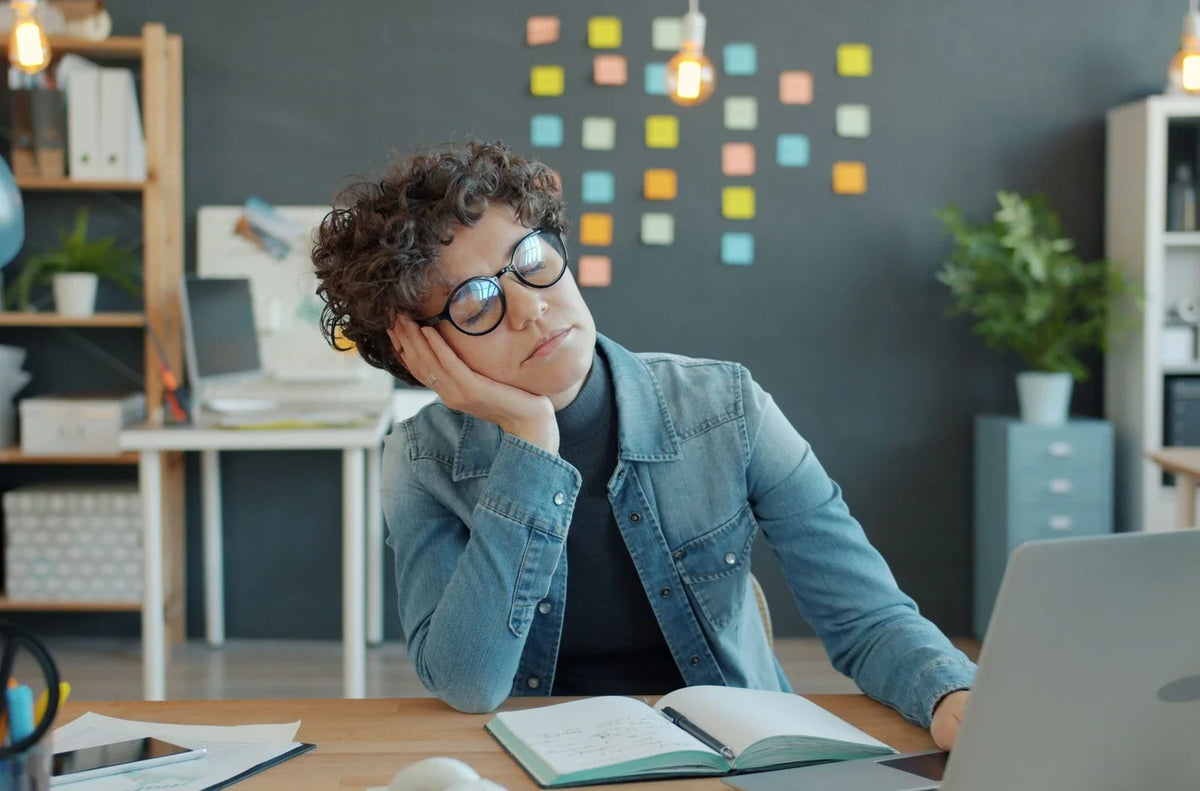
Yes, and lunch is only part of the story. Most people hit a low in alertness in the afternoon, between 2 and 4 p.m., about seven to nine hours after waking. Your body clock builds a dip into every day, and a short night or a heavy meal can make it deeper. A short nap or a walk lifts it.
Frequently asked questions
Is it normal to feel sleepy every afternoon?
Yes. The afternoon dip is one of the most common patterns in human sleep. It shows up in laboratory studies, in office workers, in students, and in people who skip lunch entirely. The timing shifts with your body clock: morning people tend to feel it earlier, evening people later. The dip itself is normal. What varies is how deep it runs, and that depends mostly on how well you slept the night before.
Is lunch the cause?
Only partly. A large or heavy lunch can deepen the dip, especially after a short night. But the dip itself is not caused by eating. In a 2015 study published in PLOS ONE, researchers tested 25 well rested adults on a task switching test in the morning, after lunch, and in the late afternoon. Accuracy got worse after lunch even in the control groups, and the authors noted that the post lunch dip is not fully explained by eating. It reflects a 12 hour rhythm in the body clock, a smaller echo of the deep low that comes in the middle of the night.
Why does it hit at the same time every day?
Because it is driven by your internal clock, not by your schedule. Sleep researchers describe alertness as the result of two forces working together. One is sleep pressure, which builds the longer you stay awake. The other is your circadian rhythm, a roughly 24 hour cycle that pushes alertness up and down on a fixed pattern. That cycle has two low points: a deep one in the small hours of the night, and a shallow one in the early afternoon. That is why the slump arrives on schedule, day after day, whether you ate a big lunch, a light one, or nothing at all.
Does a nap actually help?
Yes, if it is short and early enough. In the same 2015 study, a 30 minute nap before the afternoon test improved task switching accuracy, and bright light exposure did much the same. For most people, 10 to 20 minutes is the sweet spot: long enough to take the edge off, short enough to wake before deep sleep makes you groggy. Keep it before about 3 p.m. so it does not steal sleep from the coming night. Our guide to how long a nap should be covers the timing in more detail.
When should I worry about afternoon sleepiness?
When it is severe, daily, and does not improve after a week or two of regular sleep. Falling asleep while driving, struggling to stay awake in meetings every day despite seven to nine hours in bed, or loud snoring with gasping or pauses in breathing are all reasons to talk to a doctor. Those signs can point to a sleep disorder, and a sleep study is the way to find out. This article cannot diagnose anything. It can only help you tell an ordinary afternoon dip from something that deserves a check.
What the afternoon slump actually is
The slump has a shape. Alertness climbs through the morning, peaks late in the morning, then slides. The slide usually starts around 1 or 2 p.m. and bottoms out somewhere between 2 and 4. By late afternoon it lifts again, which is why many people feel a second stretch of energy in the early evening before the night low arrives. A day can feel like two different days split by a foggy middle.
What declines first is sustained attention. Tasks that need you to stay alert without much happening, proofreading, monitoring, reading the same paragraph twice, are where the dip bites hardest. Reaction time slows and working memory gets thinner. In the 2015 PLOS ONE study, the clearest change was in task switching, the ability to move between two rules without making mistakes. After lunch, people in the control groups made more errors when they had to switch. It was not that they could not do the task. It was that the cost of switching went up.
Your body gives the same signal in other ways. Core body temperature dips slightly in the early afternoon, mirroring the much larger drop that comes at night. Eyelids feel heavier and yawning increases. None of this is a flaw in your character or your work ethic. It is a scheduled low in a system that was built to rest in the middle of the day.
Why lunch is not the main cause
The lunch explanation feels right because the timing lines up. You eat, then you feel sleepy. But the order of events is not proof. The strongest evidence against lunch as the main cause comes from studies that removed food from the picture. In laboratory protocols where people ate nothing, or ate the same small liquid meal every hour, the afternoon dip still appeared. A meal cannot be the cause of something that happens without one.
That does not mean food is irrelevant. Food can make a real dip worse, and the research on that point is worth reading carefully. In a 2012 study, 12 young men slept only five hours, then drove a simulator for two hours in the afternoon. After a large lunch of 922 calories they showed more sleepiness and more driving incidents than after a light lunch of 305 calories. The important detail is the condition: these were sleep restricted people. A big meal amplified a dip that was already deep because the night before was short.
The same logic applies to the popular sugar crash story. A heavy meal rich in refined carbohydrate can leave you feeling sluggish, and blood sugar does rise and fall after eating. But the evidence connecting those swings to afternoon sleepiness is thin: a 2025 review that screened 521 papers found only nine that measured both blood sugar and sleepiness, and only one that measured both at the same time. If your lunch leaves you sleepy every day, the meal is worth changing. It is just probably not the whole story.
Our article on why you get sleepy after eating covers the food side in full, including what happens after a meal and why some meals hit harder than others. The short version is this: eating explains the extra depth of a bad afternoon. It does not explain the afternoon itself.
What makes the dip deeper
Four things turn an ordinary dip into a wall. The first, and by far the biggest, is short sleep. The dip is much shallower in a well rested person and severe in a short slept one. Most people who describe a crippling afternoon slump are describing sleep debt with a circadian trough on top. The second is a heavy lunch, especially one eaten quickly at your desk. The third is a warm, stuffy room with still air. The fourth is monotony: a long meeting, a long drive, or an hour of repetitive screen work gives the dip nothing to push against, so it wins.
Caffeine deserves a note here, because people often blame a caffeine crash for the slump. Caffeine does not really crash. It blocks the sleepiness signal for a while, and when it wears off, the sleepiness that was building underneath shows up all at once. A morning coffee that fades at 2 p.m. does not cause the slump. It just stops hiding it. Our guide to when to stop drinking coffee explains the timing, including why a dose late enough to help at 3 p.m. still has about half its caffeine in you at 9 p.m., which costs you that night's sleep and deepens tomorrow's dip.
What actually helps
The most useful move is not to fight the dip but to plan around it. The dip is predictable, so you can schedule the day to match it instead of pretending it does not exist. Do your hardest thinking in the morning, when alertness peaks, and save lower demand work for the afternoon: email, admin, routine calls, anything that tolerates a slower pace.
A short nap is the best studied fix. Ten to twenty minutes is enough for most people. Keep it before about 3 p.m., and keep the room dark and cool. A dark room matters more than people think, because even a little light through closed eyelids can keep a waking brain alert. A weighted sleep mask sits gently over the eyes and blocks that light. It will not fix the dip itself, and it will not make up for a short night, but for a daytime nap it removes the one thing a mask can actually fix, which is the light. Set an alarm. Waking from a short nap on purpose is the whole point.
Bright light is the other fix with real evidence behind it. In the 2015 study, 30 minutes of bright blue enriched light at 2,000 lux worked about as well as a nap for task switching accuracy. You do not need a light box to get the effect. Step outside for ten minutes. Daylight on a cloudy day is still far brighter than office lighting, and the combination of light and movement is stronger than either alone.
Movement is the simplest tool and the easiest to skip. A short walk, even five minutes around the block, raises alertness more reliably than another cup of coffee, and it does not cost you sleep later. If you cannot leave the building, stand up and walk to the far end of the floor. The goal is not exercise. It is to break the stillness that lets the dip settle.
Caffeine still has a place, used early. A cup of coffee or tea in the early afternoon can mask the dip for an hour or two. The trade is the night: caffeine has a half life of roughly five to six hours, so a 3 p.m. coffee is still half present at 9 p.m. If you use caffeine to beat the dip every day, and your nights are getting shorter, the caffeine may be feeding the very problem it seems to solve. A lighter lunch helps too, smaller, with protein and vegetables first, eaten away from the screen. It will not erase the dip, but it takes away the extra weight that makes a bad afternoon worse.
What to do tonight so tomorrow is easier
The afternoon dip is also a message about the night before. The single best predictor of how bad tomorrow afternoon feels is how long and how well you slept last night. That makes the evening the real place to fix the slump. Keep a steady wake time, even on weekends, so the clock has a fixed anchor. Get outside in morning daylight, which sets the clock for the whole day. Our guide to morning sunlight and sleep explains how little light it takes and why the timing matters.
Then protect the night. Give yourself enough time in bed for seven to nine hours of sleep, and keep the last hour before bed low and quiet. If you are not sure how much sleep you need, our guide to what time to go to bed works backward from your wake up time. And if your sleep itself feels light or broken, our guide to getting more deep sleep covers the habits that make the biggest difference, starting with a regular schedule and a cool, dark room.
None of this is dramatic. That is the point. The dip is an ordinary feature of an ordinary day, and the fixes are ordinary too. A steady wake time, daylight in the morning, a lighter lunch, a short nap or a walk in the afternoon, and caffeine kept to the morning. Do those for a week and the afternoon usually softens. If it does not, and the sleepiness stays severe, that is information, not failure, and it is worth taking to a doctor.
When the dip deserves a check
Most afternoon sleepiness is normal. A few patterns are not. Talk to a doctor if you fall asleep while driving or in the middle of a conversation, if you feel severely sleepy every day despite seven to nine hours in bed for two weeks or more, or if a partner tells you that you snore loudly, gasp, or stop breathing during the night. Those signs can point to sleep apnea or another sleep disorder, and they need a proper assessment, not a stronger coffee.
The same applies if the sleepiness arrived suddenly, or came with other changes: a new medication, a big weight change, low mood that will not lift, or a schedule that flipped overnight. A doctor can check for the common causes and order a sleep study if one is needed.
The short version
The afternoon slump is your body clock, not your lunch. It arrives about seven to nine hours after you wake, usually between 2 and 4 p.m., because your circadian rhythm has a shallow low point built into every day. A heavy meal and a short night can make it deeper, but neither one causes it. The best response is to work with it: hard tasks in the morning, a short nap or bright light in the afternoon, movement instead of another coffee, and a steady night of sleep to keep tomorrow's dip shallow. And if the sleepiness is severe every day, let a doctor take a look.



Share:
Does a Coffee Nap Actually Work?
Can a Nap Help You Think More Creatively?