

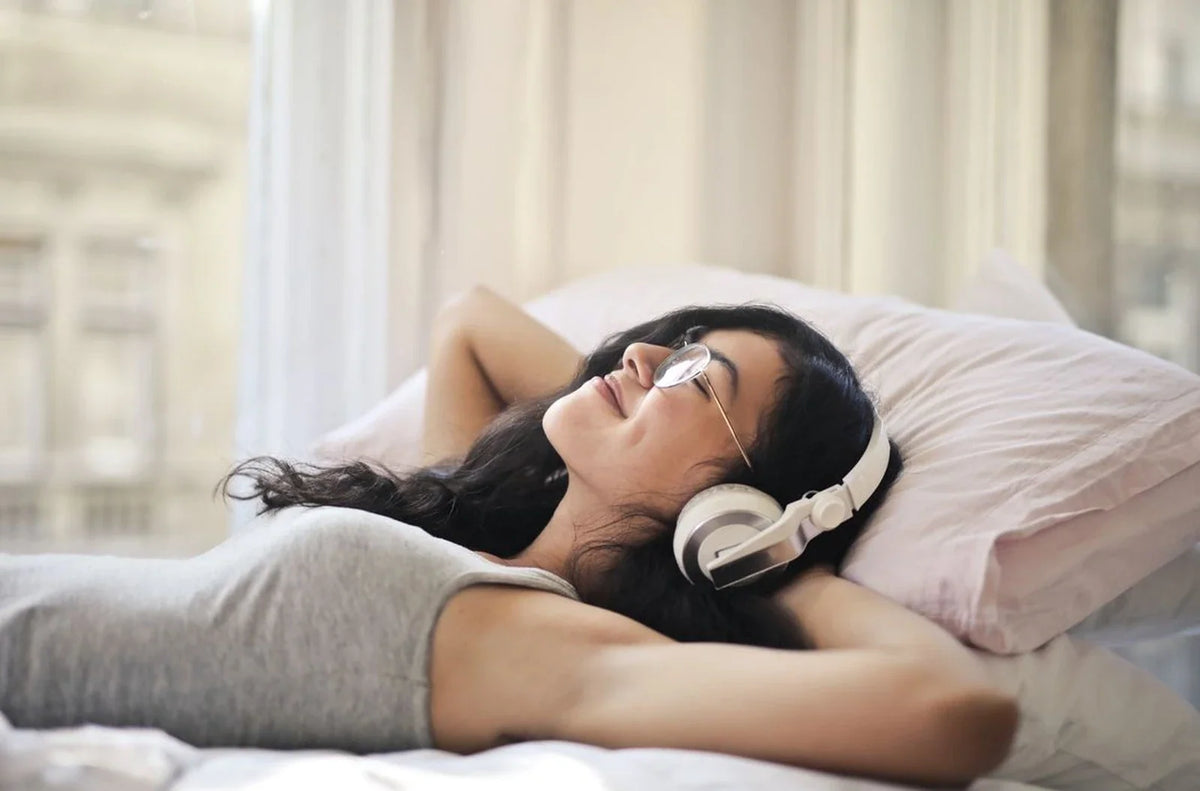
If a slow song at night has ever made your shoulders drop, you have felt the short answer. Music can help some people fall asleep faster and sleep better, but it is not a proven treatment for poor sleep, and the wrong kind of music can keep you awake. The difference comes down mostly to tempo, lyrics, and volume.
What the Research Actually Found
The strongest summary so far comes from a 2025 review in Frontiers in Sleep by Ethan Pan and Wei Wang. The authors searched the medical literature from 1990 to August 2024 and kept 21 randomized controlled trials of music and sleep in adults. Across those trials, listening to music was linked to shorter time to fall asleep, better sleep efficiency, and longer total sleep time. The pattern held up in earlier combined analyses too. A 2022 meta-analysis of 13 trials with 1,007 adults with insomnia found moderate certainty evidence that music groups reported better sleep quality than groups with no intervention or usual care, with an average improvement of 2.79 points on the Pittsburgh Sleep Quality Index, a scale that runs from 0 to 21, where higher scores mean worse sleep. A 2018 analysis of 20 trials with 1,339 adults with primary insomnia reached a similar place, ranking music listening as the most effective option among the approaches it compared for overall sleep quality scores.
Those numbers deserve a plain reading. An improvement of a few points on a sleep questionnaire is meaningful for a person who sleeps badly, but it is not a transformation, and it is not the same as curing a sleep problem. Most trials ran for three months or less, and most studied adults who already had sleep complaints. The 2025 review also only included trials that reported a statistically significant improvement, so studies with no effect were left out by design. Music looks like a low cost habit that helps many people sleep a little better. It does not look like a replacement for medical care when sleep problems persist.
One more honest detail is worth knowing before you build a playlist. A large share of the trials used music chosen by researchers, not by the listeners, often slow classical or new age pieces, with little explanation of why a given piece was chosen. The evidence therefore tells us more about a type of music than about any single song. A later analysis of real world streaming data, cited in the same review, found that the music people actually play to sleep is softer, slower, and more often instrumental than average music, but spans many more genres than the classical pieces used in trials. Lab evidence and bedroom habit point in the same direction, even if they do not match exactly.
Why Slow Music Helps the Body Wind Down
Falling asleep is not only a mental event. The body has to shift gears: heart rate slows, breathing slows, and alertness fades. The review points to a simple reason slow music fits that shift. Music at 60 to 80 beats per minute lines up with an average resting heart rate, and the authors describe that tempo as mimicking the body's natural rhythms. One proposed explanation is that such music lowers stress hormones and activates the calming branch of the nervous system, which in turn influences heart rate, breathing, and blood pressure. The authors are careful to add that the exact mechanism is likely complex and still not mapped in detail, so this should be read as a plausible path, not a settled fact.
The mental side matters just as much. A racing mind is one of the most common reasons people lie awake, and a gentle sound gives that mind something undemanding to follow. Lyrics demand language processing, sudden loud passages demand attention, and a favorite song with strong memories can stir up feelings that wake you further. Slow, simple, instrumental music does the opposite. It occupies attention lightly, which leaves less room for replaying the day or planning tomorrow. If your mind tends to race at night, that light occupation of attention may be the main benefit.
What Kind of Music Works Best
Across the trials, the winning pattern was consistent. The most effective music was slow, at 60 to 80 beats per minute, with soft and smooth melodies, a simple structure, and no lyrics. It was often classical or new age, but the review also notes benefits from culturally familiar music, nature sounds, and, for religious listeners, soothing religious music. The common thread is not a genre label. It is music that stays calm and predictable from start to finish.
Lyrics are the clearest thing to avoid. The review notes that trial designers deliberately left out lyrics, accented beats, strong percussion, and syncopation, the off beat patterns that make music feel surprising. Lyrics can activate language processing and keep the mind active, while sudden accents can startle a listener who is trying to drift off. That is why a beloved song with words, even a slow one, often works less well for sleep than a plain instrumental piece you barely notice.
Familiarity helps, but only up to a point. Music you already know and find calming can work well, because you are not spending attention on something new. Music tied to strong memories is a different case. A song from a difficult time, or one you associate with dancing or a loud concert, can stir up feelings that work against sleep, even if the tempo is slow. The practical test is simple: if you notice the music, it may be too interesting. The pieces that work best for sleep tend to fade into the background.
Timing and volume complete the picture. Most trials used 30 to 45 minutes of listening before bed, at a comfortable low volume. The review stresses that this window should be read as common practice rather than a proven optimum, since few trials directly compared different lengths. Volume matters more than length. The music should sit as a gentle backdrop, not as a performance you lean in to hear.
What Can Keep You Awake Instead
The same research that supports slow music also explains why so many sleep playlists fail. The most common mistake is picking music by mood label rather than by sound. A playlist called relaxing can still contain songs with lyrics, sudden dynamic shifts, or a tempo well above 80 beats per minute. Another common mistake is letting autoplay decide. An algorithm that follows one calm track with a louder or faster one can undo the whole wind down. If you use a streaming service, pick the tracks yourself, in advance, and set playback to stop on its own.
Headphones deserve a thought too. The review notes that headphones can create a sense of personal space and comfort, but they can also be physically uncomfortable through the night, especially for side sleepers. A small speaker at low volume avoids that trade off. If you share a room, a speaker is not always polite, so comfort and consideration, not sound quality, should decide. Whatever you use, set a sleep timer so the sound stops, rather than playing all night. The trials studied a wind down session before bed, not all night playback.
There is also a trap that has nothing to do with the music itself. Searching for the perfect track can become its own delay. Scrolling through playlists and previewing songs keeps your eyes open and your phone lit, which is the opposite of winding down. If you are still choosing music twenty minutes after you meant to be asleep, the choosing is the problem. Pick tomorrow night's music during the day, when the choice costs you nothing.
Music, Background Noise, and ASMR Are Not the Same Tool
It helps to separate three sound habits that are often lumped together. Steady background noise, such as white, pink, or brown noise, mainly masks sudden sounds. It gives the ear a constant level to rest on, so a door closing or a car passing stands out less. Music works differently. It has melody, rhythm, and structure, and its effect comes from that structure slowing the body and occupying the mind lightly. ASMR works differently again. It relies on specific triggers, such as whispering or tapping, and on a tingling, calming response that many people do not feel at all. Our earlier pieces on white, pink, and brown noise and on whether ASMR helps sleep cover those two in detail: if steady noise feels too blank and ASMR does nothing for you, structured slow music may be the middle path that fits.
That distinction also explains why combining tools can backfire. Music plus a television, music plus a podcast, or music plus a conversation all ask the brain to track more than one stream, which is the opposite of winding down. One sound at a time, chosen in advance, is the pattern the trials support.
How to Try It for a Week
Testing music for sleep works best as a small, honest experiment over several nights, not as a single verdict after one song. Start by choosing your music during the day. Look for instrumental tracks at a slow tempo, with soft melodies and no sudden changes. Classical and new age pieces are the most studied starting points, but any familiar, calm, instrumental music that fades into the background can qualify. Avoid lyrics, strong percussion, and songs tied to strong memories for this test.
Set a simple routine around the music. Begin 30 to 45 minutes before you plan to sleep, in a dim room, at a low volume you can hear without effort. Put the phone face down, or use a small speaker, and set a sleep timer so playback ends on its own. If the phone is your player, a gently weighted wraparound sleep mask can cover the glow from the screen while the music plays. Music works best as one part of a regular wind down, alongside dim light and a fixed bedtime, rather than as a rescue tool on a single bad night. Our piece on a short bedtime meditation routine pairs naturally with this, since both aim at the same shift from alert to drowsy.
Judge the week by pattern, not by one night. Note whether you fall asleep a little sooner, wake less during the night, or feel a little steadier in the morning, and whether the effect holds across several nights. If nothing changes after a week of steady, slow, instrumental music at low volume, music may simply not be your tool. And if sleep problems persist for weeks, or come with loud snoring, long pauses in breathing, or daytime sleepiness that affects your work or driving, talk to a clinician rather than adding more playlists. Music is a habit, not a diagnosis or a treatment.
The Honest Limits
The case for sleep music is real, but it has edges that matter. First, the trials were short, mostly three months or less, so nobody can claim a proven long term benefit. Second, the review only included trials with significant results, and the authors name two studies with no significant effect, both in healthy young students without sleep problems. That does not cancel the positive trials, but it is a reminder that music helps some populations more than others. Third, blinding is hard in music trials: listeners know they are hearing music, so some benefit may come from expectation and routine rather than from the sound itself. The honest claim is modest: slow, instrumental music before bed helps many adults with sleep complaints sleep a little better, and it costs almost nothing to try.
It is also worth saying what music cannot do. It cannot make up for a wildly irregular sleep schedule, a bright room, or a night of heavy drinking, and it cannot replace care for a sleep disorder. As one calm piece of a steadier routine, it earns its place. As a fix that excuses everything else, it will disappoint.
Frequently Asked Questions
Does music help you fall asleep faster? For many adults with sleep complaints, yes, a little. Combined trial evidence points to shorter time to fall asleep and better sleep quality scores, especially with slow, instrumental music played before bed. The effect is modest, not dramatic.
What tempo is best for sleep music? The trials that worked best mostly used 60 to 80 beats per minute, close to a resting heart rate, with soft, smooth melodies and a simple structure. If the music feels slow, steady, and easy to ignore, it is probably in the right range.
Should sleep music have lyrics? Better without. Trial designers deliberately avoided lyrics, because words can activate language processing and keep the mind busy. Instrumental tracks, including classical, new age, and familiar calm instrumentals, are the safer starting point.
How long should I listen before bed? Most trials used 30 to 45 minutes before bed at a low, comfortable volume. Treat that as a starting point, not a rule. Consistency across nights matters more than exact minutes.
Can I fall asleep with headphones on? You can, but a small speaker is usually more comfortable, especially on your side, and a sleep timer matters either way. Sound playing all night is a different habit from the pre bed session the trials studied.
Music will not solve every bad night, and it does not need to. For many people, it is the gentlest way to mark the end of the day: a slow, familiar sound, played low, in a dim room, while the body does the rest of the work on its own. Pick the tracks during the day, let them fade into the background at night, and judge the habit by the pattern across a week.



Share:
Can a Bedtime To-Do List Help You Fall Asleep?
Why Do We Yawn When We're Tired?