

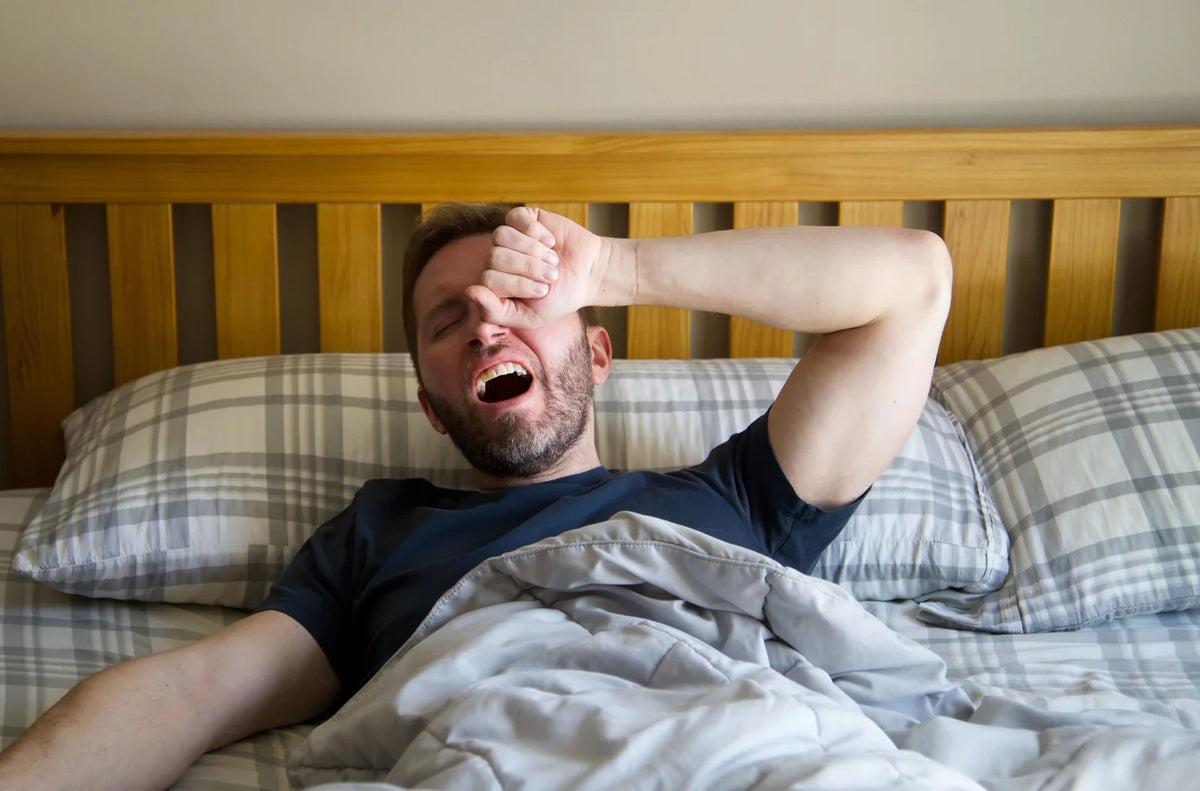
We often yawn when we are tired, especially around bedtime and waking. But scientists have not established one explanation for everything a yawn does. The familiar idea that yawning simply supplies extra oxygen is not well supported. A yawn can accompany sleepiness without telling you exactly how much sleep you need.
You may know the scene: the conversation is still interesting, the evening is going well, and suddenly your mouth opens before you can stop it. Or you wake after a reasonable night and yawn while putting the kettle on. Both fit a more complicated picture than “yawning means you slept badly.”
Why do we yawn near bedtime and after waking?
Yawning often appears around changes between sleep and wakefulness. In a 1987 diary study, university students recorded their yawning, stretching and sleep for a week. Yawns were most frequent in the hour before sleep and the hour after waking.
That observation describes when yawning happened in that study. It does not establish what a yawn is for, and it is not a timetable everyone has to follow. In particular, a morning yawn does not automatically mean the night failed to restore you.
It helps to separate two questions: “What was happening when I yawned?” and “What useful job did the yawn perform?” The first is easier to observe. The second is still being investigated.
Is yawning your body's way of getting more oxygen?
That explanation sounds plausible because a yawn includes a deep breath. However, a controlled experiment published in 1987 did not find the expected changes in yawning when participants breathed extra oxygen or gas with elevated carbon dioxide. Exercise that increased breathing also did not increase yawning.
The finding argues against the simple “not enough oxygen, therefore yawn” story. It does not make a yawn a test of your oxygen level, either. There is no useful reason to diagnose your breathing from an ordinary yawn or to start forcing deep breaths to make it stop.
So what is a yawn actually doing?
Researchers have explored several possibilities, including changes in alertness and temperature regulation. These are research questions, not interchangeable proven answers. Even an interesting physical change during a yawn does not, by itself, tell us its purpose.
For example, a 2026 MRI study described by its NeuRA research team found patterns of brain-fluid and venous-blood movement during yawning that differed from deep breathing. The team cautioned that the study did not directly test cooling or alertness explanations. Any possible role in waste clearance remains a question for further research.
That is a worthwhile finding without turning it into “yawning detoxes your brain.” It also gives no basis for treating deliberate yawning as a substitute for sleep. A clear answer can include an honest limit: we recognize the behavior much better than we understand all of its functions.
Why does someone else's yawn make you yawn?
Seeing another person yawn can trigger one of your own. People differ in how readily this happens. In a study of 328 participants, responses to a yawning video varied, and the researchers did not find that measured empathy explained that variation after accounting for age.
So there is no need to make a relationship test out of it. A partner who does not catch your yawn has not demonstrated a lack of care. Nor does a yawn during your story, on its own, prove that the story is boring. Asking “Are you getting sleepy?” is kinder and more useful than guessing what it means.
Can you tell how much sleep you need by counting yawns?
No precise sleep allowance can be calculated from a yawn count. A 1996 field study included a diary group of 45 people and found no relationship between their yawning frequency and the amount of sleep they had obtained beforehand. That does not mean sleep loss never affects yawning; it means yawning is an imperfect clue.
Look at the wider picture instead: your usual sleep opportunity, how you feel through the day, and whether you are unintentionally dozing. Our guide to sleep needs as you get older offers more context than a tally of yawns.
If a change is noticeable, you can keep a brief sleep diary. Note roughly when it happens, your sleep and naps, and how sleepy you feel. You do not need to watch every yawn or turn bedtime into another measurement project.
When should frequent yawning be checked?
MedlinePlus recommends contacting a health professional when yawning is excessive without an explanation, or comes with pronounced daytime sleepiness. You do not need to reach an invented daily number or finish a diary before asking for help.
For an ordinary evening yawn, the response can stay ordinary too. If you also feel sleepy, it may be a good moment to leave the last task for tomorrow. You do not have to solve the science of yawning before allowing yourself to rest.



Share:
Does Music Help You Sleep? What Research Says
How to Sleep With Noisy Neighbors Through the Wall (TV, Music and Voices)