

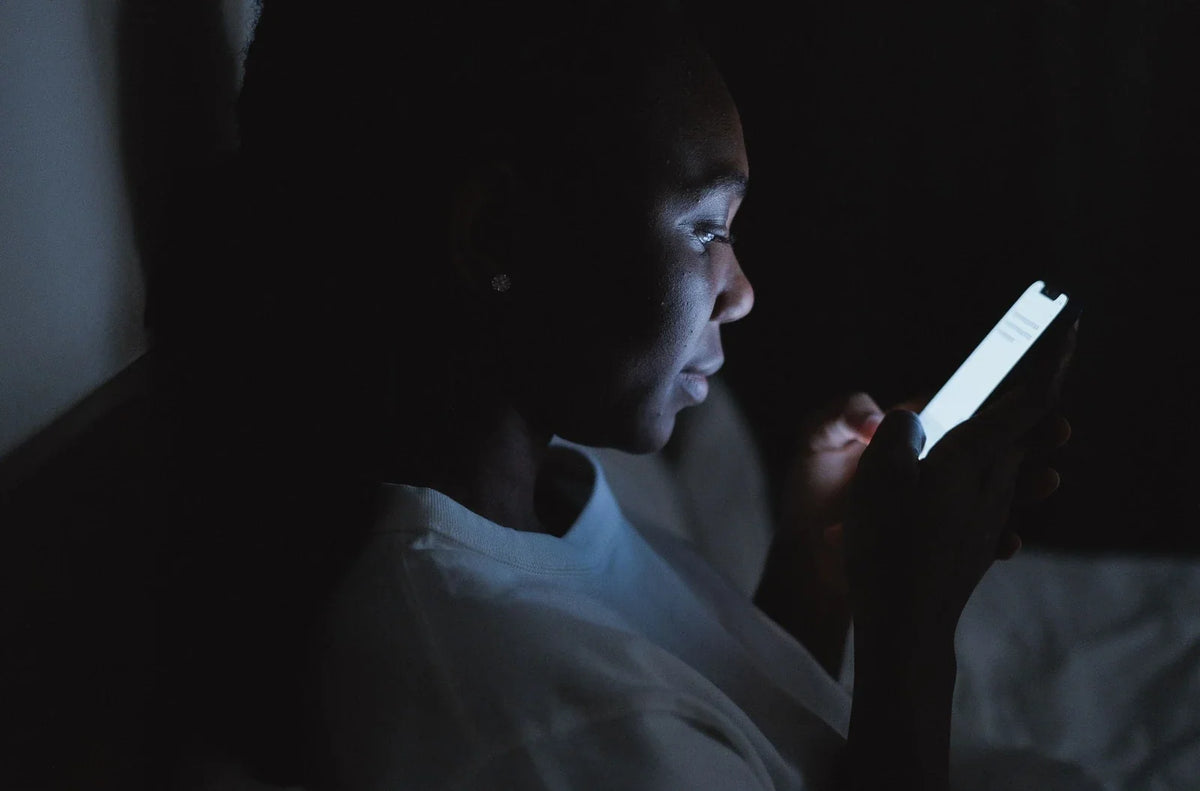
Doomscrolling in bed hurts your sleep because of what you read, not the glow of the screen. News and arguments keep your mind alert after you put the phone down, and an extra hour of screen time in bed means worse sleep. Put the news away earlier, keep the phone out of reach, and let the dark do the rest.
Frequently asked questions
Is doomscrolling really bad for sleep, or is it just the blue light?
Both play a part, but the content matters more than most people think. Blue light can delay sleepiness, yet the news itself keeps the mind working. A 2025 poll by the American Academy of Sleep Medicine found that 38% of adults say reading news on a phone or tablet before bed makes their sleep slightly or significantly worse. A large Norwegian study found that each extra hour of screen time after getting into bed was linked to a 59% higher chance of insomnia symptoms and 24 minutes less sleep, and it made no difference whether the screen time was social media or something else. What mattered was the time the screen took, and what it did to the mind.
Why can I not stop scrolling once I start?
Because the feed is built to keep you going, and because bad news grabs attention. Each swipe can bring something new, and the brain keeps checking for the next update. At night, when you are tired and your self control is low, that pull is stronger. The habit is not a character flaw. It is a normal brain meeting a feed that never ends.
Does turning on night mode or wearing blue light glasses fix it?
Not really. Night mode and glasses reduce some light, but they do nothing about the content. A 2025 review that pooled the trials of blue light blocking glasses found no clear improvement in how quickly people fell asleep or how long they slept. Light is one piece of the problem. The news you read is the larger one.
What should I do instead when I cannot sleep?
If you have been awake for about 20 minutes and the news is the reason, get up. Go to another room, keep the light low, and do something calm, like reading a paper book. Return to bed only when you feel sleepy. Lying awake with the phone only trains the brain to link the bed with being awake.
Will a sleep mask help if I doomscroll?
No, not while the phone is still in your hand. A mask blocks light, not news. It can help after you put the phone down, when darkness lets sleep arrive. But no mask can undo an hour of arguments and headlines.
What doomscrolling actually is
Doomscrolling is the habit of scrolling through bad news, social media, and comment threads long past the point where it is useful. The word caught on a few years ago, when the news cycle never seemed to stop, and it has stuck because it describes the feeling well. You are not reading to learn something. You are reading because stopping feels harder than continuing.
It is different from ordinary phone use before bed. Checking the weather or a message is a small task with an end. Doomscrolling has no end. The feed refills itself, the comments keep coming, and each post can pull a new emotion out of you. Anger, worry, sadness, and the urge to argue all show up, and each one wakes the brain up a little more.
The American Academy of Sleep Medicine asked about exactly this habit in its 2025 Sleep Prioritization Survey. The survey covered 2,007 adults across the United States, interviewed online between June 5 and June 13, 2025, and released in February 2026. Over one third of them, 38%, said that using a phone or tablet before bed to view news or current events made their sleep slightly or significantly worse. Among adults aged 18 to 24, the number rose to 46%. Half of all adults said they used a screen while in bed every day, and more than a quarter, 26%, said they put screen time ahead of getting the recommended amount of sleep. Only 14% said they never read news on their devices at bedtime.
Those numbers describe what people feel about their own sleep, not a lab measurement, so a poll cannot prove that the news caused the bad night. But it shows how common the habit is, and how many people connect it to their own poor sleep.
The numbers behind the habit
The clearest study of screens in bed comes from Norway. Researchers at the Norwegian Institute of Public Health used data from the Students Health and Wellbeing Study of 2022, covering 45,202 full time students aged 18 to 28. The results were published in Frontiers in Psychiatry in March 2025. Each additional hour of screen time after going to bed was linked to 59% higher odds of having symptoms of insomnia, and to 24 minutes less sleep. The striking part was what did not matter. The link was the same whether people were on social media, watching shows, reading, or playing games. The type of screen activity made no real difference.
The lead author, Gunnhild Johnsen Hjetland, put it plainly. The type of screen activity does not appear to matter as much as the overall time spent using screens in bed. The likely reason is time displacement. Screen use delays sleep by taking up time that would otherwise be spent resting. An hour of scrolling is an hour that is not sleep, whatever is on the screen.
That finding fits the doomscrolling question well, because doomscrolling is the habit that most easily stretches into hours. A short video ends. A news feed does not. And because the content is emotional, the hour it takes costs more than an hour of something boring. Time displacement explains the lost sleep. The content explains why the sleep that remains is lighter and harder to reach.
A second study, published in BMC Psychology in late 2025, looked at the emotional side directly. Researchers surveyed 663 adults aged 18 to 77 and found that doomscrolling went along with poorer sleep quality. Part of that link ran through nomophobia, the fear of being without your phone. Fear of missing out, by contrast, did not explain the link. The study was a one time survey, so it cannot show cause, but it points to a loop that many people will recognize. The phone stays close because being without it feels uneasy, and the phone in hand keeps delivering the news that keeps the mind awake.
None of these studies proves that the news ruins sleep on its own. All of them are surveys taken at one point in time, and people who sleep badly may reach for their phones more, not less. But the shape of the evidence is consistent. More screen time in bed goes with worse sleep, emotional content makes it harder to wind down, and the people who feel it most are the ones who scroll the longest.
Why the content matters more than the light
Blue light is real, and it is not the whole story. Light in the evening can delay the feeling of sleepiness, and the American Academy of Sleep Medicine advises avoiding blue light from handheld electronics for 30 to 60 minutes before bed. But the light from a phone is only one input, and it is a small one compared with what the screen is showing you.
Think about what actually happens during a doomscrolling session. A headline about a disaster raises your heart rate. A comment thread makes you angry. A post about money or health brings a worry you had put aside during the day. Each of these is a small alarm, and alarms are the opposite of sleep. Sleep needs the body to stand down. News tells it to stay on guard.
That is why the glasses and the night mode settings disappoint so many people. They change the light, and the light was never the main problem. A 2025 review that pooled the trials of blue light blocking glasses found no clear improvement in how quickly people fell asleep or how long they slept. The glasses may help with eye strain, but they do not calm a mind that has just read an hour of bad news.
The academy's own expert put the two pieces together. Dr. James Rowley, a past president of the American Academy of Sleep Medicine, noted that screen light paired with upsetting content can throw off the body clock. Light plus emotion is worse than either one alone. A dark room with a calm mind falls asleep. A dark room with a worried mind does not, and a lit room with a worried mind does worse still.
Put together, the picture has three parts. The screen steals time. The content raises alertness. And the loop keeps the phone close, because putting it down feels like missing something. Light is the least of it, which is why fixes aimed only at light keep failing.
Why it is so hard to stop at night
If doomscrolling were only a bad habit, willpower would fix it. It does not, because the habit is built on three forces that are strongest exactly when you are trying to sleep.
The first is the feed itself. Social media and news apps are designed around variable rewards, which means you never know whether the next swipe will bring something boring or something gripping. That uncertainty keeps you swiping. A feed that showed you the same ten posts would bore you in a minute. A feed that might show you something shocking at any moment holds you for an hour.
The second is negativity bias. The human brain pays more attention to threats than to good news, because noticing a threat once kept our ancestors alive. News feeds know this, and the posts that travel furthest are usually the alarming ones. At night, when the day's distractions are gone, a threatening headline lands harder.
The third is timing. By bedtime, you have spent a whole day making decisions and holding back impulses, and the part of you that says stop is tired. Researchers who study bedtime procrastination have found that people who resisted more temptations during the day had less self control left at night. The phone is the easiest temptation in the house. It is warm, it is beside you, and it asks nothing of you except one more swipe.
What actually helps
The fixes that work share one idea. Move the decision earlier, so that by bedtime there is nothing left to decide.
Set a news curfew. Pick a time, an hour before bed is a good start, after which the news apps close. Read the headlines earlier in the evening if you want them, and then let the day's news wait until morning. Almost nothing in the news changes between 10 at night and 7 in the morning, and the things that do change will still be there.
Charge the phone outside the bedroom. This is the single most effective step, because it removes the choice entirely. A phone on the nightstand is a decision you have to make every night. A phone charging in the kitchen is a decision you made once. Our guide to charging your phone outside the bedroom walks through the practical side, including the alarm clock problem. Most people who try it report the same surprise. The first nights feel strange, and then sleep gets easier.
If the phone must stay in the room, make it boring. Delete the news apps from the phone, or move them off the home screen and log out of them each evening. Keep only the dull tools, the alarm and the timer. A phone that can only show the time is not a phone you will scroll on.
Give the worry a place to go. Many people scroll because a thought will not let go, and the feed feels like doing something about it. Write the thought down instead. A short note on paper, one line about what you will check in the morning, is enough to let the mind release it. Our guide to quieting racing thoughts before sleep has more on this, including the simple writing exercise that works best for most people.
Replace the scroll, do not just remove it. A habit leaves a hole, and the hole fills itself with the easiest thing nearby. Put a paper book or a magazine where the phone used to sit. Keep the light low and the reading light. The point is not to read something important. The point is to give the mind something calm to do until sleep arrives. Our guide to winding down after scrolling before bed has a short routine for exactly this moment.
Use the get up rule when sleep will not come. If you have been lying awake for about 20 minutes, get up and go to another room. Keep the light dim, do something quiet, and come back only when you feel sleepy. This breaks the link between the bed and being awake. The one thing not to do is pick the phone back up.
Expect the first week to feel worse before it feels better. The urge to check the news does not vanish the night you move the charger. It fades over days, as the evening finds a new shape. That is normal, and it is not a sign that the fix is failing.
Where a sleep mask fits, and where it does not
A sleep mask is honest about what it does, and that honesty is useful here. A weighted sleep mask sits gently over the eyes with a soft, even weight, and it only blocks light. It does not block the news, it does not calm a worried mind, and it does not make up for an hour of scrolling. If the phone is still in your hand, a mask changes nothing.
But once the phone is down, darkness does real work. Light keeps the brain alert, and a dark room lets the sleep system take over. Our guide to blue light glasses and sleep explains why the light question is smaller than the content question, and why blocking light still helps once the content is gone. The mask is the second half of the fix, not the first. First the news stops. Then the dark helps you fall asleep.
The short version
Doomscrolling hurts sleep through three channels at once. It steals time, it raises alertness with emotional content, and it keeps the phone close by making the absence of news feel uneasy. Light plays a part, but the content is the larger problem, and that is why fixes aimed only at light keep disappointing.
The fix is not willpower at midnight. It is a decision made earlier in the evening, a news curfew, a phone that charges outside the bedroom, and something calm to do with the hour before sleep. Put the news away, let the room go dark, and give sleep a fair chance to arrive.



Share:
Do Sunrise Alarm Clocks Help You Wake Up?
Gifts for Light Sleepers: How to Choose One They'll Actually Use