
How to Sleep on a Red-Eye Flight Without Overcomplicating It
Written by Nora Ellis
Nora writes about travel, sensory comfort, and the small routines that make rest easier to approach.
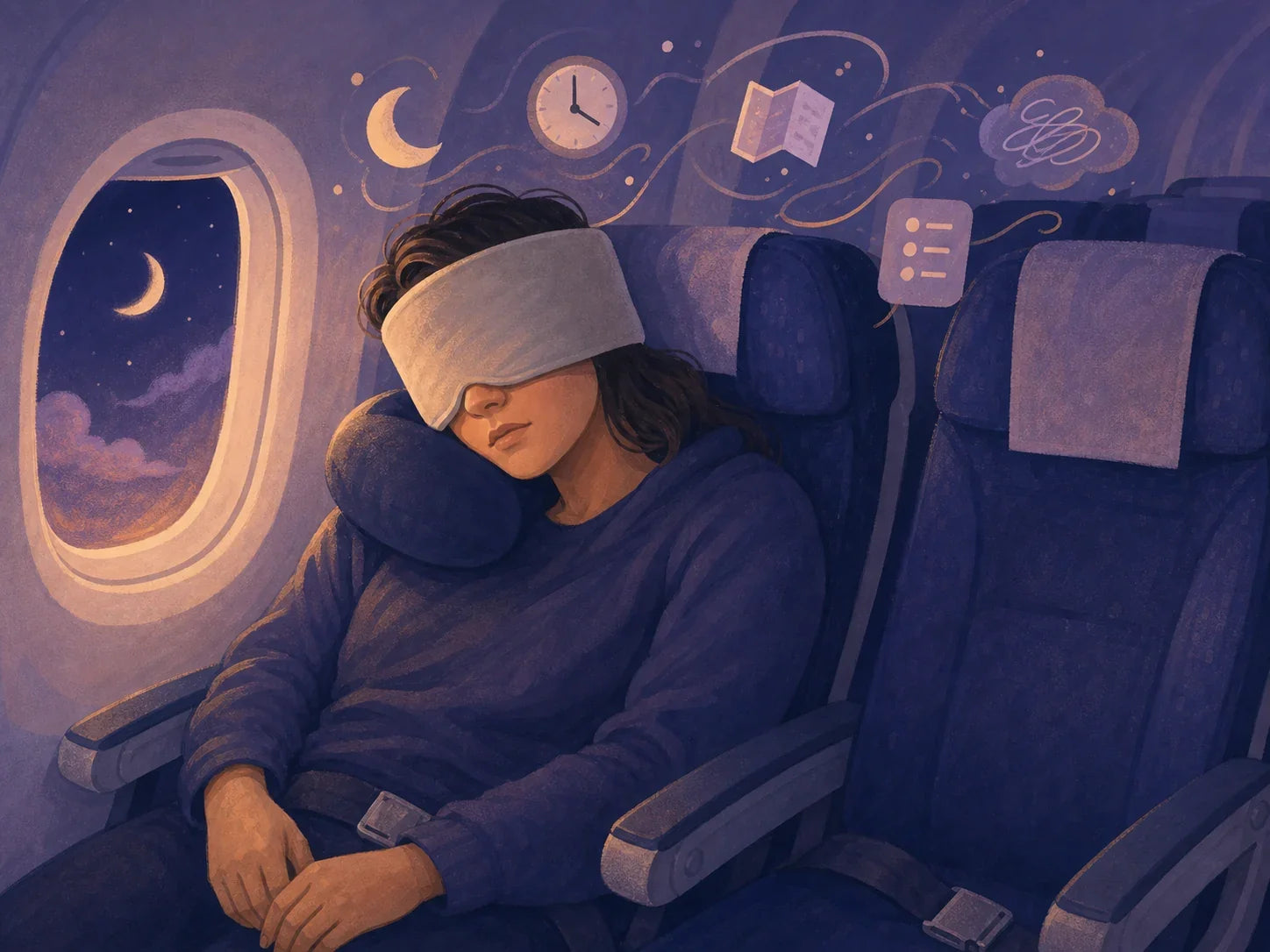
A red-eye begins with a contradiction: you are trying to sleep in a place designed to keep hundreds of people moving safely through the night. Boarding announcements continue. The cabin brightens for service. A neighbor opens a laptop. The seat is upright when your body wants a bed. You cannot turn an aircraft into a bedroom, but you can stop treating every inconvenience as a separate emergency.
The useful goal is not “eight perfect hours.” It is a quieter sequence: finish the active part of the trip, reduce the light and decisions you can control, take whatever rest the flight allows, and arrive without having spent the whole night fighting the cabin.
The direct answer: make the cabin boring
To make sleep more approachable on a red-eye flight, decide your sleep window before boarding, complete essential tasks early, and reduce light, noise, screen input, and seat adjustments once that window begins. Keep the routine short enough to repeat when you are tired.
A red-eye is not automatically a jet-lag problem. Jet lag is related to circadian misalignment after rapid travel across time zones.[1] A short overnight flight within one time zone can still be uncomfortable without creating the same clock mismatch. If you are crossing several time zones, plan sleep, light exposure, meals, and arrival-day rest around the destination rather than assuming that any sleep on the aircraft will “fix” the clock.
This field guide separates those two jobs. The cabin plan manages the environment you have for a few hours. A destination-time plan manages what happens to your internal clock. Neither guarantees sleep, and safety instructions outrank both.
Before booking or boarding: choose the tradeoff you can live with
There is no universally best seat for sleep. A window seat offers a wall to lean toward and fewer interruptions from seatmates who need the aisle. An aisle seat gives you easier movement and bathroom access, but passing passengers, carts, and requests to stand can interrupt rest. Choose the problem that is less disruptive for you.
Next, decide what a successful arrival looks like. If you land early and need to function immediately, your priority may be one protected sleep attempt during the longest uninterrupted part of cruise. If you land late and can sleep soon after check-in, quiet wakeful rest may be more useful than forcing a long in-flight sleep that leaves you wide awake at the hotel. For a major time-zone change, use the CDC’s destination-timing guidance as planning context and seek professional advice if medication or a health condition is involved.[1]
Pack only tools you already understand. An eye mask, suitable earplugs, a neck support you have used before, and one downloaded low-stimulation audio option can be enough. The first night of a work trip is a poor time to test an unfamiliar supplement, sedating medication, breathing gadget, or elaborate sleep system. This article does not recommend melatonin doses or sedatives; timing and individual risks make those medical questions, not packing-list shortcuts.
T-90 minutes: finish the active part of the trip
About ninety minutes before your intended sleep attempt—not necessarily ninety minutes before departure—close the loops that would otherwise keep reopening. Send the necessary message. Download the document you may need after landing. Put the hotel address and ground-transport details somewhere available offline. Set one alarm if you need it. Then stop adding optional tasks.
If you are still at the gate, use the bathroom and make any food decision before boarding rather than waiting until you are settled. Keep water accessible for comfort, but do not turn hydration into a jet-lag cure; it is not one. If you plan to decline meal service, decide now so the smell, tray table, and choice do not restart the evening later.
Caffeine deserves a timing decision, not a moral rule. The CDC Yellow Book treats caffeine as a timing-sensitive alertness tool and advises minimizing caffeine when trying to maximize in-flight sleep.[1] If you want to sleep during the first half of the flight, an airport coffee immediately before boarding may work against that plan. If you need to be alert after landing, plan caffeine timing separately—but do not rely on caffeine to make drowsy driving safe.
T-30 minutes: set the seat before you feel sleepy
Once seated, arrange the few things you will use and put the rest away. Keep your passport, phone, and other valuables secure rather than loose in the seat pocket. Place water where it will not spill. Untangle headphones now. If you have a sleep mask, keep it within reach instead of buried under the seat.
Fasten the seat belt as instructed and, where the carrier requests it, keep it visible over any blanket or outer layer so crew can confirm it without waking you unnecessarily. Follow the airline’s instructions about seat position, tray tables, devices, and cabin movement; these rules are not optional parts of a sleep routine.
Use the final minutes to lower stimulation rather than to “get your money’s worth” from the screen. Finish one necessary task, reduce display brightness, enable Do Not Disturb where appropriate, and choose a familiar audio track before closing the device. If scrolling tends to keep your mind active, the same principle in our guide to winding down after scrolling applies here: create a clear stopping point instead of negotiating with one more piece of content.
Takeoff: stay awake for the safety phase
Listen to the safety briefing and remain available for crew instructions. Do not build a routine that depends on becoming unreachable before takeoff. The lights, announcements, engine changes, and seat requirements during this phase are part of the flight, not failures in your plan.
After the initial service decisions are clear and the cabin settles, begin the sleep window you chose. That transition matters more than a perfect clock time. Put away the last screen, adjust your support once, cover your eyes if comfortable, and let the routine become repetitive.
Cruise: reduce inputs without chasing perfect sleep
During cruise, make fewer corrections. One seat adjustment may help; twelve small experiments usually keep attention attached to the seat. Choose a tolerable position that does not obstruct the aisle or invade another passenger’s space. Let quiet rest count even if sleep does not arrive immediately.
Reduce light first because it is often the most controllable signal. Close your window shade when airline rules and local conditions allow. Dim or turn off your screen. An eye mask can reduce light from reading lamps, cabin transitions, and sunrise. The CDC’s aircrew guidance includes eye masks and earplugs among tools for reducing environmental light and noise when trying to sleep.[2]
Handle noise honestly. Earplugs or appropriate headphones may reduce what reaches you, but they should not prevent you from responding to safety instructions. A sleep mask does nothing to reduce sound. If a crying child, conversation, or galley noise remains audible, that is not evidence that the darkness strategy failed; it is a different input with a different limit.
Avoid using alcohol as a sleep tool. The CDC warns that excess alcohol can disrupt sleep and worsen jet-lag-related symptoms.[1] Sedating medication can carry important risks and should not be improvised for a flight. If you already have medical guidance for travel, follow that guidance—not a generic article or another passenger’s routine.
The cabin signals you can actually control
Think in four channels rather than one complicated “sleep hack.”
- Light: close the screen, use the window shade when permitted, and add an eye mask if it is already comfortable for you.
- Sound: choose suitable earplugs or steady audio at a safe level; remain able to notice crew instructions and alarms.
- Touch: use familiar layers and support, keep the seat belt positioned as instructed, and avoid anything that restricts circulation or safe movement.
- Decisions: settle meal, alarm, connection, and arrival details before the sleep window so you are not reopening the trip every ten minutes.
Temperature is only partly controllable. Dress in removable layers rather than relying on one heavy item. Air vents can change how the seat feels, but do not direct them in a way that affects another passenger. The point is not total control. It is to stop spending mental energy on variables you can settle once.
Periodically move your feet and legs, and walk when the seat-belt sign is off and cabin conditions make it safe. The CDC says the overall risk of travel-related blood clots is generally small, but long periods of immobility can increase risk, especially for people with additional risk factors.[3] If you have a history of blood clots or other concerns, ask a clinician about your individual plan before travel. Sleep convenience never outranks safe movement or crew direction.
If the cabin does not match the plan
If you are in the aisle seat
Assume you may need to stand. Keep your belongings contained, use support that does not project into the aisle, and treat interruptions as part of the seat choice. A shorter, repeatable wind-down can help you return to rest without feeling that the whole attempt has been ruined.
If you are in the window seat
Use the wall only with clean, stable support and keep your body within your space. Make a bathroom decision before trying to sleep so you are less likely to wake two people later. Do not wedge yourself into a position that makes it difficult to respond during an emergency.
If the flight is too short for a full sleep window
Choose quiet rest over a performance test. Close the screen, reduce light, and stop demanding deep sleep before descent begins. Twenty minutes spent less stimulated can still make the journey feel calmer, even though this article cannot promise a specific recovery benefit.
If you have a short connection
Set a reliable alarm if appropriate, keep connection details available offline, and stay attentive to schedule or gate changes. Do not use a strategy that makes you difficult to wake. The practical goal is rest without losing situational awareness.
If a neighbor keeps a reading light on
Control your side first. An eye mask lets you manage light without asking another traveler to change a reasonable choice. If light still leaks in, adjust the mask once; avoid repeated tightening that creates pressure or discomfort.
A sleep mask solves one cabin problem
A sleep mask has a narrow, credible job on a red-eye: reduce the light reaching your eyes and create one familiar boundary while the cabin changes around you. It cannot treat jet lag or insomnia, cancel engine or passenger noise, guarantee faster sleep, or turn an economy seat into a bed.
A weighted mask adds a tactile quality that some people may find comforting, but evidence about full-body weighted blankets should not be transferred to a weighted eye mask; our weighted blanket and sleep mask comparison keeps those evidence categories separate. Mellooa has not conducted a flight-specific trial, an all-night wear study, a packing-volume test, or a seat-condition test. We therefore do not claim that the Mellooa weighted sleep mask produces a particular sleep result on a plane.
If you already find a mask comfortable, using the same one at home and while traveling can remove one unfamiliar decision. Try the fit before the trip. A weighted mask should not hurt, blur vision after removal, or create uncomfortable pressure on the eyes. Stop using it if it feels too tight, hot, painful, or otherwise uncomfortable. If you have glaucoma, recent eye surgery or injury, unexplained eye pain, or vision changes, ask an eye-care professional before using a weighted product around the eyes. Darkness can support the environment for rest; it is not medical treatment.
Landing: switch from sleep attempt to arrival
When descent begins, let the sleep attempt end. Remove anything that blocks vision or awareness, return the seat and tray table as instructed, and listen for announcements. Open the shade if required. A rushed effort to capture five more minutes is not worth missing safety information or arriving disoriented.
Use the transition to gather belongings in a fixed order and confirm the next step of the journey. Treat deliberate bright-light exposure as part of the destination-time plan, not as an automatic landing rule.[1] If your connection or ground transport requires alertness, situational awareness is the priority now.
After arrival: manage the next rest
Once you land, follow the destination-time plan rather than trying to erase the flight. The CDC recommends treating light exposure, sleep timing, meals, naps, and caffeine as timing tools when adjusting across time zones.[1] That does not mean every traveler needs a detailed protocol. It means a long accidental nap, bright light at the wrong time, or late caffeine can pull against the schedule you are trying to adopt.
If the next challenge is sleeping in an unfamiliar hotel, handle it as a separate environment rather than extending the aircraft routine into the room. Our guide to sleeping in a new place covers that transition without pretending the first-night effect and jet lag are the same thing.
Be conservative about driving or other safety-critical work if you are severely sleepy. No mask, coffee, or arrival routine makes impaired alertness harmless. Arrange safer transport or rest when needed.
The win is a calmer flight, not a perfect night
A red-eye is a managed-rest problem. You choose a realistic window, settle practical details early, reduce the inputs you can control, and accept that the cabin will continue being a cabin.
The most useful routine is almost plain: know your arrival objective, choose your seat tradeoff, stop the screen, make darkness easier, keep sound expectations honest, move safely, and respond to the crew. If sleep comes, take it. If it does not, quiet rest is still better than spending the flight redesigning the plan.
You do not need more tricks. You need fewer open decisions between takeoff and landing.
Sources
- Centers for Disease Control and Prevention. Jet Lag Disorder. CDC Yellow Book.
- Centers for Disease Control and Prevention, NIOSH. Aircrew and Jet Lag.
- Centers for Disease Control and Prevention. Understanding Your Risk for Blood Clots with Travel.
Medical disclaimer: This article is for general education only and is not medical advice, diagnosis, or treatment. Ask a qualified clinician about medications, supplements, health conditions, or persistent sleep difficulty.