

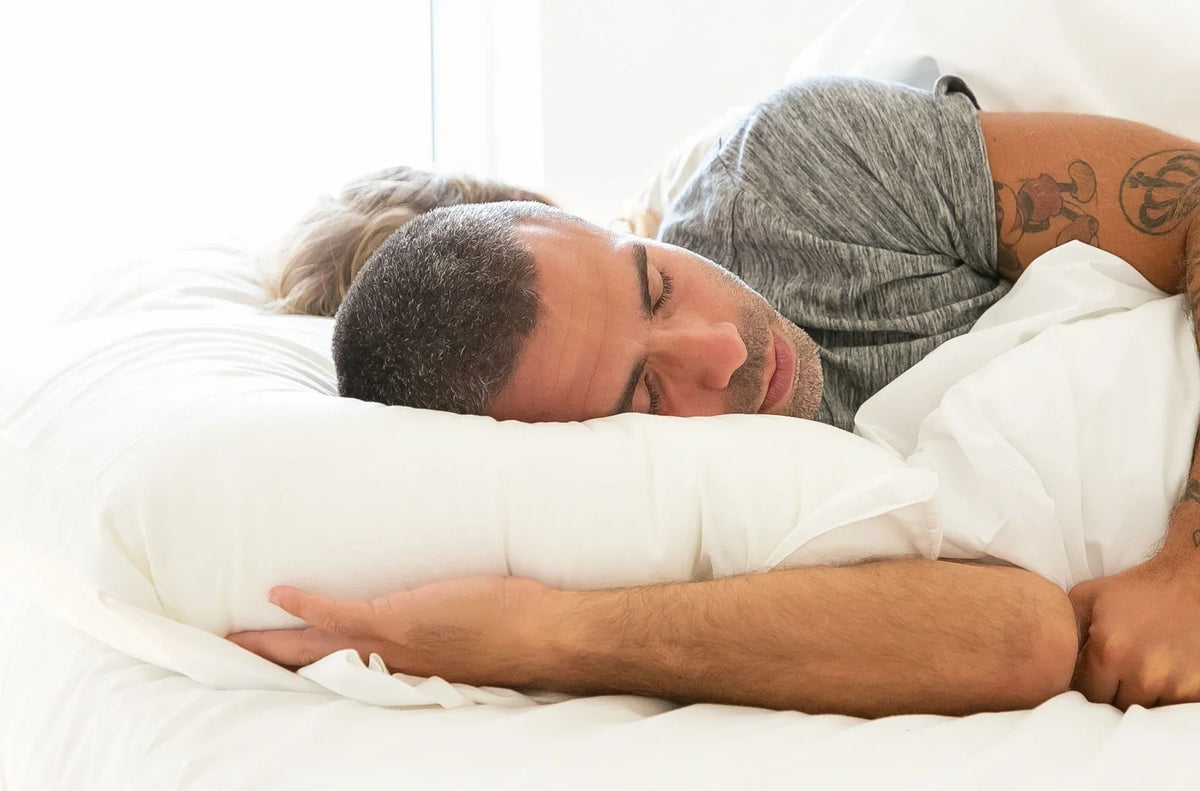
The short answer: For most adults, the best sleeping position is on your side. It keeps the airway open, which means less snoring, and the spine rests in a neutral line. Back sleeping is second for spinal alignment but can worsen snoring. Stomach sleeping is the one position sleep specialists suggest moving away from, as it strains the neck and lower back.
Why your sleeping position matters
You will spend roughly a third of your life asleep, and the position you spend it in quietly shapes how you breathe, how your spine rests, and whether you wake up sore. As the Mayo Clinic's sleep experts put it, during sleep the body recharges and repairs itself, and a good night's sleep can often be determined by what position you are lying in.
Three things are mostly decided by position. First, your airway: gravity pulls the tongue and soft tissues differently depending on whether you face the ceiling, the wall, or the mattress. Second, your spine: some positions let it rest in its natural curves, others twist or arch it for hours. Third, digestion: the stomach sits slightly to the left, so which side you lie on can nudge nighttime reflux one way or the other.
One reassuring fact before we go further: almost nobody keeps one position all night. People shift in their sleep without noticing, often in response to discomfort. So "the best sleeping position" is not a pose you must hold like a statue. It is the position where you spend most of the night, and especially the position you fall asleep in, because the first hours of the night carry the deepest sleep, when you move the least.
Side sleeping: the best default for most people
If you sleep on your side, you are already doing what most sleep specialists recommend. "There's a host of evidence overall suggesting that probably sleeping on the side is better," says Dr. Virend Somers, a cardiologist and director of the sleep facility within Mayo Clinic's Center for Clinical and Translational Science. Side sleeping helps prevent the airway from collapsing and can reduce snoring. Dr. Lois Krahn, a Mayo Clinic sleep specialist, adds that sleeping on your side, perhaps with the head slightly elevated as long as that feels comfortable, is a good way to sleep.
The Sleep Foundation reaches a similar conclusion from a different angle: side sleeping is typically the recommended position for sleep-related breathing problems, including snoring and the breathing pauses of obstructive sleep apnea. It is also considered one of the better positions for spinal support, ahead of stomach sleeping.
Left side or right side? This is where the honest answer gets narrower. Sleeping on the left side is often suggested for nighttime reflux, because it keeps the stomach below the esophagus, and it is the side commonly recommended during pregnancy. Some people find the right side worsens their reflux symptoms. None of this is a treatment, and if reflux regularly disrupts your sleep, that is a conversation for your doctor. For everyone else, the practical rule is simple: the side you sleep most comfortably on is the right side for you. If one shoulder or hip aches, switch sides or alternate through the week.
What about the fetal position? Curling up with the knees bent is a form of side sleeping, and it can ease pressure on the lower back. The caveat is tightness: curling into a very tight ball rounds the back and can restrict breathing. Keep it loose, knees softly bent, chin slightly tucked rather than jammed to the chest, and the position works well.
Two small upgrades make side sleeping noticeably better. First, put a pillow between your knees. It keeps the hips aligned and takes pressure off the lower back, a tip the Sleep Foundation specifically recommends for people with neck and back pain. Second, check your pillow height. Side sleepers need a thicker pillow than back sleepers, because the pillow has to fill the wider gap between the head and the mattress and keep the neck level with the spine. If you regularly wake with a stiff neck, the pillow is the first suspect, not the position.
One practical note for side sleepers who are sensitive to light: lying on your side can let light sneak in around the edges of a flat mask. A wraparound shape sits differently against the face. Mellooa's gently weighted wraparound sleep mask is one example of that shape, and we wrote a separate guide on choosing a sleep mask if you sleep on your side.
Back sleeping: kind to the spine, rough on snoring
Sleeping on your back gives the spine and neck their most neutral rest, which is why it is often called the best position for alignment. Nothing is twisted, nothing is compressed. A pillow under the knees takes pressure off the lower back, and a thinner pillow under the head is usually enough, since the gap to fill is smaller than for side sleepers.
The trade-off is the airway. "Sleeping on the back means that your tongue and jaw can fall down and crowd your airway," says Dr. Krahn, "and many people snore more on their back." Mayo Clinic experts describe back sleeping as the worst position for people with sleep apnea, for exactly this reason. Gravity that is kind to your spine is unkind to your throat.
So back sleeping is a genuinely good choice if you sleep quietly and wake up without aches, and a poor one if your partner has opinions about your snoring. If you fall in the second group, you do not necessarily have to abandon the position entirely: elevating the head of the bed slightly can help, and many people find that starting the night on their side and drifting onto their back later is a workable compromise. If your partner is the one losing sleep over your snoring, our guide on sleeping next to a snoring partner covers what actually helps both of you.
Stomach sleeping: the one to move away from
Stomach sleeping is the one position where expert opinion is unusually united, and not in its favor. The Sleep Foundation notes that side and back sleeping are generally more beneficial than stomach sleeping because they make it easier to support the spine. The mechanics explain why: to breathe face-down, your head must turn sharply to one side for hours, which strains the neck, and the lower back tends to arch, which strains that too.
It does have one mild point in its favor: like side sleeping, it keeps the airway relatively open. But the price is high enough that most specialists suggest treating stomach sleeping as a habit to graduate from rather than optimize.
If you are a committed stomach sleeper, two adjustments reduce the strain while you work on changing. Use a very thin pillow under your head, or none at all, to reduce the neck angle, and place a slim pillow under your hips to keep the lower back from arching so deeply. Think of these as harm reduction on the way to a new default, not a permanent setup.
What the research actually says
Here is the honest framing: no large trial has crowned one sleeping position the winner, and anyone who claims otherwise is overselling the evidence. What exists is a consistent pattern across expert consensus, physiology, and smaller studies, and it points in the same direction the Mayo Clinic experts describe.
A 2025 study in the Journal of Sleep Research found that people who spent more time awake while lying on their backs tended to prefer side sleeping, which suggests the body may self-select the position it sleeps best in (reported by EatingWell). A 2022 sensor-based study in Sensors measured the relationship between sleeping position and sleep quality directly, and a 2021 study in PLOS ONE examined how sleep posture relates to waking spinal symptoms and quality of sleep. These are associations, not prescriptions, and the study designs differ enough that they should be read as supporting evidence rather than proof.
The expert takeaway, quoted in that same EatingWell review, is worth keeping as your compass: comfort and continuous rest are the top priorities. The best sleeping position is the one that lets you fall asleep easily, stay asleep, and wake up without pain. Research can tell you which positions make that outcome more likely. It cannot tell you which one your body prefers tonight.
Small tweaks that make any position better
Position gets the attention, but the accessories do much of the work. These adjustments help whichever way you sleep:
- Match the pillow to the position. Side sleepers need a thicker, firmer pillow to keep the neck level; back sleepers need a thinner one; stomach sleepers need the thinnest of all, or none. A pillow that is wrong for your position will undo the position's benefits.
- Support the gaps. A pillow between the knees for side sleepers, or under the knees for back sleepers, keeps the hips and lower back aligned. A small rolled towel under the neck can help back sleepers whose pillow leaves a gap.
- Elevate slightly for reflux or snoring. Raising the head of the bed a few inches is the version sleep specialists tend to suggest; stacking extra flat pillows can kink the neck and trade one problem for another.
- Check the mattress. A mattress that sags lets the hips sink below the shoulders, which strains the lower back in any position. If the middle of the bed has a visible dip, no position will feel right for long.
How to change your sleeping position
Changing positions is possible, but it takes weeks, not nights, so set your expectations accordingly. The most reliable method is also the simplest: start every night in the new position. The first sleep cycles carry the deepest sleep, when you move least, so the position you fall asleep in gets a head start.
A body pillow makes a good bumper. Hug it in front to keep yourself from rolling forward onto your stomach, or place it behind you to stop yourself rolling onto your back. Some people sew a tennis ball into the back of a sleep shirt to discourage back sleeping; it is an old snoring-clinic trick, and it works by making the unwanted position mildly annoying rather than by force.
Expect to wake up in the old position for a while. That is not failure, it is just the body returning to a habit during lighter sleep. Gently return to the new position when you notice, and give it a few weeks. Do not force a change through real pain: if a new position consistently hurts, the position is not the problem to solve, and the next section is for you.
When it is worth talking to a doctor
Most position troubles are comfort problems with comfort solutions, but a few patterns deserve professional attention. Talk to your primary care doctor or a sleep specialist if you snore loudly with pauses, gasping, or choking sounds; if you wake with morning headaches or feel unrefreshed despite enough hours in bed; if neck or back pain persists no matter which position you try; or if reflux regularly wakes you up. These are prompts for a conversation, not self-diagnoses, and no article can sort them out for you.
Frequently asked questions
Is sleeping on your left side better than your right?
For nighttime reflux, the left side is often suggested because it keeps the stomach below the esophagus, and it is the side commonly recommended in pregnancy. For general sleep quality, though, there is no strong evidence favoring one side. Sleep on whichever side feels better, and switch if a shoulder or hip starts aching.
I snore. Should I stop sleeping on my back?
Back sleeping tends to worsen snoring because the tongue and jaw fall back and narrow the airway. If your snoring is new, loud, or comes with pauses and gasping, see a doctor first, since that pattern can signal sleep apnea. For ordinary snoring, trying the side is the simplest experiment, and it costs nothing.
Can I train myself to stop sleeping on my stomach?
Yes, with patience. Start each night on your side, use a body pillow as a bumper so you cannot easily roll forward, and expect a few weeks of waking up in the old position. In the meantime, a very thin pillow under your head and a slim one under your hips reduce the strain.
Do I need a special pillow for side sleeping?
You need the right height more than a special label. A side sleeper's pillow should fill the gap between the head and the mattress so the neck stays level with the spine, which usually means thicker and firmer than what back sleepers use. If you wake with a stiff neck, try a thicker pillow before you try a new position.
Why do I always end up on my stomach even though I fall asleep on my side?
Because position habits live in lighter sleep. You hold the new position through the deep sleep of the first cycles, then drift back to the familiar one as sleep lightens. This is normal and it fades with repetition. The body pillow trick helps because it makes the old position physically awkward to return to.
Is the fetal position bad for you?
Not in its relaxed form. Knees softly bent with a loose curl can ease lower back pressure. It becomes a problem only when it is very tight: a hard ball rounds the spine and can restrict breathing. Loosen the curl and it is simply side sleeping.



Share:
Why You Wake Up Just Before Your Alarm Goes Off
Is It Bad to Sleep With the TV On? What the Research Says