

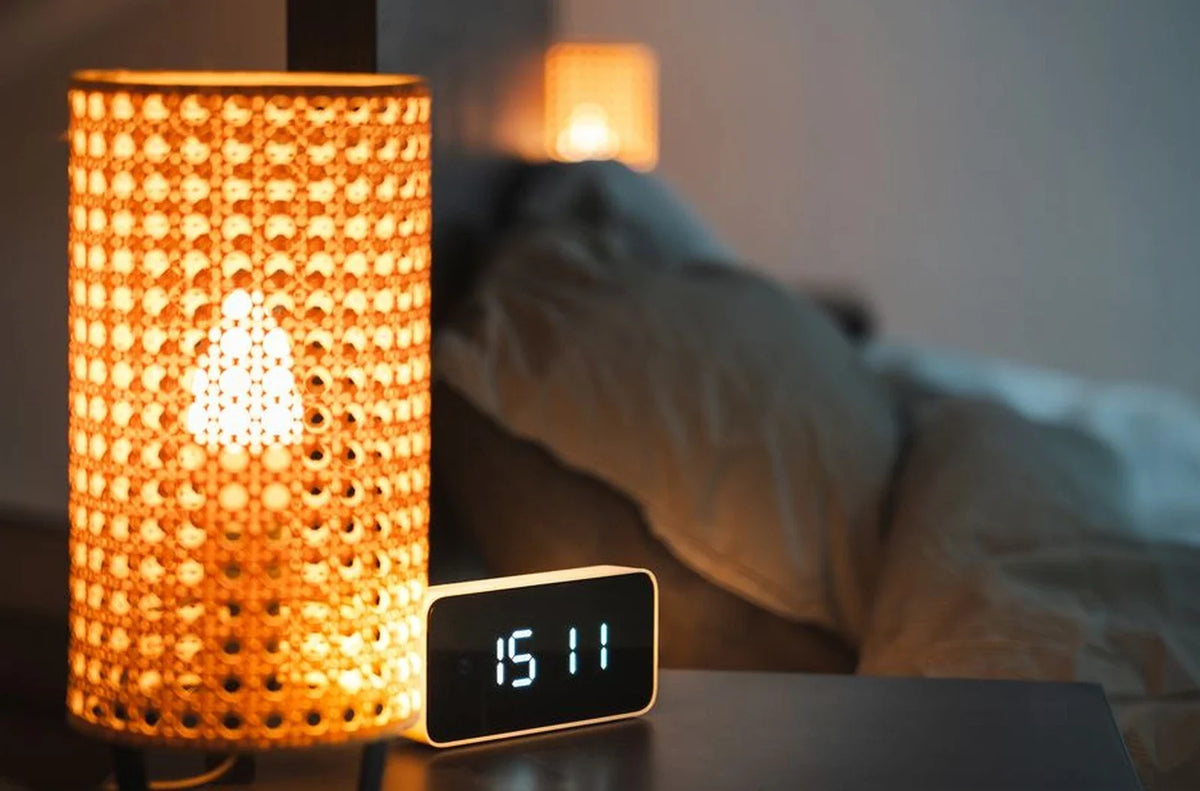
Pick your wake-up time first, then count back. Most adults need 7 to 9 hours of sleep, plus about 15 minutes to fall asleep. If you are up at 7:00 a.m., that means falling asleep between 10:00 p.m. and midnight. Your bedtime is a subtraction problem, not a guess.
Start with the wake-up time, not the bedtime
Most bedtime advice starts at the wrong end of the night. It tells you to go to bed earlier, without asking when you have to get up. But the morning is usually the fixed point. Work, school, a train, a child who wakes at the same time no matter what, these set the alarm. The bedtime has to fit around them, not the other way round.
So write down the wake-up time you actually keep on weekdays, not the one you wish you kept. Then subtract the sleep you need. If you wake at 7:00 a.m. and need 8 hours, you need to be asleep by 11:00 p.m. Getting into bed at 11:00 p.m. is not the same thing, so aim to be in bed by about 10:40 p.m. That small gap is where many bedtime plans quietly fail.
The table below does the subtraction for common wake-up times. Use the 7.5 hour column if you tend to feel rested on about that much, and the 9 hour column if you know you need more. Both columns are falling-asleep times. Get into bed about 15 to 20 minutes earlier than the time shown.
| Wake up at | Fall asleep for 7.5 hours | Fall asleep for 9 hours |
|---|---|---|
| 5:30 a.m. | 10:00 p.m. | 8:30 p.m. |
| 6:00 a.m. | 10:30 p.m. | 9:00 p.m. |
| 6:30 a.m. | 11:00 p.m. | 9:30 p.m. |
| 7:00 a.m. | 11:30 p.m. | 10:00 p.m. |
| 7:30 a.m. | midnight | 10:30 p.m. |
| 8:00 a.m. | 12:30 a.m. | 11:00 p.m. |
If your wake-up time is not in the table, the method still works. Take your wake-up time, subtract the hours you need, and then subtract a short settling allowance. A 6:45 a.m. alarm with an 8 hour need gives a falling-asleep time of 10:45 p.m. and a getting-into-bed time of about 10:25 p.m.
What about sleep cycles and the 90 minute rule
You may have seen calculators that count back in 90 minute steps and promise a perfect wake-up time. There is something real behind them. Sleep moves through repeating cycles of lighter sleep, deep sleep, and dreaming sleep, and one cycle lasts about 90 minutes on average. Waking from deep sleep can feel much worse than waking from lighter sleep, which is part of why some mornings feel heavy and others feel clear. Our earlier piece on why you feel groggy after waking up explains that heavy first half hour in more detail.
But 90 minutes is an average, not a timetable your brain follows exactly. Real cycles run roughly 70 to 120 minutes, and they change shape through the night, with more deep sleep early and more dreaming sleep later. No calculator can tell you the exact minute you will be in light sleep, so treat the 90 minute idea as a rough guide, not a rule to obey.
The more important point is that total sleep matters more than landing on a neat multiple of 90 minutes. It is never worth cutting your night short just to hit a tidy number of cycles. Six hours because it divides neatly is still short for most adults, even if the arithmetic looks clean. If you have to choose between 7 hours that ends mid-cycle and 6 hours that ends neatly, take the 7 hours. The extra hour of sleep is worth more than the tidiness. Our earlier piece on whether 6 hours of sleep is enough looks at that trade in full.
Finding your own number inside the 7 to 9 hour range
The 7 to 9 hour range is a population guide, and you live inside it somewhere, not everywhere. Two people with the same alarm can need different amounts, and the same person can need more during a demanding week than during a quiet one. The way to find your number is to watch what happens when sleep is not cut short.
One useful test is the no-alarm morning. On a day when you can wake on your own, after several nights of regular timing, note how long you slept and how you feel by mid-morning. A single long sleep after a short week says more about the debt you were carrying than about your usual need, so look at the pattern over a week, not one night. Another clue is the weekend overshoot. If you sleep two or three hours longer on Saturday than on weekdays, your weekday amount is probably short. Our earlier piece on whether you can catch up on sleep at weekends explains why that extra sleep helps a little but does not fully repay the week.
Daytime signs matter too. Needing caffeine just to feel normal by late morning, dozing off during quiet moments, or feeling your mood sink by afternoon can all point to short sleep, though each can have other causes as well. If daytime sleepiness is strong, regular, or paired with loud snoring or pauses in breathing, raise it with a clinician rather than solving it with a new bedtime alone. A bedtime calculation is a planning tool, not a diagnosis.
Once you have a rough number, hold it steady for a couple of weeks before judging it. Sleep timing shifts slowly. A new bedtime tried for two nights proves very little, and a new bedtime tried while everything else in the evening stays chaotic proves even less.
Moving a bedtime that is already too late
Knowing the right bedtime and keeping it are different problems. If your current bedtime is an hour or more later than the time the subtraction gives you, do not try to move it all in one night. A sudden jump usually ends with an hour of lying awake, which feels like proof that the new time does not work, when really the body just has not caught up yet.
Move in small steps instead. Shift both bedtime and wake-up time about 15 minutes earlier every few nights, until you reach the target. Shifting the wake-up time matters as much as shifting the bedtime, because the morning anchor is what pulls the whole rhythm earlier. Morning light helps that pull. Getting outside soon after waking, even on a cloudy day, tells the body clock that the day has started, as our earlier piece on morning light and better sleep explains.
Keep weekends close to the weekday pattern, within about an hour if you can. A weekend that runs two or three hours later undoes much of the weekday work, and Monday morning then feels like a small weekly time-zone change. Our earlier piece on why Sunday nights are hard takes that pattern apart.
Evening habits need to move with the bedtime, not stay where they were. If caffeine, a heavy meal, or a bright screen session stays at the old late hour, it will fight the new early bedtime. Our earlier piece on when to stop drinking coffee gives a cutoff to work from. Give the last hour before bed a wind-down shape of its own, with dimmer light and slower activity, so the new bedtime feels like an arrival rather than an interruption.
When the subtraction gives you a bedtime you cannot keep
Sometimes the arithmetic is honest and still unworkable. A 5:30 a.m. alarm with a 9 hour need gives a falling-asleep time of 8:30 p.m., which may clash with family life, evening work, or simply the way you live. In that case, do not quietly accept short sleep as the permanent answer, and do not pretend the problem away either. Look at what can actually move.
First, check whether the wake-up time itself has any give. A 30 minute later start, even a few days a week, changes the bedtime by the same amount. Second, check whether the evening is leaking time that could be reclaimed. An hour of scrolling after the wind-down was meant to start is not rest, and it is the easiest hour to move. Our earlier piece on how to wind down after scrolling covers that reset. Third, protect the wake-up time even when the bedtime slips. A steady wake-up time keeps the rhythm anchored, so one late night stays one late night instead of becoming a sliding week.
Short naps can soften a short night, but they are a patch, not a replacement. Keep them short and earlier in the afternoon, so they do not steal from the next night. Our earlier piece on how long a nap should be sets out the timing. If early rising is permanent in your life, such as shift work, the problem needs a different shape of plan, not just an earlier bedtime. Our earlier piece on sleeping after a night shift deals with daylight sleep directly.
There is also a version of this problem that runs in the other direction. Some people are naturally late sleepers whose body clock runs later than their alarm allows. Forcing a very early bedtime on a late body clock often produces hours of wakefulness, not sleep. If that sounds familiar, our earlier piece on whether night owls can become morning people explains how far, and how slowly, that clock can shift.
When you get into bed on time and still cannot fall asleep
A bedtime plan only works if falling asleep follows getting into bed, and sometimes it does not. Lying awake while watching the minutes pass makes the problem worse, because the bed starts to feel like a place for worrying rather than sleeping. If you have been awake for roughly 20 minutes and feel more alert rather than sleepier, get up. Go to another dim room, do something quiet and dull, and return only when sleepiness comes back. Our earlier piece on why sleep experts tell you to get out of bed explains the reasoning behind that move.
It also helps to separate the wind-down from the bed itself. The last 30 to 60 minutes before bed should already be slower, with lights lower and activity calmer. If the whole evening runs at full speed until the moment you get into bed, the body has no ramp down. A short, repeatable wind-down, the same few steps in the same order each night, gives the body a cue it can learn to recognize.
Racing thoughts deserve their own note here. If the mind starts rehearsing tomorrow the moment the lights go out, the problem may not be the bedtime at all. Writing the next day's tasks down earlier in the evening, and closing that list before the wind-down starts, can keep the bed from becoming a planning desk. Our earlier piece on quieting racing thoughts at night goes into that pattern in more detail.
One last practical point. If your bedtime falls while the room is still light, or your partner reads beside you, light alone can keep you awake past the time you planned. A gently weighted wraparound sleep mask keeps that one problem separate from the rest. It handles the light. It does not set your bedtime, fix a late body clock, or replace the hours themselves, and it is worth being clear about that boundary.
Frequently asked questions
What if my wake-up time changes between weekdays and weekends?
Use the weekday wake-up time for the calculation, since that is the one that sets the cost of short sleep. Then keep the weekend wake-up time within about an hour of it. A much later weekend wake-up feels like a reward, but it moves the body clock later and makes Monday morning harder.
Is 6 hours enough if I feel fine on it?
Feeling fine is useful information, but it is not the whole story. Some people adapt to short sleep in the sense that they stop noticing the tiredness, while their focus and mood still run below their best. If 6 hours is your regular amount, try a couple of weeks at 7 to 7.5 hours, with the same wake-up time, and compare how the days feel. The comparison is more honest than a single night either way.
Should I go to bed even earlier if I cannot fall asleep at my new bedtime?
Usually not. Going to bed earlier when you are not sleepy tends to add wakeful time in bed, which trains the bed to feel like a worrying place. Hold the wake-up time steady, keep the wind-down calm, and let sleepiness build to meet the bedtime over several nights. If lying awake stays a nightly pattern for weeks, that is worth discussing with a clinician rather than pushing the bedtime earlier and earlier.
Does going to bed earlier always help?
Only up to the point where it matches your actual sleep need and your body clock. Earlier than that, you simply lie awake longer, and the extra time in bed can make sleep feel worse rather than better. The goal is the right bedtime for your wake-up time and your need, not the earliest bedtime you can force.
What if my partner's bedtime is very different from mine?
Keep your own wake-up time and bedtime as the anchor, and treat the shared bedroom as a negotiation, not a single schedule. Dim light, quiet activity, and separate wind-down routines can let one person settle while the other is still awake. Our earlier piece on a partner on their phone in bed covers the light and noise side of that compromise.



Share:
How to Fall Back Asleep After a Nightmare: A Calm Plan for Tonight
Should You Charge Your Phone Outside the Bedroom?