

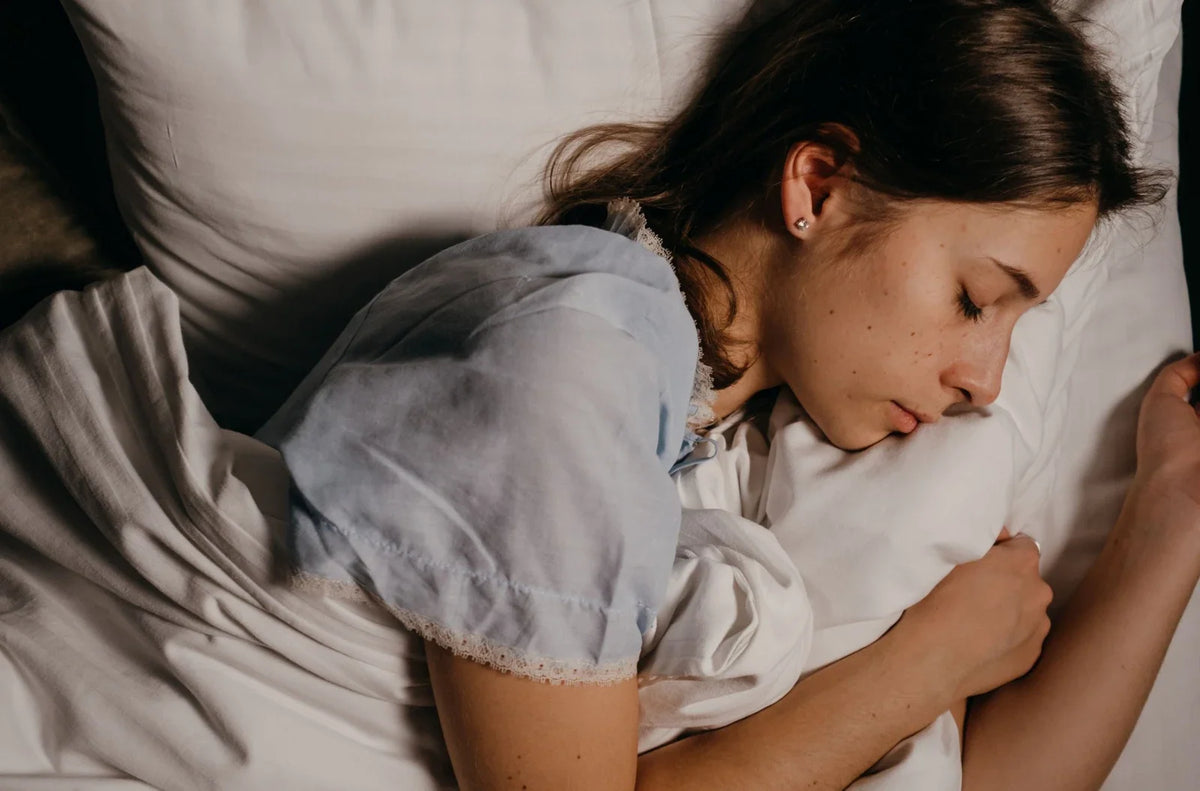
You wake up, turn over, and find a damp patch on your pillow. It is not a sign that something is wrong with you, and it is not a verdict on how well you slept. Most nighttime drooling happens for a simple reason. Your mouth falls open while you sleep, your swallowing slows down, and gravity does the rest.
What actually happens when you drool in your sleep
Your body keeps making saliva all night. Saliva keeps your mouth and throat moist, helps protect your teeth, and starts the work of digestion. During the day you swallow without thinking about it, roughly once or twice a minute, so saliva never gets a chance to pool. At night that quiet system changes.
As you fall into deeper sleep, the muscles around your face and jaw relax. Your mouth may fall slightly open. At the same time, you swallow far less often. The saliva your glands still produce has nowhere to go, so it gathers in the mouth. If your head is turned to one side, or your jaw has gone slack, the pooled saliva follows the easiest path, which is out over your lip and onto the pillow.
That is why the damp patch can look dramatic while the cause is ordinary. You are not making extra saliva because something went wrong. In fact, saliva production usually drops at night compared with the daytime. Drooling is mostly a problem of clearance, not of supply. Less swallowing, an open mouth, and gravity together turn a normal amount of saliva into a wet pillow.
It also helps to know that drooling is common. Children drool in their sleep often because their swallowing control is still developing. Adults do it too, and many people only notice it when they change position, catch a cold, or sleep somewhere new. An occasional wet pillow, on its own, is rarely a reason to worry.
Why side and stomach sleeping make it more likely
Sleep position is the biggest everyday factor. When you sleep on your back, gravity works in your favor. Saliva stays in the mouth or drains toward the throat, where it can be swallowed. When you sleep on your side or stomach, gravity pulls saliva toward the corner of your mouth and down onto the pillow. That is why side sleepers report drooling far more often than back sleepers, and why the same person can drool one night and not the next, depending on how they ended up lying.
Your pillow setup can add to the effect. A low pillow, or a pillow that lets your head roll forward and your jaw drop open, makes it easier for the mouth to stay open. A pillow that holds your head in a more neutral line does not stop drooling on its own, but it removes one small push toward an open mouth.
If you are a side sleeper who drools, it is worth knowing that the position itself is not a bad habit. Side sleeping suits many people well, and changing position just to avoid a damp pillow can cost you comfort and sleep. The position explains the drool. It does not mean you are sleeping wrong.
The usual reasons behind a wet pillow
Most nighttime drooling traces back to a short list of ordinary causes. Often two or three of them are true at once.
Nasal congestion is near the top. When your nose is blocked by a cold, allergies, or a sinus flare, you breathe through your mouth instead. Mouth breathing dries the mouth at first, then leaves it open all night, which is exactly the setup drooling needs. Sleeping through a cold often means more drooling for a few nights, and it usually fades as the congestion clears.
Mouth breathing without congestion can do the same thing. Some people naturally sleep with their mouth open, especially when they are very tired or sleeping deeply. Habit, a dry bedroom, and sleeping on your side all push in the same direction.
Acid reflux can play a part too. When stomach acid rises into the throat, it can irritate the lining and make swallowing uncomfortable. The body may respond by making more saliva, which is its way of soothing the irritation. Lying flat makes reflux more likely, so the effect can show up at night even when daytime symptoms are mild.
Teeth grinding is another companion. Grinding during sleep often goes with mouth breathing and restless sleep, and saliva escapes more easily when the mouth is open and the jaw is moving. A sore jaw, worn teeth, or a partner who hears grinding are clues worth noticing, though they do not prove a link in any one person.
Some medicines list drooling or extra saliva as a side effect. Certain medicines for mood, seizures, and muscle relaxation are among them. Alcohol and sedatives before bed can also relax the muscles around the mouth and throat more than usual, which makes an open mouth and pooled saliva more likely that night.
Then there is sleep apnea, the cause that deserves attention rather than alarm. In obstructive sleep apnea, the airway narrows or closes repeatedly during sleep, and breathing pauses for short stretches. Many people with apnea breathe through their mouth as the body works to get air past the narrowing, and that open mouth breathing can lead to drooling. Drooling alone does not mean you have apnea. It becomes worth a closer look when it travels with other signs, which are covered below.
Does drooling mean you slept deeply?
This is the most repeated claim about drooling, and it is only half true. Drooling often happens during deep sleep, because that is when muscles relax most and swallowing slows most. So a wet pillow can coincide with a stretch of deep sleep. But drooling is not a reliable measure of sleep quality, and it is not proof that you slept well.
Think about the other causes. Congestion, reflux, grinding, and apnea can all produce drooling during nights that feel broken and unrestful. A person can drool heavily and still wake up tired, just as another person can sleep soundly for eight hours and wake up with a dry pillow. The pillow tells you about mouth position and swallowing during the night. It does not grade the whole night.
A similar caution applies to the reverse idea, that drooling means something is wrong with your brain or your sleep. Occasional drooling in an otherwise healthy adult is usually just the mechanics of sleep: relaxed muscles, less swallowing, and gravity. The pattern over time matters more than any single morning. A new pattern, or a pattern that keeps getting heavier, tells a different story from a damp patch you have had on and off for years.
What you can try at home
There is no single trick that stops drooling, because drooling has more than one cause. The useful approach is to remove the easiest causes first and see what changes over a couple of weeks.
Start with your nose. If congestion is part of the picture, clearing it before bed helps more than any pillow change. A warm shower, rinsing away bedroom dust, and keeping the room at a comfortable humidity are gentle places to start. If congestion lasts beyond a couple of weeks, or keeps coming back in the same season, that pattern is worth raising with a clinician rather than working around it night after night.
Look at your sleep position without making it a rule. If you naturally fall asleep on your side and sleep well there, stay there. If you sometimes wake up on your back with a dry pillow, you already know position matters for you. A pillow that keeps your head from rolling too far forward can help, but comfort comes first. Trading good sleep for a dry pillow is a bad bargain.
Keep your mouth comfortable. Brushing and flossing before bed, and drinking water earlier in the evening rather than a large amount right before lying down, keep the mouth in better shape overnight. If you grind your teeth, or wake up with a sore jaw, a dentist can check whether a night guard makes sense. That is a dental question, not a drooling cure, and it is worth asking directly.
Ease off the things that slacken the mouth muscles before bed. Alcohol in the evening and sedatives relax the muscles around the mouth and throat, and they can make drooling more likely that night. They also break up sleep in other ways, so cutting back in the last hours before bed tends to help on more than one front.
Give it time before judging. Saliva, congestion, and sleep position all vary from night to night. One dry morning does not prove a fix worked, and one wet morning does not prove it failed. A week or two of notes, even just a tick on a calendar for wet or dry, gives you a clearer picture than any single night.
When it is worth talking to a clinician
Most drooling needs no appointment. A few patterns are worth bringing to a clinician, because they can point to something that deserves treatment in its own right.
Book a conversation if drooling is new for you as an adult, heavy most nights, or getting worse over weeks rather than staying occasional. The same applies if drooling comes with loud snoring, pauses in breathing that a partner notices, waking up with a headache, or daytime sleepiness that does not lift after a full night. Snoring plus drooling is a combination worth mentioning, since both can follow from mouth breathing and a narrowed airway.
Also mention it if you notice trouble swallowing, food or drink going down the wrong way, a change in your voice, weakness on one side of the face, or drooling that started after a new medicine. These are not things to diagnose at home. They are the details a clinician needs to decide whether a closer look is warranted.
Seek prompt care if drooling arrives with trouble breathing, trouble swallowing your own saliva, severe throat pain, or sudden facial weakness. Those situations are uncommon, and they are not what an occasional wet pillow looks like, but they should not wait for a routine appointment.
This article is general information, not medical advice. It cannot tell you why you drool on a particular night. It can help you separate an ordinary wet pillow from a pattern that deserves a professional opinion.
Drooling, light, and the rest of the bedroom
Drooling is a mouth and airway story, not a light story, and it helps to keep those jobs separate. A sleep mask does not stop drooling, and no bedding change will fix congestion or apnea. What the bedroom can do is remove the other things that wake you up, so that a damp pillow is not piled on top of light leaking through the curtains or a partner's phone glowing at midnight.
If light is the thing that wakes you once you are already stirring, a gently weighted wraparound sleep mask handles that one job: it keeps light out while you sleep. It will not change how much you drool, and it should not be sold as a fix for it. The honest version is simpler. Fix the light problem with light tools, fix the nose problem with nose tools, and let drooling be judged on its own pattern.
The same separation applies to the rest of the night. Sleeping with the lights on does not cause drooling, and drooling does not mean your room is too bright. If you wake up tired and your pillow is wet, the tiredness and the wetness may share a cause, like broken sleep from congestion, or they may be unrelated. Looking at them separately makes the next step clearer.
Frequently asked questions
Is it normal to drool in your sleep?
Yes, occasional drooling is normal for adults and common in children. It usually means your mouth was open, you swallowed less often during deeper sleep, and gravity pulled saliva onto the pillow. It becomes worth a closer look when it is new, heavy most nights, or comes with snoring, breathing pauses, daytime sleepiness, or trouble swallowing.
Why do I drool more on my side than on my back?
Gravity. On your back, saliva tends to stay in the mouth or drain toward the throat. On your side or stomach, it drains toward the corner of your mouth and onto the pillow. Side sleeping is a healthy position for many people, so drooling on your side is not a reason to force yourself onto your back.
Does drooling mean I slept well?
Not necessarily. Drooling often happens during deep sleep, when muscles relax and swallowing slows. But congestion, reflux, grinding, and apnea can also cause drooling on restless nights. A wet pillow tells you about mouth position and swallowing, not about the quality of the whole night.
How can I drool less at night?
Clear congestion before bed, keep your head in a neutral position on a comfortable pillow, look after your teeth and gums, and ease off alcohol and sedatives in the evening. If you grind your teeth or wake with a sore jaw, ask a dentist about it. Judge the change over a week or two, since drooling varies from night to night.
When should I see a doctor about drooling?
See a clinician if drooling is new, heavy most nights, or worsening, or if it comes with loud snoring, breathing pauses, morning headaches, persistent daytime sleepiness, trouble swallowing, or a change in facial strength. Seek prompt care for trouble breathing, trouble swallowing saliva, severe throat pain, or sudden facial weakness.
Waking up to a wet pillow is an unglamorous way to start the day, and it is easy to read too much into it. Most of the time it is just sleep doing what sleep does: muscles relaxing, swallowing quieting down, and gravity finishing the job. Notice the pattern, clear the easy causes, and save the worry for the patterns that actually change.



Share:
Why You Get a Second Wind at Night
How to Sleep on an Overnight Bus