

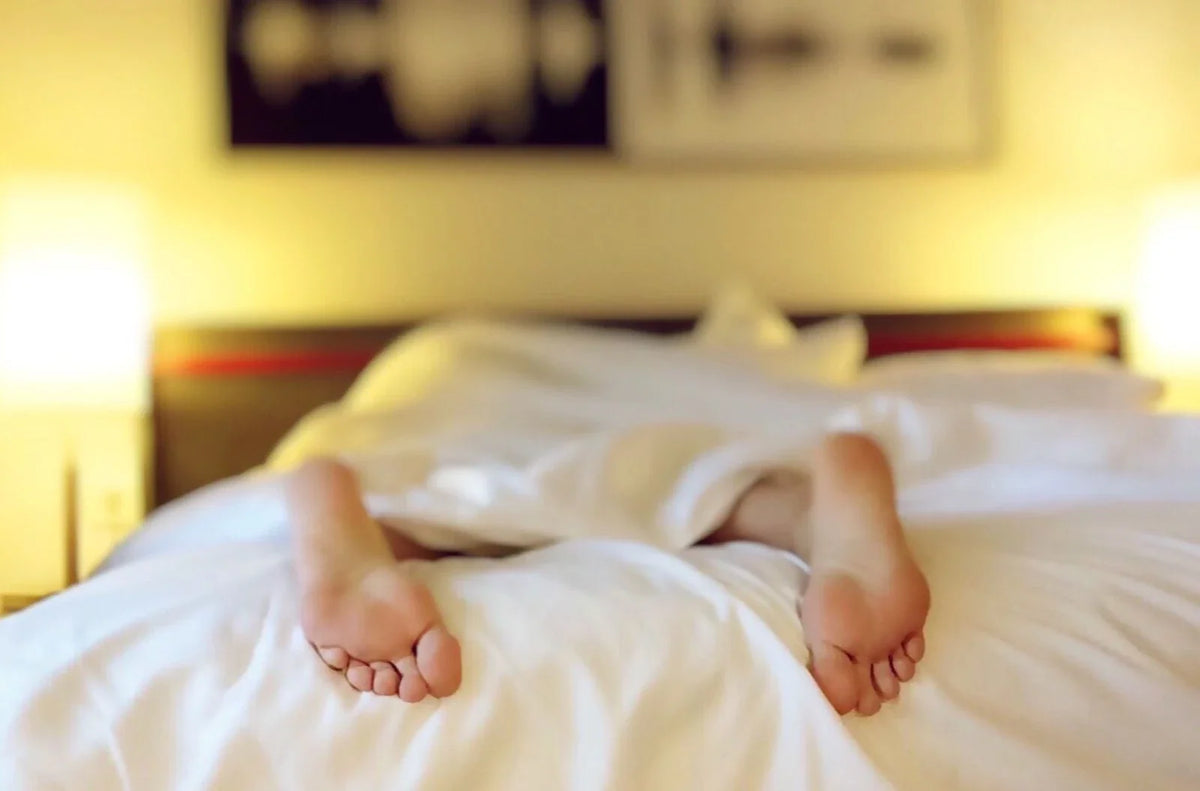
Sleeping naked can help some people sleep better, mainly because it removes a layer that traps heat. It is not a proven sleep treatment, and it is not the layer that matters most. If you sleep hot, it is worth trying. If you sleep cold, light sleepwear will usually give you most of the same benefit.
What Your Body Does Before Sleep
Falling asleep is not only a mental event. In the hours before bed, your core body temperature falls, and that fall is part of the signal that sleep is near. At the same time, blood vessels in your hands and feet widen, warm blood moves toward the skin, and heat leaves the body. Researchers call the gap between hand and foot skin temperature and chest and forehead skin temperature the distal to proximal gradient. In a controlled laboratory study by Kurt Krauchi and colleagues, published in 2000, that gradient was the best predictor of how fast healthy adults fell asleep, ahead of core temperature itself, heart rate, melatonin timing, and how sleepy people said they felt.
That finding sounds backward at first. Warm hands and feet help you fall asleep, yet sleeping naked is meant to cool you down. Both can be true, because they describe different parts of the same process. Warm skin at the hands and feet is a sign that heat is leaving the core. The core cools because the skin is giving heat away. Anything that blocks that release, such as heavy pajamas under a thick duvet in a warm room, can slow the process. Anything that lets heat leave in a controlled way can support it.
A second line of research makes the point even clearer. Roy Raymann and colleagues used a suit that warmed the skin by only about 0.4 degrees Celsius, within the normal range for the night, and found that small change shortened the time it took people to fall asleep without changing core temperature. In older adults with insomnia, the same kind of mild skin warming was linked to deeper sleep. The lesson is not that cold is good and warm is bad. The lesson is that the skin temperature pattern around sleep onset matters, and it is easy to disturb with too much insulation, just as it is easy to disturb by getting cold enough to shiver.
Room temperature sits behind all of this. The National Sleep Foundation puts the usual bedroom range for adults at 60 to 67 degrees Fahrenheit, about 15.6 to 19.4 degrees Celsius. That is a starting range, not a prescription. A person who runs cold may sleep worse at the low end, and a person who runs hot may still feel warm at the high end under a heavy duvet. The right question is whether you wake up hot, sweaty, or cold, and which layer is causing it.
What Sleeping Naked Actually Changes
Think of your night as a stack of layers. Room air sets the limit on how much heat can leave. The mattress traps heat underneath you. The duvet or comforter is usually the thickest layer on top. A sheet adds a smaller layer. Sleepwear is the thinnest adjustable layer in the stack. Removing it is a real change, but it is the change with the least leverage on its own. That is why sleeping naked can feel like a clear improvement for one person and like nothing at all for another. If the duvet is the problem, removing pajamas will not fix it. If the room is warm, removing pajamas will not cool the room.
Where sleeping naked does make a difference is in the details that add up. Tight waistbands, twisted fabric, and damp cotton can wake light sleepers when they turn over. Bare skin under a light sheet stays drier when the room is warm, because there is one less layer to hold sweat against the body. For people who kick the covers off and pull them back on through the night, one less layer also means one less thing to tangle. None of that is dramatic. It is the kind of small friction that matters more than it sounds at 2 a.m., when a small annoyance is enough to break sleep.
Sleeping naked does not mean sleeping cold. Most people who sleep naked still use a sheet or a light duvet, and the point is to let the bedding do the insulating, so you can add or remove a layer in seconds when your temperature shifts. If you try it and spend the night cold, you have learned that your room, your bedding, or your body runs colder than the version in the post you read.
The Claims That Go Too Far
Sleeping naked has become a favorite subject for short video posts, and many of them promise far more than the evidence supports. The most common claims are easy to spot: better skin, faster metabolism, stronger immunity, better fertility, deeper sleep, and a closer relationship, all from one change of habit. Some of those claims borrow a real finding about something else and attach it to naked sleep. A cool bedroom study is not a naked sleep study. A study of touch between partners is not proof that sleeping without clothes improves a relationship. A study of tight clothing and heat is not proof that loose pajamas are harmful.
Take skin first. Airflow can feel more comfortable, and less trapped moisture can feel better for skin that is easily irritated. That is a long way from proof that sleeping naked heals skin or prevents infection. Loose, breathable sleepwear and clean bedding give you most of the airflow benefit. If a skin problem keeps coming back, it deserves a clinician, not a change of sleepwear.
The same caution applies to hormones and metabolism. The body does make more brown fat, the kind that burns energy to make heat, when it is kept cool for long periods, and cool sleeping conditions have been studied for that reason. But those studies were about room temperature and bedding, not about whether the sleeper wore pajamas. Sleeping naked in a warm room under a heavy duvet will not recreate a cool room study. Sleeping in light pajamas in a cool room may come closer. The variable that matters is temperature, not nudity.
Closeness is the claim most likely to feel true personally and least likely to be proven generally. Many couples find skin contact calming, and many do not want it every night. If sleeping naked makes one partner uncomfortable, the lost comfort will cost more sleep than the gained coolness can repay.
The honest gap at the center of this topic is worth stating plainly. There is strong evidence that body temperature and skin temperature relate to sleep onset. There is no direct trial, as far as the published record shows, that assigned one group to sleep naked and another to sleep clothed and then measured sleep quality over weeks. That does not make sleeping naked useless. It means the honest claim is modest: it removes a small insulating layer, which can help people who sleep hot, and it is easy to test at home for a few nights.
Who It May Suit, and Who Should Skip It
Sleeping naked is most likely to help if you recognize yourself in one of these patterns. You wake up sweaty even when the room feels cool to someone else. You kick the duvet off, cool down, pull it back, and repeat. You wake because twisted pajamas pull or bunch when you turn. You sleep in a warm climate, or your bedroom holds heat through the night. In those cases, the layer you remove is the layer that was trapping heat, and the change can be felt on the first night.
It is less likely to help if you sleep cold. If your feet are cold at bedtime, your hands stay cold under the covers, or you wake shivering, removing a layer moves you in the wrong direction. That cold feet pattern deserves a special note, because it connects back to the temperature research. Warm feet before bed are linked to faster sleep onset in laboratory work, which is why a warm foot bath or warm socks before bed can help some people. That is one reason our earlier piece on sleeping with socks on reaches a different conclusion from the one people expect. Naked does not have to mean barefoot. A light top sheet, bare skin, and warm socks can coexist, and for a cold sleeper that combination may work better than either extreme.
There are also practical reasons to skip it. Children in the house, roommates, a shared dorm room, or a partner who prefers privacy all count. So does a cold house in winter, a bedroom with drafts, or a habit of getting up often at night. Allergies and sensitive skin can also argue against it, because bare skin spends more of the night in direct contact with sheets. If you try it, wash sheets more often than you did in pajamas.
Age and health change the calculation too. Older adults often tolerate cold less well, and the skin warming research that helped some older insomniacs used gentle warming, not cooling. If sleep problems last for weeks, or come with loud snoring, long pauses in breathing, or daytime sleepiness that affects work or driving, a clinician is the right next step, not a new set of sleep habits.
How to Try It for a Week
A week is long enough to learn something and short enough to stay honest. Start with the big layers first, because they matter more than sleepwear. Set the room toward the cool end of your comfort range, not the cold end. Our earlier piece on why a cool room helps sleep explains that range and why going too cold backfires. Use a light sheet as your first layer, with a duvet nearby that you can pull up or push down without waking right up. That way you are testing one change, not three.
On the first two nights, keep the rest of your routine steady. Go to bed at your usual time, keep the room dark, and keep the phone out of the bed. If light is part of what wakes you, a gently weighted wraparound sleep mask can cover that problem without adding a warm layer over the rest of your body. If you usually take a warm bath before bed, keep it. Our piece on warm baths before bed notes that the bath works in part because the body cools after it, which fits the same temperature pattern as this article.
Judge the week by pattern, not by one night. Note three things each morning: did you fall asleep faster, did you wake less from heat or sweat, and did you wake cold at any point. If the first two improve and the third never happens, the habit suits you. If you wake cold even once or twice, add back a light layer, or keep socks on, and see whether the benefit stays. If nothing changes after a steady week, the layer was not your problem. The problem may be the duvet, the room, the schedule, or something else entirely, and chasing it with more extreme versions of the same change will not help.
Keep a robe within reach, so a midnight trip does not become a cold shock, and wash the sheets at the start of the week, so you are judging the habit, not last week's bedding. If you share a bed, agree the test together. It works best when both people can sleep.
Frequently Asked Questions
Does sleeping naked help you fall asleep faster? It can, for people who sleep hot, because it removes a layer that traps heat and lets the body cool. There is no direct trial proving it for everyone, and the effect, when it happens, is small. Room temperature and bedding matter more.
Is sleeping naked better than light pajamas? For hot sleepers, sometimes. For cold sleepers, no. Light, loose, breathable pajamas give much of the airflow benefit without the cold, privacy, or laundry trade offs. The best choice is the one that leaves you neither sweaty nor cold at 3 a.m.
Should I still wear socks if I sleep naked? You can. Warm feet before bed are linked to faster sleep onset, and cold feet can keep you awake. Socks plus a light sheet is a reasonable middle path, especially if your feet run cold while the rest of you runs hot.
Do I need to wash sheets more often? Yes, a little more often. Bare skin leaves more skin cells and body oil on sheets than pajamas do. Once a week is a sensible starting point for most people, and more often if you sweat at night or have sensitive skin.
Can sleeping naked replace other sleep habits? No. It cannot make up for an irregular schedule, a bright room, late caffeine, or a sleep disorder. Think of it as one small layer in a larger routine. If the rest of the routine is unsettled, changing sleepwear will not settle it.
Sleeping naked is a reasonable experiment, not a secret that other sleepers have missed. It helps when heat is the problem, it hurts when cold is the problem, and for many people it makes no difference at all. Try it for a week with the room cool, a light sheet ready, and a way to warm up fast. Then keep it only if your mornings tell you it helped, and let it go without a second thought if they do not.



Share:
How to Sleep With Noisy Neighbors Through the Wall (TV, Music and Voices)
Does Sleep Help You Remember What You Learn?