
Article: Tired but Wired: Why Young Adults Can’t Switch Off at Night
Tired but Wired: Why Young Adults Can’t Switch Off at Night
Written by Laura
Laura writes about the quiet systems that shape how we rest—our environments, routines, and emotional lives.
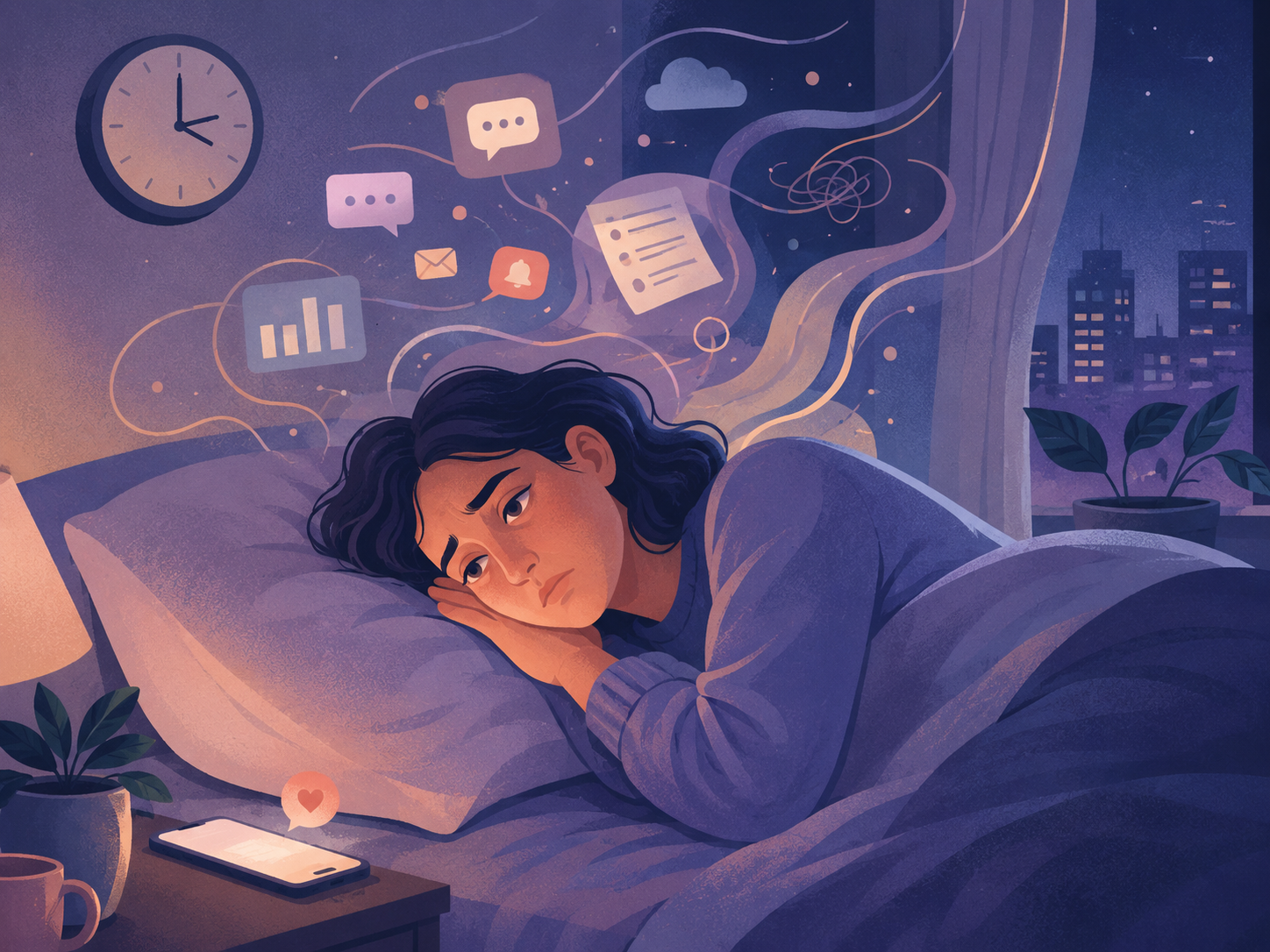
It is 11:48 p.m. You felt exhausted on the sofa, but the moment you got into bed, your mind became strangely efficient. It replays a message you should have answered, tomorrow’s unfinished list, a conversation from three years ago—and then suggests one more scroll while you wait to feel sleepy again.
This is the modern tired but wired feeling: your body is asking for rest while your brain is still scanning, solving, anticipating, or trying to reclaim a little time that feels like your own. Heat, light, caffeine, body clocks, and inconsistent schedules all matter. But for many young adults, these factors meet at one final pathway: emotional arousal. The body may be in bed, while the nervous system has not yet received the message that the day is over.
Why can’t young adults switch off at night?
Young adults often cannot switch off because sleep depends on more than tiredness. Sleep pressure may be high, but the circadian system, environment, habits, and emotional state can still signal “stay awake.” A late schedule, warm room, bright phone, caffeine, unfinished work, or social worry can each add a small amount of alertness. Together, they can overpower the feeling of physical fatigue.
That is why “I am exhausted” and “I cannot fall asleep” can be true at the same time. Tiredness describes a need for rest. Sleepiness is the brain’s readiness to cross into sleep. When your mind is anticipating, rehearsing, or protecting, those two states can drift apart.
Modern young adulthood also compresses many roles into the same space and the same device. Work, entertainment, relationships, news, shopping, and identity all arrive through one screen. Bedtime is no longer a clean edge between day and night; it can feel like the only quiet place left to catch up on everything.
What does the data show?
Recent U.S. data show that difficulty falling asleep is especially common among younger adults. In the 2024 National Health Interview Survey, 18.3% of adults ages 18–34 reported trouble falling asleep most days or every day—the highest share of the age groups reported. This is a current age comparison, not proof that sleep has become worse across generations.
Reading the chart: Young adults are not necessarily sleeping the fewest hours, but they are the age group most likely to struggle with falling asleep. Source: U.S. National Center for Health Statistics, National Health Interview Survey, 2024.
One chart cannot tell us why an individual is awake. It does, however, challenge the idea that sleep trouble is only an age-related problem. For many younger adults, the hardest part is not waking early—it is making the transition from an activated day to a resting night.
Can weather and heat make sleep harder?
Yes. Warm nights can make it harder for the body to begin and maintain sleep. The body normally sheds heat as bedtime approaches. When the bedroom is hot or humid, that cooling process becomes less efficient, and sleep onset may be delayed. Research using large-scale sleep data has linked unusually warm nights with shorter sleep, particularly through later sleep onset.
Weather is therefore a real part of the story, not an excuse. A warm room can increase tossing, sweating, thirst, and light awakenings. Those sensations also give the mind more opportunities to notice that it is still awake. Once you think, “Why am I not sleeping yet?”, physical discomfort can become emotional pressure.
This is the first important pattern: an environmental trigger can become an emotional amplifier. Heat may start the problem, but frustration, clock-watching, and worry about tomorrow can keep it going even after the room cools.
Is your body clock part of the problem?
Your body clock can make you feel alert at a time when your schedule says you should sleep. Young adults often have later biological timing than older adults, and evening light can push that timing later. Add irregular weekends, late meals, caffeine, or bright screens, and the brain may not interpret midnight as “night” yet.
Two systems are interacting. Sleep pressure builds the longer you stay awake. Your circadian rhythm helps decide when alertness rises and falls. You can have plenty of sleep pressure and still catch a circadian “second wind,” especially after bright light, stimulating content, or late-night work.
Individual differences matter too. Some people are more sensitive to caffeine, noise, temperature, or schedule changes. Hormonal shifts, medications, pain, breathing problems, and mental health conditions can also affect sleep. “It is just your mindset” is neither accurate nor helpful. The better question is: which layers are keeping this particular nervous system awake tonight?
Why does it often come back to emotion?
Emotion is often the final common pathway because sleep requires a reduction in vigilance. Worry, unresolved conflict, loneliness, performance pressure, and even excitement can tell the brain that something still needs attention. The trigger may be physical or behavioral, but the brain’s interpretation—safe enough to let go, or important enough to monitor—helps determine whether arousal fades.
Sleep researchers use terms such as cognitive arousal for racing thoughts and physiological arousal for the body’s activated state. You may notice a tight jaw, quick heartbeat, shallow breathing, or the urge to check something. These are not personal failures. They are signs that the brain is still running a daytime protection program at night.
| What You Notice | Environmental Layer | Body Layer | Emotional Layer |
|---|---|---|---|
| Hot and restless | Heat or humidity | The body struggles to cool | Discomfort increases alertness |
| Tired but scrolling | Light and notifications | Bedtime shifts later | Night feels like the only personal time |
| Racing thoughts | Quiet, with no obvious trigger | Cognitive arousal stays high | Worry and unfinished thoughts resurface |
| Waking easily | Light, sound, or movement | The arousal threshold is lower | The brain remains on guard |
The layers are not competing explanations. They interact. A dark, cool room will not solve every worry, and a calming routine will not cancel a medical sleep disorder. But identifying the layers helps you stop treating sleep as a willpower test.
Why do we keep scrolling when we are tired?
Bedtime procrastination often happens when going to sleep feels like surrendering the last piece of personal time. Researchers define it as going to bed later than intended without an external reason preventing it. The behavior can look irrational from the outside, but emotionally it may function as compensation after a day dominated by work, study, family, or other people’s needs.
The phone is unusually good at meeting that need. It offers novelty, connection, escape, and choice with almost no effort. Unfortunately, it also brings light, emotional stimulation, unpredictable rewards, and an endless supply of unfinished content. The activity that provides short-term relief can create tomorrow’s fatigue.
- A stressful, demanding day
- A need to reclaim personal time
- Scrolling and bedtime procrastination
- Shorter or more fragmented sleep
- Weaker emotional regulation the next day
- More stress and sensitivity—and the loop begins again
Sleep loss can also make negative events feel more intense the next day. That means the problem is self-reinforcing: stress delays sleep, and insufficient sleep reduces the emotional bandwidth available to handle stress. Breaking the loop may require more than removing the phone. It may require creating genuine choice and recovery before bedtime.
How can you help your brain switch off?
Help your brain switch off by reducing both sensory input and unfinished emotional business. Start with one or two repeatable cues rather than building a perfect routine. The most useful routine is not the most elaborate one; it is the one your brain can learn to recognize as a reliable end to the day.
1. Make the room say “nothing to monitor”
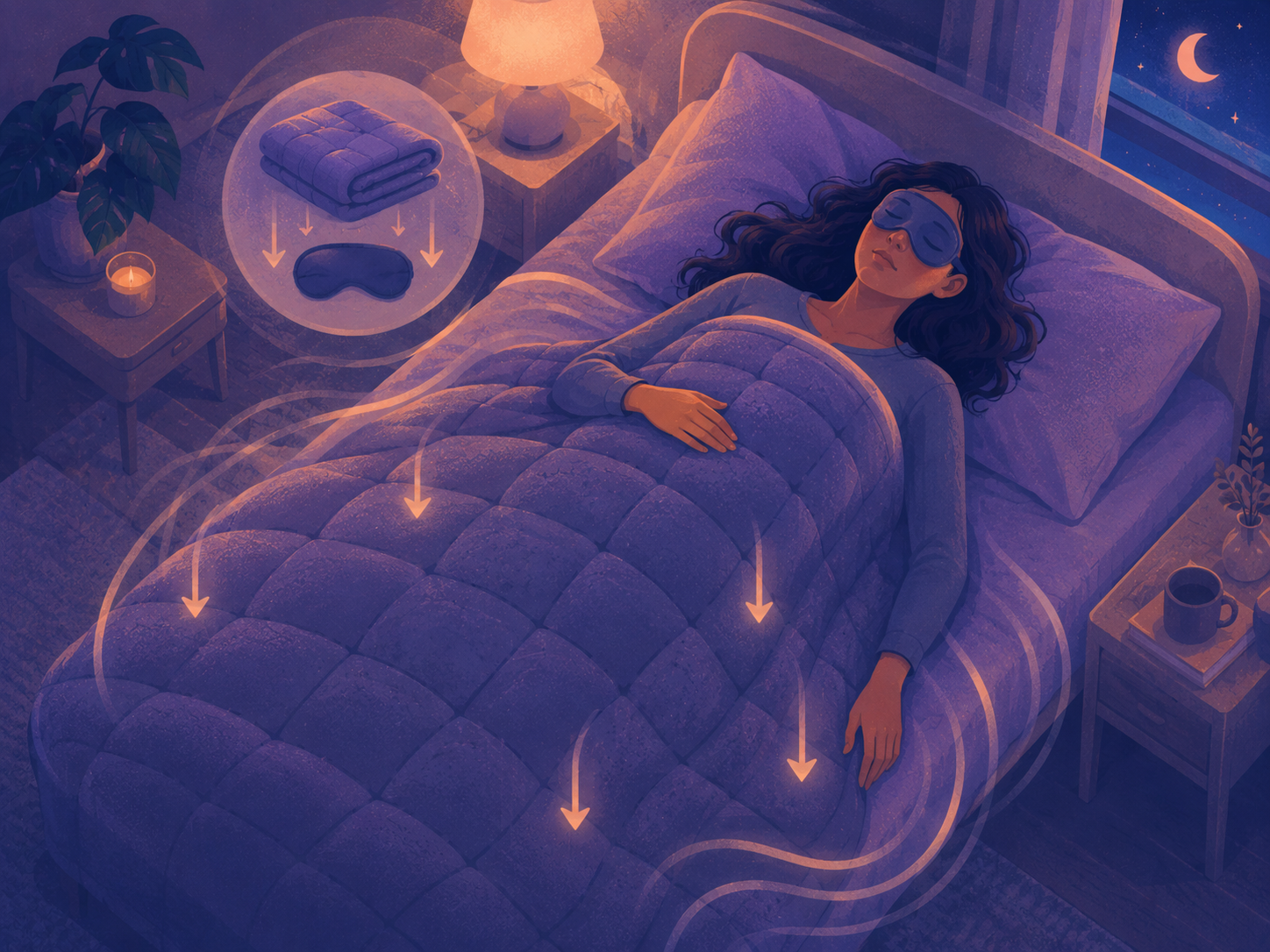
Cool the room when possible, reduce sudden noise, and remove small light sources. Darkness supports the brain’s nighttime signal and reduces visual interruptions. Blackout curtains can help; a comfortable sleep mask can create a more consistent darkness cue when the room or travel environment is difficult to control. Think of it as supporting the conditions for sleep, not treating anxiety or insomnia.
2. Give unfinished thoughts somewhere to go
Five minutes before your wind-down, write three short lists: what is unfinished, the next physical action, and when you will return to it. The goal is not to solve tomorrow tonight. It is to show the brain that the task has been captured and will not disappear if vigilance stops.
3. Reclaim personal time earlier
If bedtime is your only free time, sleep advice can feel like another demand. Protect a small period of choice earlier in the evening—even 20 minutes with no productivity goal. When autonomy is not postponed until midnight, the urge to “steal” time from sleep may become less powerful.
4. Anchor the morning, not only the night
A fairly consistent wake time and morning light help stabilize circadian timing. Night routines work better when the body receives a clear daytime signal too. After a poor night, avoid shifting the entire schedule dramatically if you can do so safely.
5. Reduce friction before willpower is low
Charge the phone away from the bed, turn off nonessential notifications, choose tomorrow’s alarm in advance, and decide what “last content” means before you begin scrolling. These steps move the decision to an earlier moment, when the tired brain has more self-control.
6. Stop trying to win a fight with sleep
Clock-watching and mentally calculating the hours left can increase pressure. If you are awake and becoming frustrated, a quiet, low-light activity away from the bed may help interrupt the association between bed and struggle. Return when sleepiness grows. If this pattern is frequent or persistent, cognitive behavioral therapy for insomnia (CBT-I) is a well-established treatment to discuss with a qualified clinician.
The deeper shift: Do not ask, “How do I force myself to sleep?” Ask, “What is my brain still trying to protect, finish, or reclaim?”
So, why are young people sleeping badly?
Young people are not sleeping badly for one simple reason. Climate and bedroom conditions can disturb the body. Circadian timing, caffeine, light, and individual sensitivity can delay sleepiness. But emotion often connects these pieces: discomfort becomes frustration, an unfinished day becomes rumination, and a lack of autonomy becomes bedtime procrastination.
The answer is not to blame young adults for using their phones or to pretend every sleep problem can be solved with a better routine. It is to recognize that sleep is a transition into safety and reduced vigilance. Better rest becomes more possible when the environment is gentler, the body receives consistent timing cues, and the mind no longer has to use midnight as its only place to process the day.
Frequently Asked Questions
Why can’t I sleep even though I’m tired?
You may have high sleep pressure but also high alertness. Stress, racing thoughts, bright light, caffeine, a warm room, irregular timing, or an activated body can keep the brain awake even when you feel exhausted. Persistent difficulty deserves professional assessment because medical and mental health conditions can also affect sleep.
Does “tired but wired” mean I have insomnia?
Not necessarily. “Tired but wired” is a description, not a diagnosis. Insomnia involves ongoing difficulty falling asleep, staying asleep, or waking too early, along with daytime impact, despite having an adequate opportunity to sleep. A healthcare professional can assess the pattern and rule out other causes.
Can hot weather really stop me from sleeping?
Yes. The body normally loses heat around sleep onset, and a hot or humid room can interfere with that process. Cooling the room, using breathable bedding, improving airflow, and reducing heat-trapping layers may help. Sudden or severe night sweats should be discussed with a clinician.
How do I stop racing thoughts at night?
Try capturing unfinished tasks before bed, scheduling a short worry period earlier in the evening, reducing stimulating content, and using a repeatable low-light wind-down. If thoughts remain intense, distressing, or linked to anxiety, trauma, or low mood, professional support may be more appropriate than adding more sleep “hacks.”
How much sleep do young adults need?
The American Academy of Sleep Medicine and Sleep Research Society recommend that adults sleep seven or more hours per night on a regular basis to support optimal health. Individual needs vary, and sleep quality, timing, and daytime functioning matter alongside the number of hours.
When should I talk to a doctor about sleep?
Seek medical advice if sleep difficulty is persistent, causes significant daytime impairment, or comes with loud snoring, gasping, breathing pauses, unusual movements, severe pain, extreme daytime sleepiness, or major changes in mood. Do not drive or operate machinery when dangerously sleepy.
Sources
- National Center for Health Statistics. Sleep difficulties in adults: United States, 2024.
- American Academy of Sleep Medicine and Sleep Research Society. Recommended amount of sleep for a healthy adult.
- Minor K, et al. Rising temperatures erode human sleep globally. One Earth. 2022.
- Kroese FM, et al. Bedtime procrastination: introducing a new area of procrastination. Frontiers in Psychology. 2014.
- Study of emotion coping strategies, sleep-related beliefs, and sleep in young adults with insomnia.
- Sleep debt and amplification of negative emotional responses to daily events.
Medical disclaimer: This article is for general education only and is not medical advice, diagnosis, or treatment. Sleep products can support a comfortable sleep environment but do not treat insomnia, anxiety, or other health conditions.