

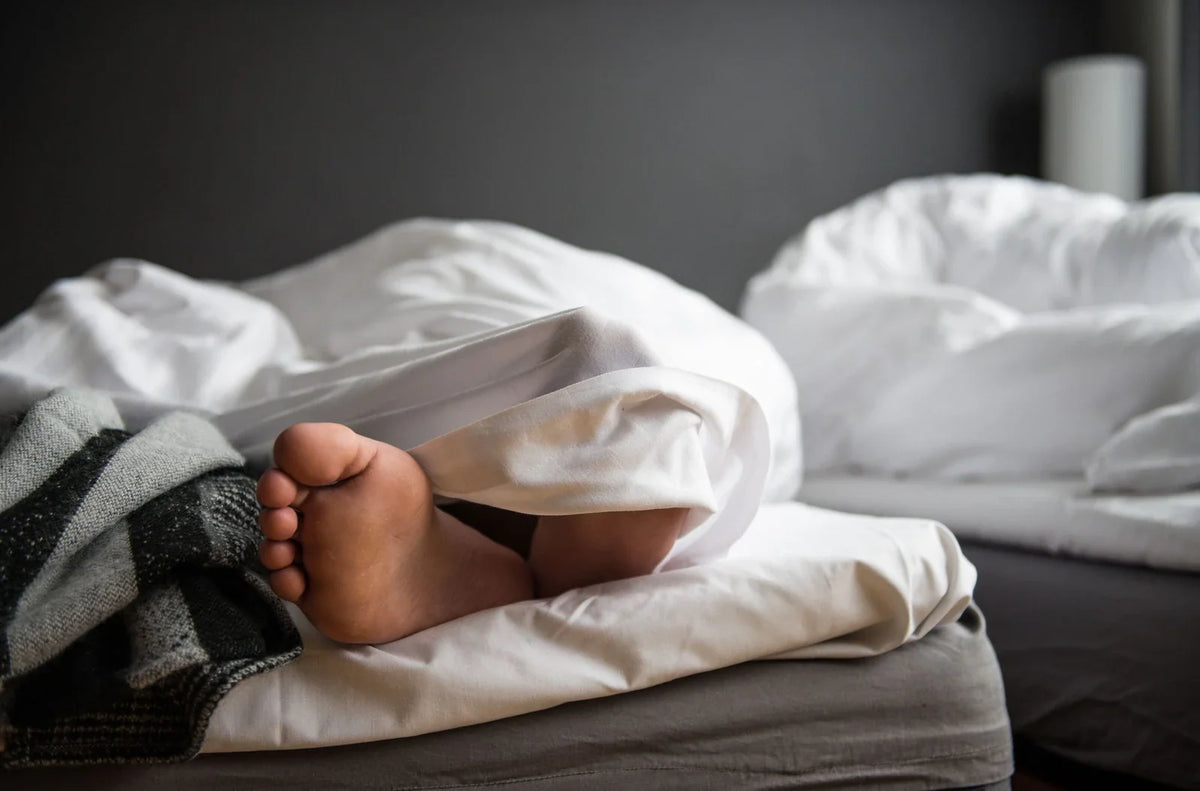
Cold feet at night are common, and they can slow the process that puts you to sleep. Your body sheds heat through your feet to fall asleep, so cold feet mean that exit is half closed. Warming them helps in most cases. Feet that stay cold every night, especially with numbness or color changes, are worth mentioning to a doctor.
Frequently asked questions
Does wearing socks to bed help you fall asleep?
For many people, yes, and there is a small study behind it. In a 2018 trial, six young men slept in a cool room at 23 degrees Celsius, once wearing bed socks and once without. With socks they fell asleep about 7.5 minutes faster, slept about 32 minutes longer, woke less often, and their sleep efficiency was 7.6 percent higher. Six people in a lab is a small sample, so treat the numbers as a signal, not proof. Loose, breathable socks are the low risk way to test it. Our guide to whether you should wear socks to bed covers fit and fabric.
Why are my feet cold but the rest of me is warm?
Because your feet sit at the far end of the line. They are the farthest point from your heart, they carry less muscle than your legs or torso, and muscle is one of the ways your body makes heat. At night your body also pulls blood toward the core to protect it, which leaves less warm blood reaching your toes. That is why your chest can feel fine while your feet feel like ice.
Can cold feet wake you up at night?
They can. Falling asleep needs your body to lose heat, and it loses most of that heat through the skin of the hands and feet. When the blood vessels in your feet stay narrow, heat cannot get out, core temperature stays up, and sleep comes slower. A foot that slips out from under the covers in the night can cool down enough to wake you, and once it is cold it takes a while to warm again. Warming the feet helps with falling asleep, not with every kind of waking.
What is the fastest way to warm cold feet in bed?
Put on loose bed socks and tuck your feet under the covers. Socks work by holding the heat your feet already make, so they help most when your feet are only mildly cold. If your feet are properly cold, warm them first. A warm foot soak for ten to twenty minutes before bed, or a hot water bottle at the foot of the bed, raises foot skin temperature directly, and then the socks hold that warmth in place. A few minutes of walking or gentle ankle circles before bed gets blood moving too. Tight socks do the opposite: a band that squeezes the ankle slows the blood flow you are trying to encourage.
When should I worry about cold feet at night?
When the pattern is new, persistent, or comes with other symptoms. Cold feet every night despite socks or a soak, tingling or numbness, skin that turns white, blue, or blotchy, sores that heal slowly, or leg pain when you walk are all reasons to talk to a doctor. Those signs can point to circulation or nerve problems, and only an examination can tell. This article cannot diagnose anything. It can only help you tell ordinary cold feet from a pattern worth checking.
Your feet are your body's radiators
To fall asleep, your body has to cool down. Core temperature falls by about one degree Celsius in the hours before bed, and that fall is one of the signals that tells the brain it is time to sleep. The heat has to go somewhere, and it goes out through the skin, mostly at the hands and feet. The blood vessels near the surface there widen, warm blood flows out to the skin, and heat escapes into the air. Scientists call this widening distal vasodilation.
The link between warm extremities and fast sleep onset is one of the steadier findings in sleep research. In a 1999 study published in Nature, researchers in Basel found that how far the blood vessels in the hands and feet had opened was the strongest physiological predictor of how quickly people fell asleep. A follow up in 2000 found that the temperature gap between the feet and the torso predicted sleep onset better than core temperature, heart rate, or melatonin onset. In plain terms, warm hands and feet mean the heat exit is open.
That is the counterintuitive part of this whole subject. Warming your feet does not warm your core. It helps your core cool down. Warm feet let heat leave the body, core temperature falls faster, and the brain gets the signal it is waiting for. Cold feet do the opposite. The vessels stay narrow, heat stays trapped in the core, and the body holds on to wakefulness a little longer. This is also why the room matters. A cool bedroom gives the heat somewhere to go; a hot one does not, no matter how warm your feet are. Our article on why you sleep better in a cool room covers the room side of the same system.
Why feet go cold at night
Most cold feet at night have an ordinary explanation, and usually more than one is true at once. Distance and muscle come first. Your feet are the farthest point from your heart, so warm blood takes longest to reach them, and they carry little muscle of their own to generate heat. Any dip in circulation shows up in the feet before anywhere else.
Lying still comes second. During the day your calf muscles help push blood back up toward the heart every time you walk. In bed that pump stops. Blood moves more slowly, and feet that were fine while you were moving can go cold within minutes of lying down. A sedentary evening makes it worse: hours on the sofa leave the feet cooler at lights out than an evening with movement in it.
A cool bedroom comes third, and here the line is finer than people expect. A cool room helps sleep, but a cold room can overdo it. Sleep researchers usually put the ideal bedroom around 65 to 68 degrees Fahrenheit, about 18 to 20 degrees Celsius. Below that, feet left outside the covers can lose heat faster than the body replaces it. Blankets only trap the heat you already have, so feet that were cold before bed tend to stay cold under the covers.
Stress and tension come fourth. When you are anxious or wound up, the body narrows the small blood vessels in the hands and feet and sends blood toward the core and the muscles. It is the same response that makes your hands cold before a difficult conversation. If you cannot fully relax in the evening, blood flow to the feet stays limited, and the feet stay cold. Slow breathing can help, not by warming the feet directly, but by letting tension ease and vessels open. Our guide to 4-7-8 breathing for sleep is one simple version.
Tight clothing during the day comes fifth. Shoes that pinch, socks with a tight band, or high heels can restrict blood flow for hours, and the effect lingers into the evening. Changing into soft socks or going barefoot for a while before bed gives the vessels room to open again. Hormones come sixth, and this is one reason women report cold feet more often. Hormonal changes can make hands and feet more sensitive to cold, and thyroid and iron levels both affect how much heat the body makes. That does not make cold feet a hormone problem, only a reminder that the same cool room feels different to different people.
Why cold feet can keep you awake
The mechanism is simple enough to state in one sentence. Falling asleep needs heat to leave the body through the feet, and cold feet mean that exit is closed. The evidence is stronger than most sleep tips, and narrower than it first looks.
The strongest evidence is the Basel work on the temperature gap. Warm feet relative to the torso predicted fast sleep onset in healthy young adults, and the prediction held up against the other signals researchers usually trust. That tells us the heat exit matters. It does not tell us that warming cold feet fixes every sleep problem, and later work showed the limits. A review of foot warming studies found the same limit: warming sped up sleep onset in healthy adults and in older adults without sleep complaints, but in older adults with insomnia none of the methods helped. The heat exit was not their bottleneck, so opening it wider did nothing.
The bed socks trial is the most direct test, and the one to quote with care. Six young men, one cool room, two nights each, with the numbers already given above. Core temperature did not change, which matters: the socks helped the body shed heat rather than overheating it. But six people is a small group, all young, all male, all healthy, in a lab. Treat the numbers as a signal, not a promise.
A warm bath works on the same logic from the other direction. A 2019 review of warm baths before bed found that bathing in water around 40 to 42.5 degrees Celsius, one to two hours before bed, was associated with falling asleep sooner and better self rated sleep quality. Heating the body first lets core temperature fall faster afterward. A warm foot soak is the smaller version of the same idea. None of this makes warm feet a treatment for insomnia. If your mind is racing, if pain wakes you, or if your schedule is shifted, warming your feet will not fix those things. It fixes the temperature piece of falling asleep, and only when that piece is actually the problem. If you lie awake with cold feet night after night, the feet may be the whole story. If you lie awake with warm feet, look elsewhere.
What actually warms them
Start with the simplest test, because it costs nothing. Tonight, put on loose bed socks. Not the socks you wore all day, and not anything with a tight band at the ankle. Soft wool or cotton, loose enough that you can slide a finger under the cuff. If your feet warm up within twenty minutes and you fall asleep faster, you have your answer. If they stay cold, the socks are not failing; the feet need warming first, and the socks only hold the warmth in.
A warm foot soak is the most direct way to warm cold feet. Ten to twenty minutes in comfortably warm water before bed raises foot skin temperature and opens the vessels. Dry your feet well, put the loose socks on right away, and get into bed while the warmth is still there. A hot water bottle at the foot of the bed does the same job with less effort: put it under the covers ten minutes before you get in, and keep it at your feet. Take care with both. Water that is too hot can scald, and a hot water bottle against bare skin all night can burn. Warm, not hot, and never fall asleep with a heating pad on high.
Movement is the tool people skip because it sounds too simple. A few minutes of walking around the room, gentle ankle circles, or standing on tiptoe a few times before bed gets the calf pump working and sends warm blood down to the feet. It does not need to be exercise. The goal is to break the stillness, not to raise your heart rate. A short walk after dinner does the same job earlier in the evening. Fix the room, not just the feet. Keep the bedroom around 65 to 68 degrees Fahrenheit, and keep your feet under the covers. A foot that slips out in the night cools fast and wakes you, so tuck the covers in at the foot of the bed. If the room is much colder than that, warm the room a little rather than piling on blankets. Blankets cannot warm feet that are already cold; they only keep the warmth you bring to bed.
A few things are not worth trying. Tight socks slow the blood flow you are trying to encourage, so they make the problem worse even though they feel warm at first. An electric blanket turned up high all night overheats the core, which works against the cooling your body needs to stay asleep. Alcohol may feel warming, because it widens blood vessels in the skin, but it fragments sleep later in the night. Our article on whether alcohol helps you sleep covers that trade in full.
When to mention it to a doctor
Ordinary cold feet come and go with cold nights, still evenings, or stress, and they warm up with socks or a soak. A pattern worth checking looks different. Feet that are cold every night no matter what you try, feet that tingle, go numb, or feel painful, skin that turns white, blue, or blotchy and stays that way, sores on the feet that heal slowly, or pain in the legs when you walk are all reasons to talk to a doctor.
A few conditions are commonly linked to persistent cold feet, and knowing their names helps you describe what you feel. Poor circulation from narrowed arteries can leave feet cold and painful. Nerve damage, most often from diabetes, can make feet feel cold, numb, or tingly even when their actual temperature is normal. An underactive thyroid slows the body's heat production, low iron leaves less oxygen reaching the tissues, and Raynaud's phenomenon makes the small vessels in the fingers and toes narrow sharply in response to cold or stress. None of these can be diagnosed from a feeling of cold feet alone. If cold feet are new, persistent, or come with any of those signs, say so at your next appointment. Bring the pattern, not a diagnosis.
Cold feet at night are not the same as waking up cold in the middle of the night. Feet cold at lights out are usually a heat exit problem, and warming them helps. Waking up cold hours later usually means the room got colder or the covers slipped, and the fix is the room and the bedding. Our article on why you wake up cold at night covers that second problem.
The short version
Cold feet at night are common, and they are not just uncomfortable. Your body needs to lose heat through your feet to fall asleep, so cold feet can slow that process down. Warm them first with a soak or a hot water bottle, hold the warmth with loose socks, keep the room cool and your feet under the covers, and give it a few nights. If the pattern does not change, or if numbness, color changes, or slow healing sores come with it, talk to a doctor.
One honest limit belongs here. A sleep mask cannot warm your feet. It only handles the light. A weighted sleep mask sits gently over the eyes and blocks the light that keeps a waking brain alert, which helps when the room is not fully dark. It will not fix cold feet or make up for a cold room. But once your feet are warm and the lights are handled, that is usually enough to let sleep do the rest.



Share:
Can a Nap Help You Think More Creatively?
How to Sleep When Your Cat Wakes You Up at Night