

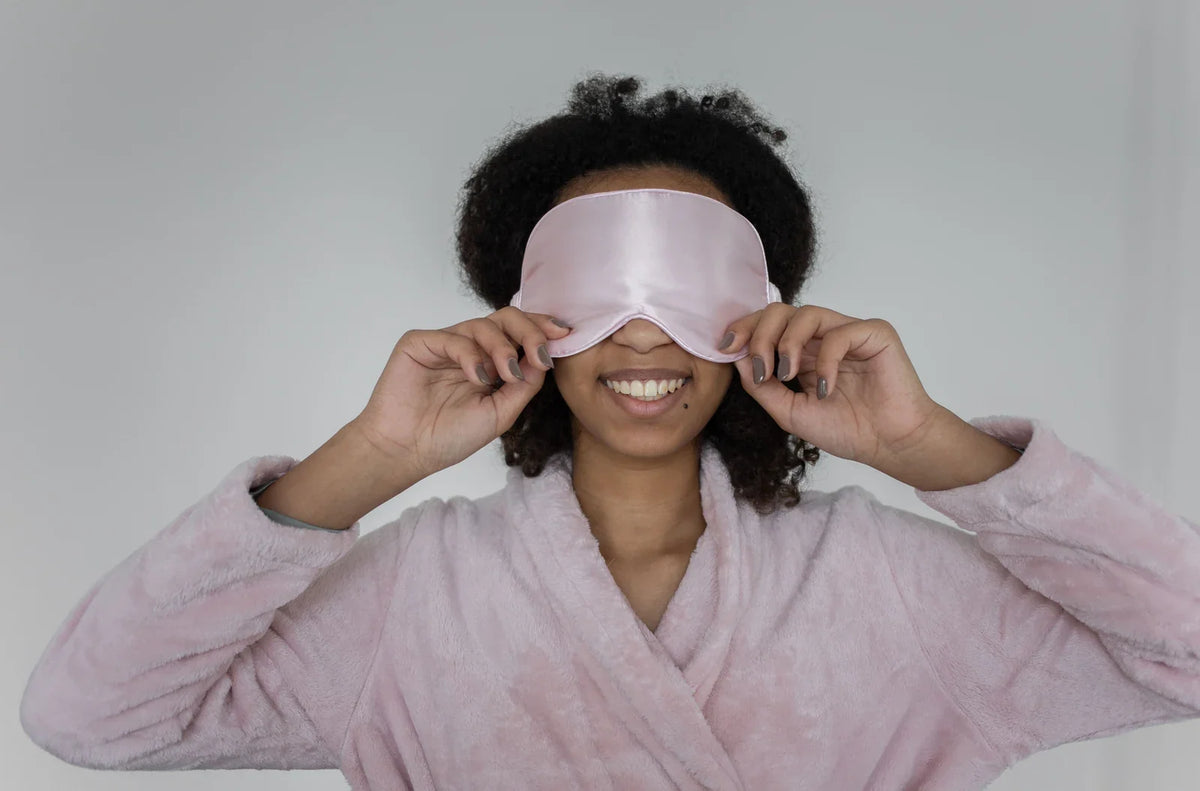
The best sleep mask for travel is not simply the smallest one or the darkest-looking one. It is the mask that passes four tests for your actual trip: it controls the light gaps you expect, stays acceptable in your usual travel position, packs without becoming awkward or damaged, and has care instructions you can realistically follow. Choose for the seat, room, bag, and cleaning routine you will actually use—not for a generic “best” label.
Start with the trip, not the product page
A two-hour train ride, an overnight flight, a bright hotel room, and a week of changing accommodations create different problems. Before comparing materials or shapes, write down where you expect to rest and what you cannot control.
CDC/NIOSH travel guidance includes eye masks among the ways to reduce light and suggests packing one when sleeping away from home. That supports a modest role: a mask can create a personal light barrier when the cabin or room is not fully dark. It does not mean a mask fixes jet lag, replaces enough sleep time, or solves noise, temperature, timing, or interruptions. If noise is part of the trip too, see whether to pack earplugs, a sleep mask, or both.
Turn the itinerary into a short brief. Will you mainly sit upright? Do you expect side sleeping in a hotel? Is the mask going into a tightly packed personal item? Will you need it before your checked bag arrives? Will you be able to wash and fully dry it before the return journey? Your answers decide which compromises matter.
Test 1: Map the light gaps you need to control
Travel light is rarely one uniform source. On a plane it may enter from a window edge, reading light, aisle, or seatback screen. In a hotel it may come around curtains, under a door, or from small device indicators. A mask should be judged by how it covers the areas where light reaches your eyes, especially around the nose, upper cheek, and temples.
Look at the actual shape rather than relying on words such as “blackout.” A small flat panel may pack easily but leave more room for side gaps on some faces. A contoured design may create eye space but add bulk. A broad wrap may extend coverage toward the temples and ears but create more contact and take more room. These are construction trade-offs, not a universal ranking.
At home, reproduce the type of light you expect. Leave one lamp or a narrow curtain gap on, place the mask, wait for your eyes to adjust, then turn your head once in each direction. If the same bright line remains, the shape may not match your face. If the gap moves when your head moves, the fastening, hair, or pillow may be the more important variable.
Test 2: Try the position you will actually use
Do not choose a travel mask only while standing in front of a mirror. Test it where the pressure will occur.
- For an upright seat: lean against a headrest and notice whether the rear hardware pushes forward, slides, or catches your hair.
- For a hotel bed: lie on your usual side and check whether an edge, buckle, or thick seam sits between your temple and the pillow.
- For changing positions: move once from back to side. A setting that works only when perfectly still may be too demanding for the trip.
Separate coverage from pressure. More surface area can close a gap, but it also means more contact. Eye cups create space around the eyelids, while flat or wraparound designs contact different areas. Stop or reposition a mask if you feel sharp pressure, pinching at the nose, or a closure that must be pulled uncomfortably tight. “Adjustable” only means you can change the setting; it does not promise a workable fit for every traveler. The same comfort checks apply at home; see sleeping in a mask every night.
Test 3: Run a real packing test
Packability is not just the number of centimeters a mask occupies when you squeeze it. A useful travel mask should fit into your real bag, remain easy to find, and return to a usable shape without forcing delicate parts into a hard fold.
Do one rehearsal with the same personal item or carry-on you plan to use. Put the mask where you will reach it during the journey, not at the bottom beneath shoes or toiletries. Close the bag, leave it packed for several hours, then remove the mask and check four things:
- Shape recovery: does the front panel, nose area, or eye-cup structure return to its intended shape?
- Closure control: is the fastening secured so it does not catch on knitwear, cables, or loose hair accessories?
- Clean separation: can you keep the face-contact surface away from shoes and used clothing without pretending an unlisted pouch is included?
- Access: can you retrieve it after boarding without unpacking the whole bag?
A very compact mask can still be a poor travel choice if it creases into your eyes or disappears at the bottom of the bag. A larger design can still be workable if it rolls predictably and has an obvious place in your packing system. Judge the complete routine, not a staged product photo.
Test 4: Check the care plan before you leave
A travel mask touches skin, hair, headrests, pillows, and the inside of a bag. Before buying, read the product-specific care instructions. Do not assume that every mask can be machine washed, tumble dried, folded wet, or treated with the same detergent.
Ask three practical questions: Can you clean it during the trip if needed? Where will it dry completely? What will you do with it between uses? If the answer depends on a hotel dryer, harsh detergent, or packing it while damp, choose a different routine or a construction whose stated care you can follow.
For any personalized design, also check whether the maker gives separate instructions for protecting the print or lettering. Care convenience is part of the purchase decision because a mask that is difficult to clean on your itinerary may be less useful than a simpler option whose instructions match your trip.
Use a six-point travel buyer checklist
Score each candidate against the same six questions. You do not need a fake total out of 100; a clear pass, compromise, or fail is more honest.
- Expected light: does the shape address the nose and temple gaps you found in your home test?
- Travel position: does it remain acceptable against a headrest and in your usual hotel sleep position?
- Contact preference: do you want eye space, a small contact area, or broader wraparound contact?
- Fastening: can you set it consistently without hard hardware where your head rests?
- Bag behavior: does it roll or pack predictably, recover its shape, stay clean, and remain accessible?
- Care reality: can you follow the stated cleaning and drying instructions during this trip?
Mark a fail when one issue would stop you using the mask. For example, a compact eye-cup mask fails if the cup collapses in your bag and presses the eye area. A broad wrap fails if you dislike temple and ear contact. A narrow strap fails if it repeatedly catches your hair. The point is to identify the trade-off before you travel.
Where Mellooa fits in this decision
Mellooa’s weighted sleep mask is a continuous broad wraparound band rather than a small eye panel with a thin rear strap. Its verified open geometry is approximately 72 × 13 × 1 cm (28.3 × 5.1 × 0.4 in), and the current product wording lists an approximate weight of 309 g (10.9 oz). It includes a centered nose notch, broad side coverage, a wide overlapping rear closure, and smooth and plush material faces.
Those facts make it relevant if your priorities are broad coverage and wraparound contact. They also create honest travel trade-offs: it is heavier and occupies more space than many small unweighted masks, and broader contact is not every traveler’s preference. Do the bag and position tests rather than assuming “weighted” means better travel sleep.
The current Single-mask care instructions say it is machine washable: use a garment bag, air dry when possible, avoid bleach, harsh detergents, and high heat, and follow the sewn-in care label. If you choose personalization, plan storage and drying so the face-contact surface and lettering are protected. These are care instructions, not a durability guarantee.
If your unresolved question is construction, use the separate wraparound-versus-eye-cup comparison. If you already own a mask that moves, follow the one-variable slipping diagnostic. For the actual timing and environment of an overnight journey, the red-eye flight guide owns that routine; this page stays focused on choosing the mask.
Make the decision before departure day
Choose a sleep mask for travel at least early enough to run one realistic rehearsal. Pack it, retrieve it, wear it against a headrest, test your usual side, and confirm how you will keep it clean. If one failure appears, change one variable and test again. Do not compensate for light leakage by overtightening, for care uncertainty by inventing a wash method, or for poor packability by crushing the product into an unsuitable space.
CDC’s Yellow Book treats travel timing, light exposure, sleep scheduling, hydration, caffeine, and naps as separate parts of managing jet lag. A sleep mask belongs only to the personal light-control part of that larger picture. It cannot guarantee sleep, reset your body clock, or make an uncomfortable position comfortable.
Choose predictable trade-offs, not perfect-trip promises
The right travel mask is the one whose compromises you understand before the trip. Start with the expected light and position, then test fastening, contact, packing behavior, and care. A mask that passes those checks for your itinerary is a stronger choice than one that wins a generic roundup but fails in your seat, room, bag, or cleaning routine.



Share:
Reversible Sleep Masks: Does a Two-Sided Design Matter?
Cooling Eye Masks: What Cold Actually Helps (and What It Worsens)