
Weighted Blanket vs Weighted Sleep Mask: What’s the Difference?
Written by the Mellooa Editorial Team
We write about sleep environments, sensory comfort, and the small signals that help a busy day feel finished.
A weighted blanket and a weighted sleep mask can sound like the same idea at two different sizes. Both add steady physical contact at bedtime. Both are often described with words such as grounding, calming, or comforting. But in practice, they change very different parts of the sleep environment.
If you are comparing a weighted blanket vs weighted sleep mask, the useful question is not which product is more powerful. It is which sensation you want to change. A blanket spreads weight across much of the body. A mask creates darkness and keeps a smaller amount of gentle contact around the brow and eye area while leaving the body uncovered.
Neither option is automatically better, and neither should be treated as a cure for insomnia, anxiety, or another health condition. The better fit depends on what interrupts your bedtime most: whole-body restlessness, light, heat, restricted movement, travel, or simply the need for one repeatable cue that tells the day it is over.
Same broad design principle, different job.
A weighted blanket changes how the body feels in bed. A weighted sleep mask changes what reaches the eyes and how the space around them feels.
Weighted blanket vs weighted sleep mask: the short answer
Choose a weighted blanket when you want broad, full-body contact and do not mind extra warmth or coverage. Choose a weighted sleep mask when light is a central problem, you want to keep your body free, or you need something compact enough to use beyond your own bed.
A blanket may feel more immersive because the sensation reaches the torso and legs. A mask is more targeted. It cannot reproduce the experience of being covered from shoulders to feet, but it adds something a blanket cannot provide on its own: a controlled visual environment. Once the mask is on, a bedside lamp, an early sunrise, or a partner’s screen is less available to monitor.
The evidence also differs. Weighted blankets have been studied directly in several adult populations, although the research remains limited and varied. Ordinary, non-weighted eye masks have been studied as tools for reducing nighttime light in specific settings. Direct peer-reviewed evidence for weighted sleep masks is still sparse. That means findings about full-body weighted blankets cannot simply be shrunk down and applied to the face.
The same idea does not mean the same experience
Weighted products are often explained through deep pressure stimulation: steady, distributed contact that some people experience as organizing or calming. It is an appealing explanation, but it is not a complete mechanism that predicts what every person will feel.
A 2020 systematic review found only eight eligible weighted-blanket studies and concluded that evidence for anxiety was more promising than evidence for insomnia.[1] A 2024 systematic review and meta-analysis in psychiatric populations found improvements in some sleep and anxiety outcomes, while also stressing that studies were small, used different outcomes, and varied in quality.[2]
One randomized trial of 120 adults with psychiatric diagnoses and insomnia found a clear advantage for weighted chain blankets over a light control blanket on self-reported insomnia severity after four weeks.[3] That result matters, but the participants, blankets, and clinical setting were specific. It does not prove that every consumer will sleep better under any weighted blanket.
Another laboratory crossover study of 26 healthy young adults found a larger pre-sleep rise in salivary melatonin under a weighted blanket than under a light blanket.[4] The same study did not find significant differences in subjective sleepiness or total sleep time. A biological signal can be interesting without becoming a promise about how rested someone will feel tomorrow.
Eye-mask research answers a narrower question. In a small simulated intensive-care study, earplugs and ordinary eye masks together improved several measured and perceived sleep outcomes under noisy, bright conditions.[5] The experiment did not isolate the eye mask from the earplugs, did not study a weighted mask, and did not resemble an ordinary bedroom. Its value is modest but practical: controlling environmental light can be part of creating a more sleep-supportive setting.
This is why the comparison should stay honest. A weighted blanket is mainly a whole-body sensory product. A weighted sleep mask is first a light-management product, then a localized sensory product. The overlap is real, but incomplete.
Seven differences that matter in real life
1. Coverage: whole body or one small zone
A weighted blanket distributes its mass over a large surface. Depending on how it is placed, the sensation can reach the legs, hips, torso, or shoulders. People who like a clear sense of being tucked in may find that broad contact reassuring.
A weighted sleep mask concentrates contact around the upper face. The rest of the body remains under normal bedding—or no bedding at all. That smaller sensory field can feel less immersive, but it is also easier to add without changing the entire bed.
2. Darkness: an extra function only the mask provides
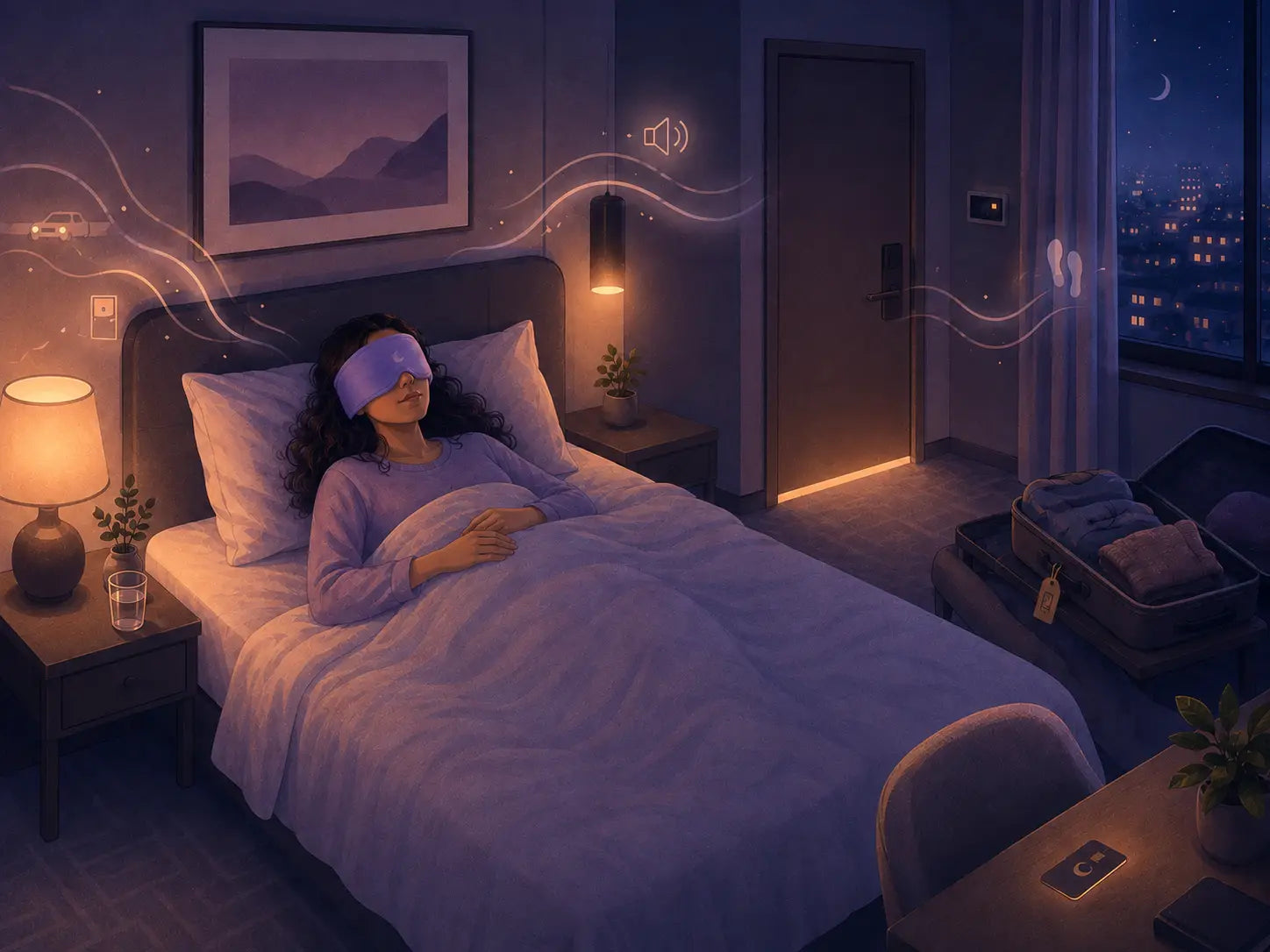
A blanket does not change the room’s light. A weighted sleep mask does. That matters if the actual disruption is a curtain gap, an electronic display, a partner reading, a late summer sunset, or early morning light.
The National Heart, Lung, and Blood Institute recommends keeping the bedroom quiet, cool, and dark as part of healthy sleep habits.[6] A mask does not regulate the body clock by itself, but it gives the wearer direct control over one part of the environment that is often difficult to control otherwise.
3. Warmth: cozy for one person, too much for another
Extra material across the body can retain heat. In a cool room, that may be part of the comfort. In summer, during hot flashes, or for anyone who naturally sleeps warm, the same coverage can become the reason the blanket is pushed away.
A sleep mask leaves the torso and legs free, so it changes less of the body’s thermal environment. It can still feel warm around the face, especially if the fabric is plush, but the scale of the heat is different.
4. Movement: held in place or free to turn
A weighted blanket can make turning over feel slower. Some sleepers enjoy that reduced movement. Others want to change position easily, keep one leg outside the covers, or avoid anything that feels restrictive.
A mask preserves most body movement, but fit becomes more important. It should remain comfortable when the head turns without digging into the face or creating direct pressure on the eyes. A product that slips, pinches, or needs constant adjustment has stopped being a calming cue and become one more thing to monitor.
5. Portability: part of the bed or part of the routine
A weighted blanket usually belongs to a room. It can travel, but its size and weight make spontaneous use less convenient. A weighted sleep mask can fit in a bedside drawer, carry-on, overnight bag, or desk drawer for a planned rest break.
Portability does not make a mask more effective. It makes the same object easier to repeat across settings. For someone who sleeps in hotels, takes long flights, works night shifts, or moves between two homes, consistency may be more valuable than total coverage.
6. Shared-bed impact: one person’s preference or the whole bed
A large blanket can affect a partner, change how bedding is layered, or take up storage space. A single-person weighted blanket reduces some of that friction but still changes a visible part of the bed.
A mask is personal. One person can use it while the other reads, watches something quietly, or prefers ordinary bedding. It creates a boundary around the wearer rather than reorganizing the whole sleep setup.
7. Evidence: more research does not mean universal certainty
Weighted blankets have the larger research base, especially in selected adult and clinical populations. The results are encouraging in places but not uniform. Product construction, blanket weight, participant needs, study length, and outcome measures differ substantially.
For weighted sleep masks, the two parts of the product have different evidence. Darkness is an established environmental principle, and ordinary eye masks have been studied in some controlled settings. The added weight is the less certain part. It should be described as a comfort preference—not as a proven miniature version of blanket therapy.
When a weighted blanket may be the better fit
A weighted blanket may make more sense when the desired experience is unmistakably full-body. You like being tucked in firmly. Your room is cool. You spend most nights in the same bed. Light is already well controlled. The feeling you want is less “turn off what I can see” and more “give my body one broad, steady boundary.”
It may also be the clearer choice if facial contact bothers you. Some people dislike any object around the eyes, no matter how soft. A product does not become calming because its category says it should. Comfort is the first test.
Extra caution is sensible if a person cannot remove the blanket independently, has breathing or circulation concerns, has difficulty regulating body temperature, or has limited mobility. In those situations, a clinician or occupational therapist who understands the person’s health and daily function is a better source of guidance than a general shopping rule. Weighted bedding is not appropriate for infants.[7]
When a weighted sleep mask may be the better fit
A weighted sleep mask may be the more practical choice when light is the problem you can name immediately. The room gets bright too early. A partner keeps a lamp on. Hotel lighting changes from one trip to the next. You want one small object that makes the visual environment more predictable without adding another layer to the whole body.
It may also suit people who sleep warm, dislike the feeling of full-body coverage, or want an object that can travel with the bedtime routine. The smaller scale makes it easier to test: wear it briefly while winding down, notice the fit, and decide whether the darkness and gentle contact reduce distraction or simply create a new one.
A sleep mask should never hurt, blur vision after removal, or create uncomfortable pressure on the eyes. People with glaucoma, recent eye surgery or injury, unexplained eye pain, or vision changes should ask an eye-care professional before using a weighted product around the eyes.
Can you use a weighted blanket and weighted sleep mask together?
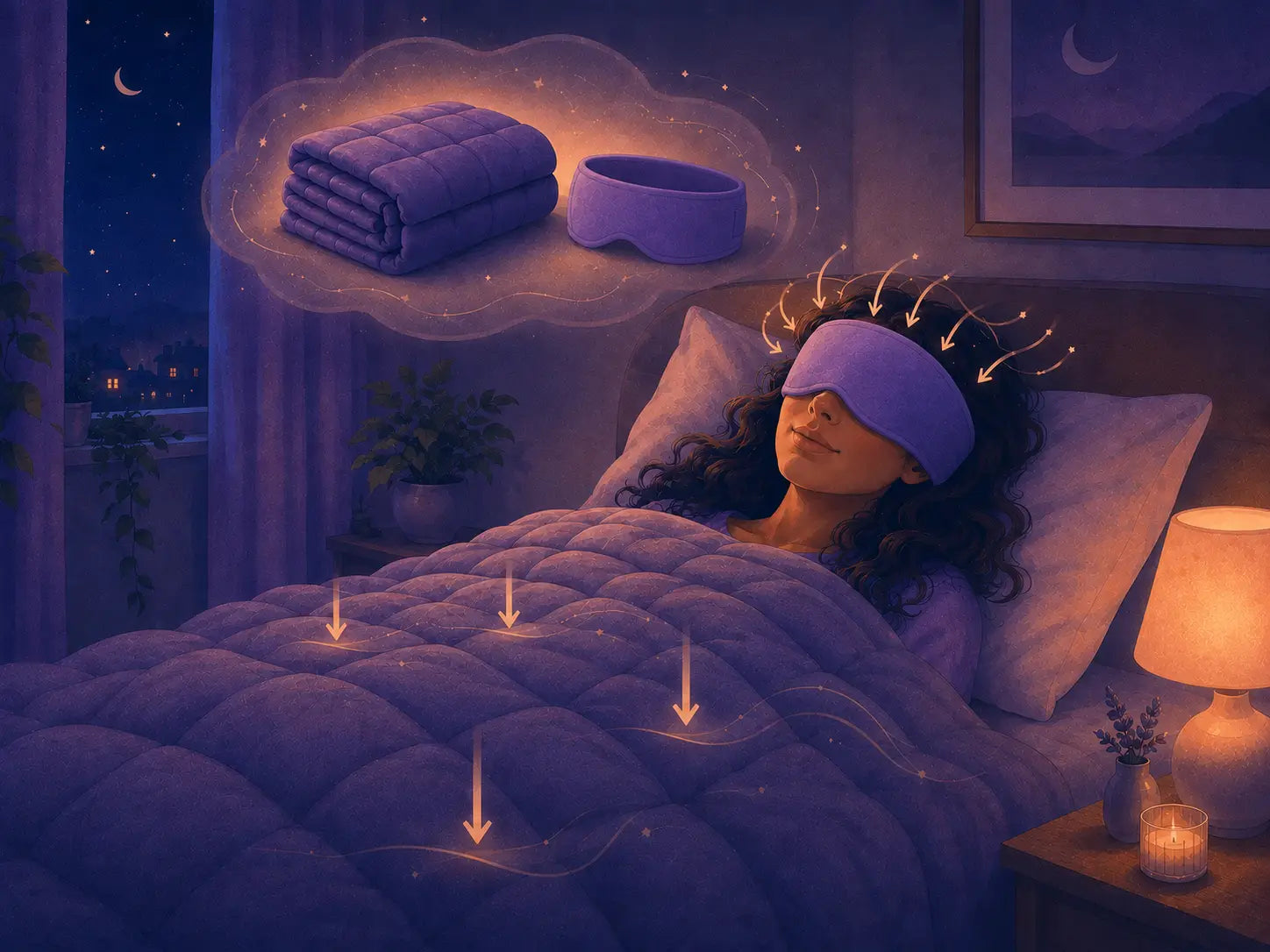
Yes, if both feel comfortable and you can remove them easily. The two products are not redundant: the blanket changes full-body contact, while the mask changes light and localized contact. Used together, they can create a more enclosed sensory environment.
But more sensory input is not automatically better. If you add both on the same night and feel too warm, restricted, or restless, you will not know which product caused the problem. Test one change at a time for several ordinary nights. Notice comfort, heat, movement, awakenings, and whether the object still feels effortless at 3 a.m.
If both work separately, combining them becomes a preference rather than an escalation. You are not increasing a dose. You are assembling a sleep environment.
Start with the smallest useful change
Before buying either product, name the disruption as specifically as possible.
- “My whole body feels restless.” Broad coverage may be worth testing.
- “The room never gets dark enough.” Start with light control, including curtains, displays, or an eye mask.
- “I overheat under extra bedding.” A localized option may create less thermal change.
- “I sleep in many different places.” Portability and repeatability may matter more than maximum coverage.
- “Anything touching my face annoys me.” A mask is unlikely to become a useful ritual, however attractive the concept sounds.
The smallest useful change is often the easiest one to repeat. If closing a curtain solves the light problem, the solution does not need to become a product. If normal bedding already feels comforting, adding more weight may not improve it. Good sleep support reduces friction; it does not collect accessories.
If sleep difficulty is frequent, lasts for weeks, affects daytime function, or appears alongside loud snoring, gasping, breathing pauses, unusual nighttime behavior, severe anxiety, pain, or persistent low mood, a product comparison is not enough. A healthcare professional can help identify what the routine is missing.
Where Mellooa fits—and where it does not
Mellooa is for the person who wants a smaller, portable boundary around bedtime: a light-blocking design, softly distributed weighted comfort, and a familiar cue that can be repeated at home or away.
It is not a medical device and not a blanket reduced to face size. We do not transfer blanket research directly to the eye area. The honest promise is narrower: darkness first, gentle presence second, with the body left free.
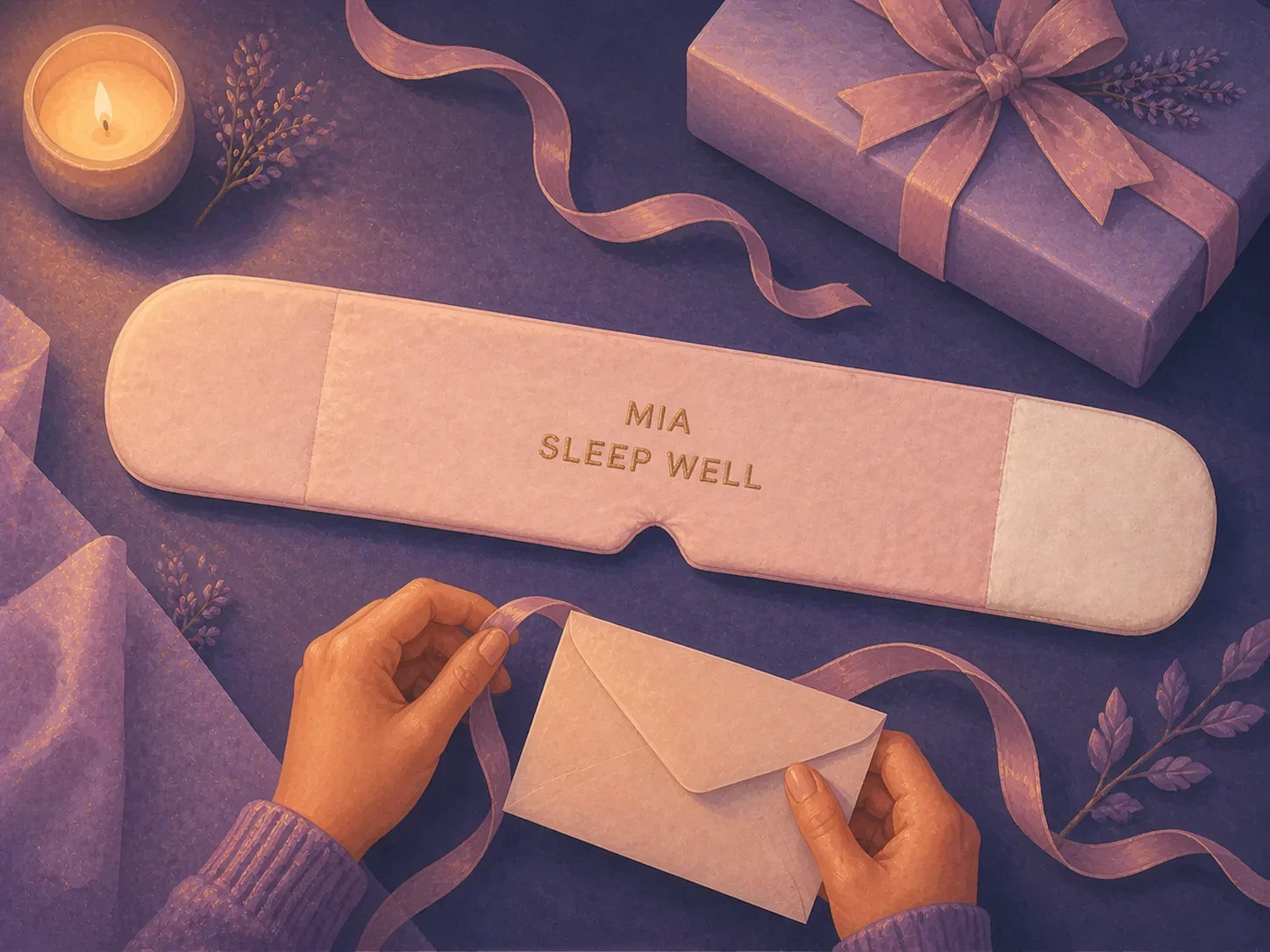
That is the role of the Mellooa weighted sleep mask. It can also carry a name or short message, turning an ordinary bedtime object into a quiet gesture for someone you hope will rest well. The personalization changes the meaning of the gift; it does not change the evidence or guarantee sleep.
If you want the deeper research context before choosing, read our earlier guide to why weighted blankets may help some people sleep and where weighted eye masks fit. That article examines the science; this one is meant to help you decide which experience belongs in your real bedtime routine.
There is no universal winner
A weighted blanket offers breadth. A weighted sleep mask offers focus. One changes how much of the body feels covered; the other combines darkness with localized contact. One usually stays with the bed; the other can move with the person.
The better option is not the one with more weight, more claims, or more research headlines. It is the one that removes a specific obstacle without creating a new one.
If your body wants broad, steady coverage, begin with the blanket. If your eyes keep finding light and your body wants freedom, begin with the mask. If neither feels comfortable, neither is required. Sleep does not need to be forced by weight. It needs enough darkness, safety, comfort, and time for attention to let go.
Medical note: This article is for general education and is not medical advice, diagnosis, or treatment. Weighted sleep products may support a comfortable sleep environment, but they do not treat insomnia, anxiety, or other health conditions.
Sources
- Eron K, et al. Weighted Blanket Use: A Systematic Review. American Journal of Occupational Therapy. 2020.
- Wong S, et al. The effect of weighted blankets on sleep quality and mental health symptoms in people with psychiatric disorders: a systematic review and meta-analysis. Journal of Psychiatric Research. 2024.
- Ekholm B, et al. A randomized controlled study of weighted chain blankets for insomnia in psychiatric disorders. Journal of Clinical Sleep Medicine. 2020.
- Meth EMS, et al. A weighted blanket increases pre-sleep salivary concentrations of melatonin in young, healthy adults. Journal of Sleep Research. 2023.
- Hu RF, et al. Effects of earplugs and eye masks on nocturnal sleep, melatonin and cortisol in a simulated intensive care unit environment. Critical Care. 2010.
- National Heart, Lung, and Blood Institute. Healthy Sleep Habits.
- U.S. Consumer Product Safety Commission. Safe Sleep—Cribs and Infant Products.