
What to Write on a Personalized Sleep Mask
Written by the Mellooa Editorial Team
We write about thoughtful gifting, sensory comfort, and the small details that make care feel personal.
A personalized sleep mask is a small gift with an unusually intimate job. It sits on a bedside table, travels in a carry-on, and appears in the final minutes before someone falls asleep. That is why the message matters—and why a grand declaration can feel less touching than a few words the recipient would actually recognize as yours.
Imagine the moment before the gift is opened. You know the person: the partner who keeps answering one last email, the parent who wakes before everyone else, the friend who never takes a proper day off. The blank message field can make you feel as if you need to summarize the whole relationship. You do not. The best line simply completes one quiet sentence: When you put this on, I hope you feel…
The answer is smaller than a greeting card
What should you write on a personalized sleep mask? Choose a short line that sounds like one person speaking to one person. Name the kind of care you want to send—reassurance, affection, permission to pause, or a private smile—then remove every word that does not carry that feeling.
A useful sleep-mask message is usually:
- Personal: it could plausibly come from you, not from a gift catalog.
- Easy to receive: it does not ask the recipient to perform gratitude or decode a speech.
- Comfortable at night: the wording feels calm, warm, or lightly playful rather than demanding.
- Short enough to read at a glance: the object, name, lettering, and message work together instead of competing.
Gift research by Francesca Gino and Francis Flynn found that recipients can appreciate gifts they explicitly requested more than givers expect. That study is about gift choice, not inscription copy, so it cannot tell us which line will land. It does support a useful discipline: start with the recipient’s preferences instead of trying to make the gift prove how original the giver is.
Choose the feeling before the phrase
Do not begin by scrolling through hundreds of sayings. Begin with a decision. Should the message feel tender, steady, witty, or encouraging? One feeling is enough. A message that tries to be romantic, funny, inspirational, and poetic in fourteen characters will usually sound like none of those things.
Then ask one more question: is this person likely to enjoy seeing affection written plainly, or would a quieter signal feel more natural? Some people love an open declaration. Others prefer the emotional equivalent of leaving a glass of water by the bed. Both can be loving. The right line is the one that respects how the recipient likes to be cared for.
For a partner: close, not performative
A romantic message does not need to announce the scale of the relationship. On an object used every night, familiarity is often more intimate than drama. Think about the phrase you would use after turning off the light, or the reassurance you give without making a ceremony of it.
- Goodnight love (14 characters) — direct and familiar, for couples who already speak this way.
- Dream with me (13 characters) — gently romantic without promising a perfect night.
- Here with you (13 characters) — quiet reassurance, especially meaningful when time apart is part of the relationship.
- Rest well love (14 characters) — caring and unembellished.
Choose the line that resembles your actual language. If you never call each other “love,” adding it because it looks romantic will make the gift feel less personal, not more. A shared phrase is powerful because it is shared, not because strangers would find it poetic.
For family: appreciation without a speech
Messages for parents, grandparents, and close family can carry years of gratitude. The temptation is to fit all of that history on the mask. Let the gift hold the longer meaning; let the printed line offer one small act of care.
- Rest easy Mom (13 characters) — warm and specific without being ornate.
- Sleep well Dad (14 characters) — straightforward affection for someone who dislikes sentimental copy.
- Love you Nana (13 characters) — plain words that do not need improving.
- Proud of you (12 characters) — suited to a milestone, difficult season, or new beginning.
The family title matters. Use the name the recipient actually hears from you—Mom, Dad, Nana, or their first name—rather than a technically correct label that feels formal. Check the name field separately, because the name and message are two different printed lines.
For a friend: let the friendship show
Friendship messages have permission to be lighter. A tiny joke can feel affectionate when it reflects a real habit: the friend who sends midnight voice notes, sets five alarms, or calls every nap a productivity strategy. Keep the joke kind. The mask should not turn a private insecurity into a punchline.
- Offline now (11 characters) — for the always-connected friend.
- Rest then text (14 characters) — playful permission to leave the chat unanswered.
- Dream big pal (13 characters) — encouraging, with a relaxed tone.
- Do not disturb (14 characters) — a familiar phrase that works as both instruction and joke.
If an inside joke needs a paragraph of explanation, it is not ready for print. Use the smallest recognizable fragment. The recipient should understand it immediately; everyone else is allowed to be slightly confused.
For a traveler: send a familiar cue
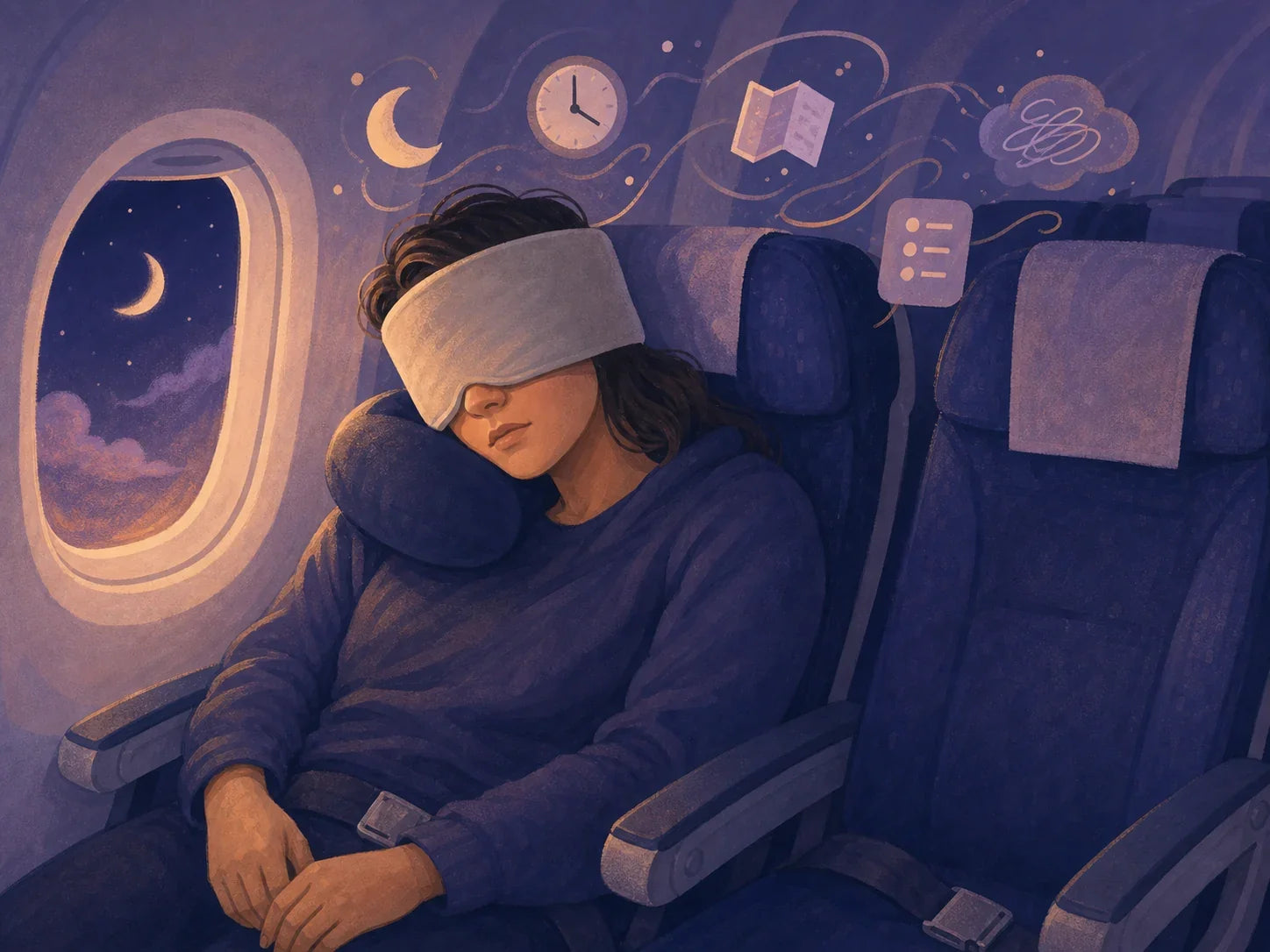
A travel gift can acknowledge motion without pretending a mask controls the journey. The line can make a hotel room or aircraft seat feel a little more personal, while the mask provides darkness and a familiar object to include in a wind-down routine. For hotel stays, our guide to sleeping in a new place explains how a familiar sequence can make the first night feel less abrupt.
- Rest then roam (14 characters) — balanced for someone who likes both plans and pauses.
- Dreams travel (13 characters) — soft and slightly poetic.
- Next stop rest (14 characters) — a travel cue with no promise about sleep quality.
- Rest en route (13 characters) — restrained and suitable for frequent flyers.
For someone facing a busy period rather than a holiday, a care-led line may fit better:
- Pause for now (13 characters) — gentle permission to stop without sounding like an order.
- Rest is yours (13 characters) — gives permission without diagnosing a problem.
- Near in dreams (14 characters) — for distance, deployment, study, or travel.
- Sweet dreams (12 characters) — familiar, affectionate, and easy to receive.
When the tone should be playful
Playful wording works best when the gift itself is already thoughtful. That keeps the joke from feeling careless. These lines are intentionally simple; the name above them does most of the personalizing.
- Nap mode on (11 characters) — cheerful and tech-adjacent.
- No alarms (9 characters) — ideal only when the occasion actually allows it.
- Off duty now (12 characters) — a dry little joke for a frequent traveler who is finally switching off.
- Rest your eyes (14 characters) — warm, plain language for a friend who needs a screen break.
For a fuller routine around that final phrase, see how to wind down after scrolling before bed.
Avoid teasing someone about insomnia, snoring, exhaustion, appearance, or health. Even if the joke works in conversation, printing makes it permanent and removes your tone of voice.
One-minute rewrite workshop
If your first thought is too long, do not abandon it. Distill it. Set a one-minute timer and use this three-pass edit:
- Write the private meaning in full. This is for you, not for printing. Name the moment, memory, or care you want the gift to carry.
- Circle one emotional verb or image. Rest, dream, near, here, home, or offline may hold the center of the thought.
- Write the line as you would say it at bedtime. Remove explanations, intensifiers, dates, and decorative language. Count spaces as characters.
For example, a long thought about wanting a partner to feel accompanied while traveling can become Here with you. A paragraph thanking a parent for carrying everyone else can become Rest easy Mom. A joke about the group chat continuing all night can become Rest then text.
Read the result aloud once. If it sounds like advertising copy, make it plainer. If it sounds like a command, soften it. If it could be printed for anyone, replace one generic word with the way you actually speak.
What not to write
Do not use the mask as a tiny greeting card. Dates, full quotations, several nicknames, and a complete declaration compete for space. Put the longer note in the package and let the mask carry the memorable fragment.
Do not borrow intimacy. A phrase can be beautiful and still feel wrong if it is not part of your relationship. Familiar language is more personal than impressive language.
Do not make a medical promise. Avoid wording that claims the gift will fix insomnia, cure jet lag, stop anxiety, or guarantee sleep. A sleep mask can help create darkness; a gift message can express care. Neither should be presented as treatment.
Do not hide criticism inside concern. Comments about screen time, work habits, parenting, or “finally getting some rest” can land as judgment. Write for the recipient’s comfort, not your correction of them.
The real Mellooa print limits
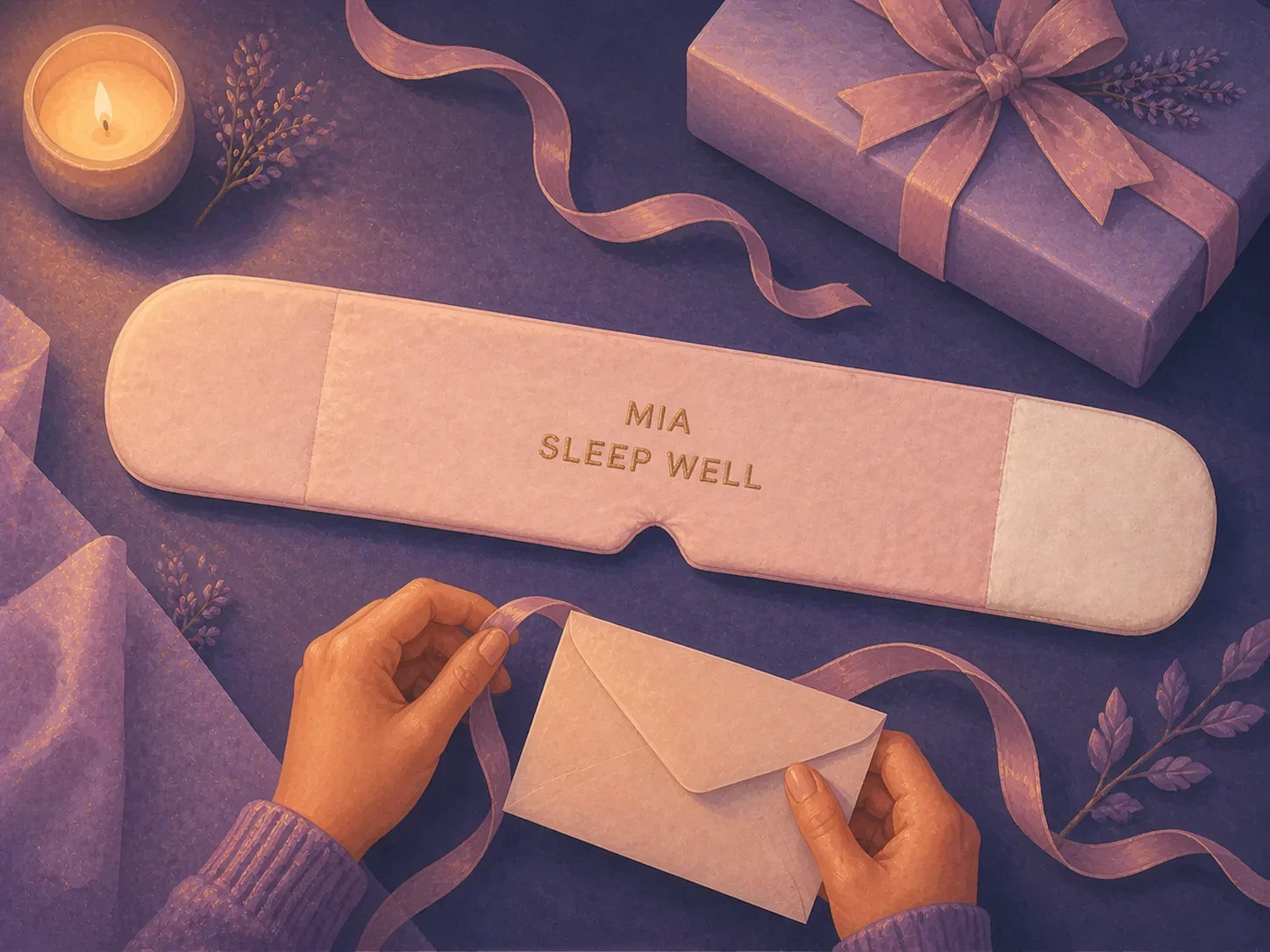
Before falling in love with a line, work inside the actual personalization fields. On Mellooa’s Personalized edition, the recipient name is required and allows up to 12 characters. The short message allows up to 14 characters, including spaces. If the short-message field is left blank, it is filled with Sleep well when you add the personalized mask to your bag.
The current customizer accepts letters, combining marks, numbers, spaces, and a limited set of punctuation. For the most predictable result, keep the wording to letters, numbers, and spaces. Emoji, heart symbols, and question marks are removed from the field by the current customizer. Always check the live preview and spelling before adding the mask to your bag.
You can choose Gold, Black, White, or Dusty Pink for the print, then select Modern or Signature lettering. Treat those choices as part of the message: Modern makes a playful phrase feel cleaner; Signature adds softness to a restrained line. Contrast matters too, so review the selected print color against the mask color in the preview.
Mellooa’s brand line, Love is hoping they sleep well, expresses the idea behind this kind of gift, but it is longer than the 14-character message field. Let that sentiment guide your choice rather than trying to print it in full.
Ready to test a name and line together? Open the personalization studio, review the Weighted Sleep Mask, and check the personalization notes before ordering. The best result will not say everything. It will say the one thing the recipient should carry into the quiet.
Before You Send It to Print
Should I repeat the recipient’s name in the short message?
Usually, no. The name has its own 12-character field, so the 14-character message can carry the feeling. Repeat the name only if that repetition is part of a phrase you genuinely use.
How should I choose a print color?
Start with contrast. Preview Gold, Black, White, and Dusty Pink against the selected mask color, then choose the clearest combination that still feels like the recipient.
Will the current customizer accept an emoji, heart, or question mark?
No. The current customizer removes those characters from the field. For the most predictable result, use letters, numbers, and spaces, then confirm the live preview before adding the mask to your bag.
Sources
- Gino, F., & Flynn, F. J. “Give Them What They Want: The Benefits of Explicitness in Gift Exchange.” Journal of Experimental Social Psychology.
- Mellooa personalization interface and theme configuration, reviewed August 11, 2026.